
Published on
•Updated
Artificial intelligence’s (AI) carbon footprint in 2025 could match New York City’s or a small European country, and use as much water as the global annual bottled water industry this year, according to a new study.
The report estimates that AI systems running in data centres could be responsible for between 32.6 million and 79.7 million tonnes of carbon dioxide in 2025.
This is in the same ballpark as New York City’s total emissions, which the report cites at 52.2 million tonnes of CO2 in 2023.
At the lower end, that is comparable to Norway’s total emissions in 2023, estimated at about 31.5 million tonnes, according to 2025 data from the European Environment Agency.
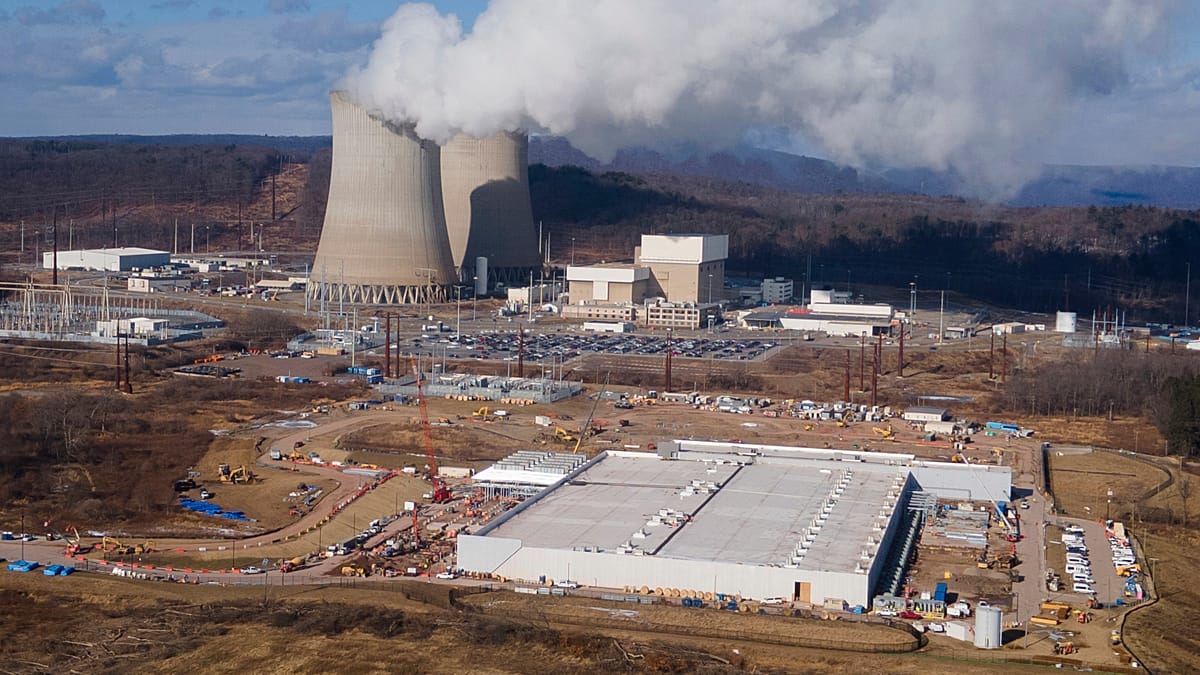
Data centres are large facilities that house the servers used to run online services such as cloud computing, video streaming, and AI.
These servers generate large amounts of heat and often rely on water-based cooling systems to operate safely.
As the pace of AI and other technologies gains pace, demand for data centres that require energy to run and water for cooling has also soared.
The study also estimates that AI’s water use footprint could be equivalent to the range of the global annual consumption of bottled water, ranging between 312.5 and 764.6 billion litres in 2025.
Water consumption includes both direct use for cooling data centres and indirect consumption in electricity generation. The study found that indirect water use can be up to four times higher than direct consumption, yet tech companies rarely disclose this metric.
Europe’s ‘cleaner’ advantage
Europe hosts about 15 per cent of the world’s data centres, second only to the United States, which accounts for roughly 45 per cent, according to the World Economic Forum.
The report noted that Europe benefits from substantially cleaner electricity generation.
European power grids have a carbon intensity of approximately 174 grams of CO₂ per kilowatt-hour (gCO₂/kWh) – less than half the global average of 445 gCO₂/kWh and significantly lower than the United States at 321 gCO₂/kWh.
This means data centres located in Europe have a considerably smaller carbon footprint per unit of electricity consumed.
Lack of transparency
The study examined environmental reports from nine major tech companies and found consistent failures in transparency.
No company reports AI-specific environmental metrics, despite several acknowledging AI as a key driver of increased energy consumption.
The study used a top-down approach, combining public sustainability reports from major tech companies, including those from Amazon, Apple, Google, and Meta, with estimates of AI electricity demand and grid intensity factors to estimate AI’s environmental footprint.
However, the author stressed that “significant uncertainty surrounds these figures” as company disclosures rarely distinguish between AI and non-AI computing activities.
“Further disclosures from data centre operators are urgently required to improve the accuracy of these estimates and to responsibly manage the growing environmental impact of AI systems,” wrote de Vries-Gao.
The other companies include Baidu, Microsoft, Oracle, Tesla, and Tencent.
While no company reports any AI-specific metrics, firms such as Google, Meta, and Microsoft reported significant increases in electricity consumption in 2023 and 2024, attributing the growth to AI.
“Because the environmental impact of data centres is growing rapidly, the urgency for transparency in the tech sector is also increasing,” he added.
The research calls for new policies mandating disclosure of additional environmental metrics, including the specific locations where AI systems operate, the scale of operations at each site, and water usage effectiveness (WUE) values for individual facilities.
Euronews Next reached out to the tech companies but did not receive a reply at the time of publication.