
US President Donald Trump has suggested that companies building data centres should pay a “dividend” to the communities where they are based to make them more appealing to local residents.
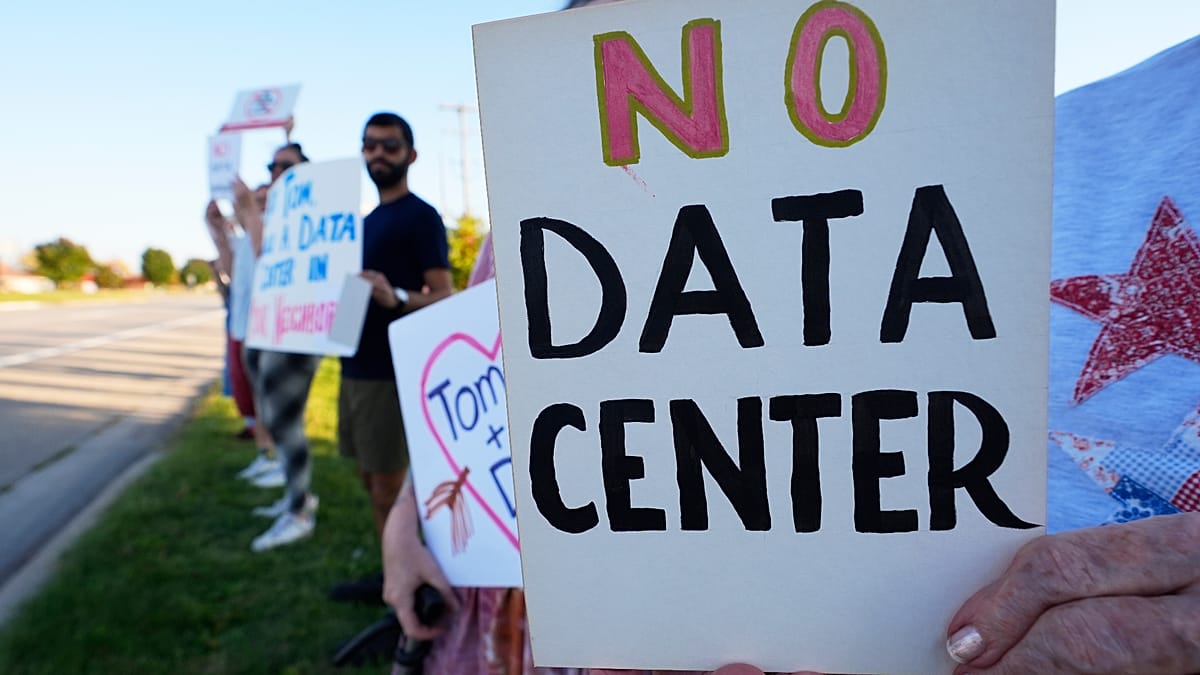
With companies around the world racing to deploy AI infrastructure, there has been a widespread backlash against new projects due to the substantial water and energy requirements of these sites and the impact they have on the local environment, energy prices and water scarcity.
The US President said that he had been “watching data centers very closely” and that he had “come to a very strong conclusion” over the matter, namely that highly unpopular data center projects become “extremely popular” once a financial deal is struck to address locals’ concerns.
On energy, Trump stated that he had personally mandated that data centres must “make their own electricity and give or sell any excess back to the local community, or grid” to offset energy price increases, believing that if they do so, there “could be a substantial decrease”.
In 2026 alone, at least 47 large-scale projects have been delayed and more than 1000 local communities across the US have formally proposed or sought moratoria, zoning caps or strict environmental limits on incoming AI infrastructure, according to financial site Investing Live.
Yet there are no signs of developments slowing down. Investing Live’s analysts say US AI infrastructure spending is projected to exceed $10 trillion (€8.9tn) between 2025 and 2032, around 3.6% of the country’s GDP per year.
While some data centre projects have gone ahead once agreements, now referred to as “Community Benefits Agreements” or CBAs, have been struck with local authorities, this hasn’t necessarily resulted in shifting public opinion.
Earlier this summer, Meta struck a deal with Texas governor Greg Abbott over a controversial data centre project in El Paso, Texas, funded by investment giant BlackRock.
What started as a $1.5 billion (€1.3bn) investment in 2023 and blew up to a $14 billion (€12.5bn) mega-campus project, resulting in widespread public backlash and prompting authorities to consider scrapping the project. In June, the local council voted 5-3 against cancelling the deal.
The governor then reached a deal establishing a number of guardrails to protect the local community, including paying making Meta pay for their electrical infrastructure, reuse their own water and promise to “eliminate reliance on outdated taxpayer-funded incentives”.
Meta has since commented on the deal, but not on the specifics set out by the governor, with critics including Democratic nominee for governor of Texas Gina Hinojosa, who argues that the agreement does not set out any binding conditions on the tech company. Meta expects construction to finish in two years.
In September, the first fully executed CBA for a data centre project in the US was signed by the Lancaster City Council in Pennsylvania for a $6-10 billion (€5.3-€8.9bn) cloud computing and AI complex — the Lancaster AI Hub.
It included a number of measures aimed at supporting the local community such as a $10 million (€8.9 mn) economic development fund, another $10 million (€8.9 mn) fund for sustainable development and clean energy, $250,000 (€222,500) planning fund and $10 million (€8.9 mn) worth of credit to protect the city should the default on its environmental and financial promises.
And this October, developer Digital Realty won initial public approval for a project in De Soto, Kansas, for a new 280-acre data centre campus by bypassing local rules and paying citizens directly.
The company is offering locals $1000 (€890) in utility and property tax credits for 10 years, as part of an overall $20 million (€17.8mn) investment that they argue will provide recurring tax revenue, create jobs and deliver other economics benefits to residents.
Close to home in Europe, so-called “Cash for Communities” approaches have taken off.
In Ireland this October, one of Europe’s largest data centre clusters, OpenAI has said future data centres could come with cash for local communities to address citizen concerns over their impact.
The country, however, already has strict requirements for data centres including a mandate that they must provide electricity into the grid.
Germany also has strict reciprocity requirements, especially in relation to energy use. In major hubs such as Dietzenbach, where Google is building a multi-billion euro campus, developers must first secure energy infrastructure deals to feed excess heat generated by data centres back into the grid to lower local residents’ utility bills.