
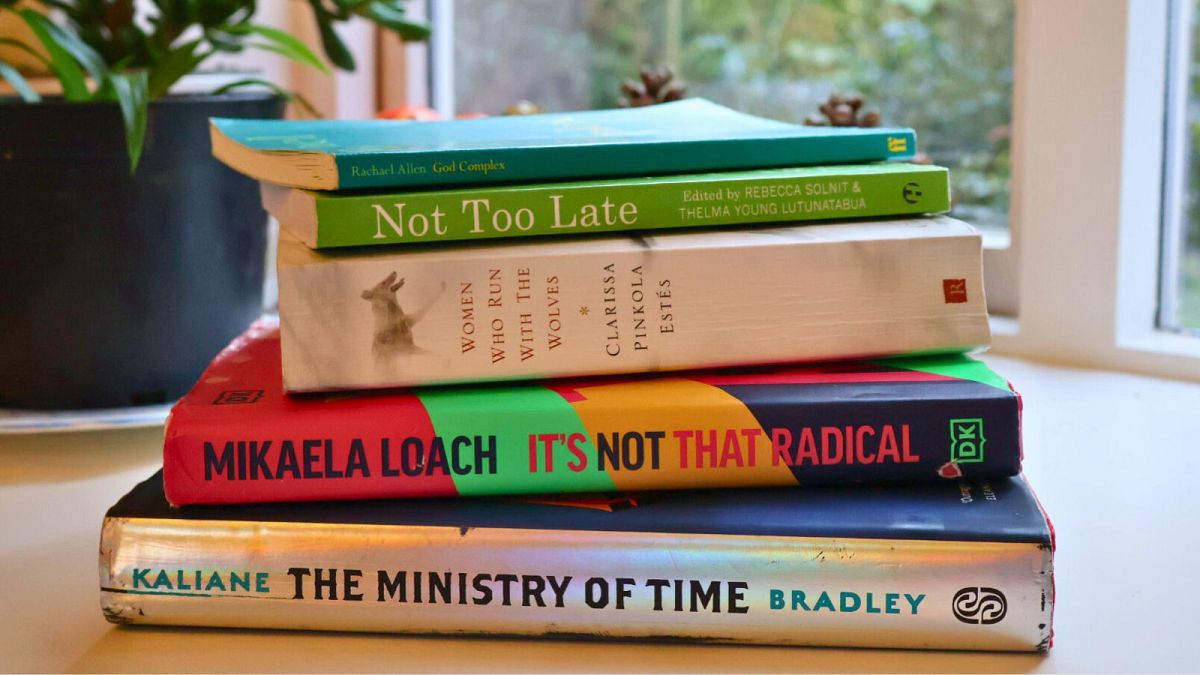
As a certified bookworm, I am rarely without written company. And as an environmental journalist, I am often drawn to the ‘nature writing’ section of bookshops.
But here I recommend a small collection of books from different genres and years. All have deepened my thinking on the climate crisis in some way, and all would make great companions this World Book Day if you’ve not come across them yet.
In their different ways, they give hope that it’s not too late to heal or grow. They delve into pain to take us somewhere better, and strengthen us for action.
Women Who Run With the Wolves, Clarissa Pinkola Estés, 1992
First up is a book that, for me, would not be a great exaggeration to describe as life-changing. Certainly immensely revitalising. Written by US poet and psychoanalyst Clarissa Pinkola Estés in 1992, it is a work profoundly concerned with the wellbeing of women.
Once I got over my initial (British) reservations about the title, I found myself in a unique and expansive landscape. By turns snow-blasted, rivered, and fairytale-forested, it moves from old stories to psychological commentary in order to guide women back to our instinctive nature.
It’s inherently ecological – fully alive to the harms done to the Earth and, by extension, ourselves. In one section, Estés recalls with prescient horror being a child in the 1950s, “in the early days of industrial disgraces against the earth,” when an oil barge sank in Lake Michigan.
“Injury to instinct,” she writes, “normalizing the abnormal, is what allowed mothers to wipe the stains of that oil spill, and later, the further sins of factories, refineries, and smelters, off their little children, their laundry, the insides of their loved ones as best they could, and while confused and worried, the women effectively cut away their rightful rage.”
The cure for such silence is repairing instinct, and Women Who Run With the Wolves is the ultimate hefty handbook on how to do that by getting back in touch with our inner ‘Wild Woman’.
The recurring takeaway is that it’s not too late. Whatever the internal or external damage – or the fargone-ness – things aren’t irreversible. Estés shows us that our ability to rally and create is limitless.
Not Too Late, edited by Rebecca Solnit and Thelma Young Lutunatabua, 2013
The argument that it’s not too late from a climate point of view is forcefully made in this collection of essays, edited by Rebecca Solnit and Thelma Young Lutunatabua.
For many in the climate movement, Solnit is the voice of pragmatic hope. Here, the floor is given to an array of changemakers, from activists and community organisers to climate scientists and academics, poets and lawyers.
It gives courage to know that many brilliant minds are dedicated to climate action – and that there’s a role for us all.
In sum, the book aims “to return hope and power through both facts and perspectives.”
One section is simply entitled ‘An Extremely Incomplete List of Climate Victories’. It includes, among many things, cancelled pipelines and coal plants thanks to grassroots organising, rights of nature breakthroughs, and the Paris Climate Treaty.
It’s Not That Radical, Mikaela Loach, 2023
Another book to lift you out of climate despair and inertia is Mikaela Loach’s It’s Not That Radical, also published in 2023.
‘Climate books’ often follow a predictable shape, with a dispiriting beginning as they set out the crisis first, before reaching an optimistic ending. Given their target audience, it can feel a bit like preaching to the choir.
But Loach is well-tuned to new and familiar readers as she provides a clear framework for the problems and solutions, in language that is both rigorous and accessible and builds on the words of great thinkers before her.
She shows how the climate crisis is rooted in colonialism and capitalist exploitation. ‘Green’ forms of capitalism (EVs, for example) are not the answer. Excitingly, the real solutions will improve many other aspects of life too, by getting to the roots of injustice.
Alongside this radical vision, Loach related her own journey as a prominent activist with helpful openness. You don’t have to be perfect to grow and act, she tells us, and stop idolising climate activists who you think are.
Personal growth involves discomfort – but the goal isn’t to reach individual enlightenment. Above all, It’s Not That Radical is a call for collective action, and it clears the path to taking part.
God Complex, Rachael Allen, 2024
This narrative poem is a 2024 gem that brought joy, despite its bleak subject matter.
Through the lens of a failed relationship, the narrator reaches into the nooks of the UK’s degraded environment, with its ‘contaminated soil / eking into the bloodstream’ and ‘industrial estates ballooning from / motorways like bronchioles.’
Like Estés description of an oily US, it blurs the boundaries of human and non-human bodies, uncovering mutual wounds.
As with all the best poetry in this vein, it re-sensitises us to reality – clearing the eyes and activating the brain. Take this description of climate abnormality:
‘The seasons are slowing in their age. They fumble the order / of systems, a power-mad king past his prime.’
The Ministry of Time, Kaliane Bradley, 2024
Bradley’s stunning debut novel was long-listed for the inaugural Climate Fiction Prize. It deserves all the prizes in my opinion, but I’d hesitate to classify it as cli-fi.
Despite casting forwards to a future in which (as one character puts it in an understated way) “the planet is not in a good way, climate-wise” – and this being a major driver of the plot – it just doesn’t feel where its heart lies.
But I’m including it here for two reasons. Firstly, because it contains an extremely powerful formulation for change:
“Forgiveness, which takes you back to the person you were and lets you reset them. Hope, which exists in a future in which you are new. Forgiveness and hope are miracles. They let you change your life. They are time-travel.”
Secondly, quite simply because it was my favourite book from 2024. It is a wholly original love story brimming with creative energy and humour.
And to paraphrase Loach, the things that bring us joy are also the things that galvanise us to fight for a better world. Falling in love, running around in nature and (if you’re like me) curling up with a good book.