




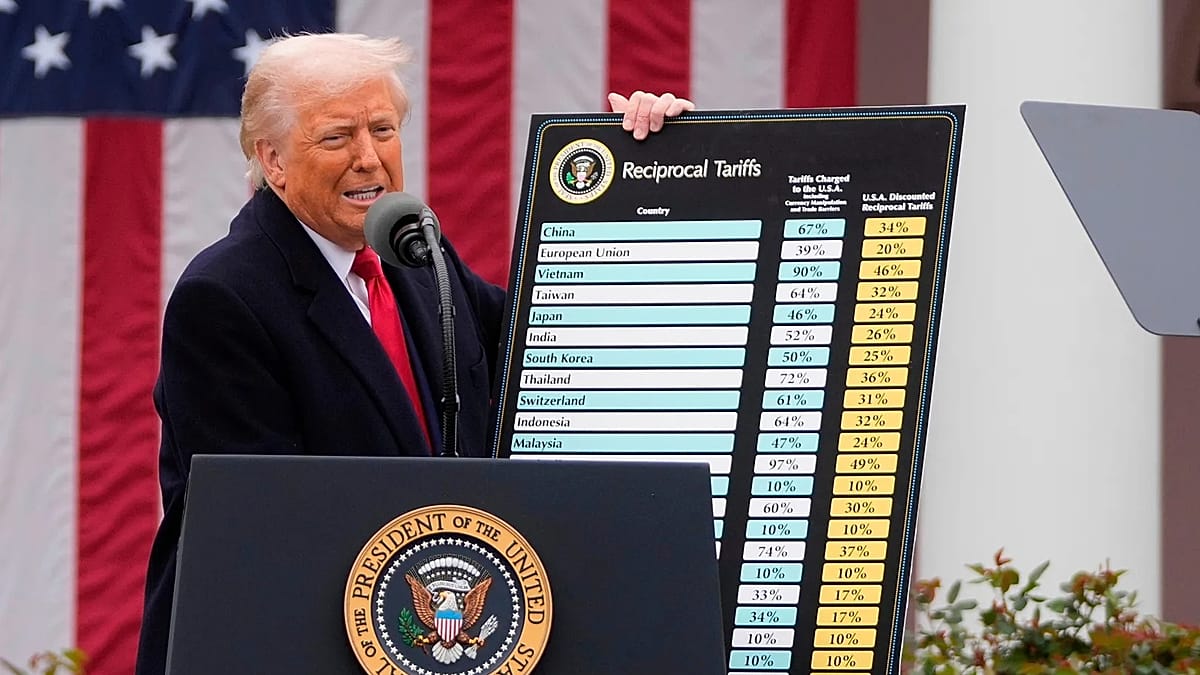
The Trump administration has accused major world economies of routing exports through more than 40 third countries to avoid US tariffs, claiming in a report on Thursday that the practice results in annual tax revenue losses of between $19 billion (€16.4bn) and $26 billion (€22.4bn).
Pointing a finger at China and India, Peter Navarro, the White House trade adviser, told reporters the administration would incorporate anti-transhipment clauses into new trade rules, and that partners found enabling the practice would face consequences.
He said US Customs and Border Protection had begun using AI to identify transshipped goods, and warned that importers found to have falsified a product’s country of origin could face retroactive tariffs stretching back roughly a year.
The report estimates that between $34.2 billion (€29.6bn) and $303 billion (€262.2bn) worth of goods are transshipped annually to avoid duties, using a central figure of $75 billion (€64.9bn) to calculate the revenue loss range.
Transhipment, or the routing of goods through an intermediate country to disguise their origin, has increased since the US imposed sweeping tariffs on Chinese goods beginning in 2018 under Trump’s first term, and again after tariffs were dramatically raised in 2025.
Malaysia, Vietnam and Mexico have all seen surges in exports to the US in categories where Chinese exports fell sharply, a pattern analysts say also shows genuine relocation of manufacturing.
Beijing described the report as misrepresenting China’s trade practices. China has consistently rejected the characterisation of its export model as predatory, arguing that its manufacturing competitiveness reflects economies of scale, infrastructure investment and workforce development.
The Chinese government’s position is that trade surpluses result from structural factors, including the dollar’s role as the global reserve currency, rather than from state-directed dumping.
The report comes as President Xi Jinping is expected to visit the US in September. Trump described the Chinese leader in positive terms during his own visit to Beijing in May, where the two discussed trade as part of broader diplomatic engagement.
Imports from China fell to a 16-year low of $308.7 billion (€267.1bn) in 2025, US Census Bureau data show.
The US trade deficit — the gap between what it imports and exports — stood at $371 billion (€321bn) for the period covered in the report, roughly $189 billion (€163.5bn) lower than the equivalent period a year earlier.
The administration has attributed the improvement partly to tariff effects, although economists have noted that some of the reduction is due to a sharp drop in imports driven by uncertainty.
The Trump administration’s tariff strategy has drawn sustained criticism from economists across the political spectrum.
Navarro, who holds a doctorate in economics from Harvard, has faced persistent criticism from fellow economists for his methodology and conclusions. A 2016 open letter signed by more than 1,000 economists described his positions on trade as historically discredited.
Additional sources • AP