
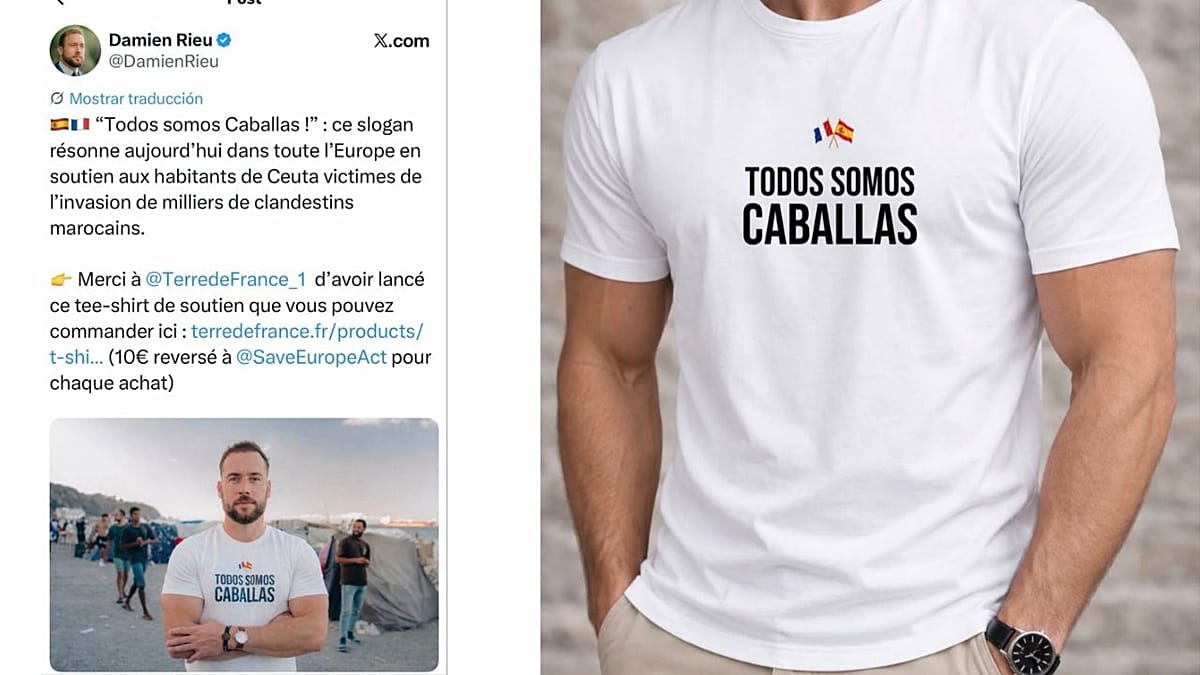


Journalist and social media expert Carmela Ríos posted on 27 September on X (source in Spanish) an investigation into the sale of the garment, which emerged after the mass entry of migrants into Ceuta on 30 and 31 July. Here is what lies behind the sale.
The T-shirt is being launched by Terre de France, a brand that sells a “patriotic and solidarity-based” range of products it claims are 100% French. Part of the revenue is used to support other organisations that, according to its website**,** include groups of farmers, agricultural colleges and an association for wounded French soldiers.
In this case, of the €35 price of the garment, €10 is allocated to Save Europe Act (source in Spanish). No money was earmarked for direct support for people or organisations in Ceuta, while almost 28.6% of the purchase price went straight to Save Europe Act.
The company claims that residents of Ceuta, whose nickname and popular demonym is “caballas”, “are surviving a migratory invasion that threatens the very existence of their city”. One X account, Damien Rieu (@DamienRieu (source in Spanish) on x.com), who has 325,000 followers, promoted the sale on 26 September.
The promotional image shows a person wearing the T-shirt in front of what appears to be Trampolín beach, but the image is fabricated. The tools Hive Detect, TruthScan and Sight Engine indicate that it was generated using artificial intelligence.
On its social networks, Terre de France (T-shirt (source in Spanish)) spreads messages claiming to defend a Catholic and white France, which, according to the brand, is not represented by LGBTQ+ people. It also rejects “crousty”, the fried-chicken-based fast food currently in fashion in the country, saying it is not 100% French.
Save Europe Act and remigration
Save Europe Act presents itself as a “patriotic” movement. It demands that “the political elite” “put an end to replacement immigration”, that borders be protected and that the “ethnocultural identity of European nations” be defended. It proposes halting “non-Western/non-European migration routes” until “social cohesion and cultural continuity” have been restored in the member states.
It also advocates “remigration”, compulsory or voluntary, of people in an irregular situation, those who have committed crimes and those “who are not integrated or constitute a significant cultural or financial burden”.
The organisation is collecting signatures across Europe in a bid to reach one million and submit its proposal as a European Citizens’ Initiative. That mechanism allows citizens to put forward new rules to the European Commission.
The Commission has refused to register it, considering it “manifestly contrary to the values enshrined in the Treaty and in the Charter of Fundamental Rights of the EU”. The Commission also says the initiative would be used as “a vehicle for offensive or caricatural messages”. According to ‘Euronews’, its organisers are preparing to challenge the decision in court.
Europe’s far right in Ceuta and a precedent
After the 30 July arrival, the autonomous city was visited by members of far-right organisations. Activists from Reform UK on 1 August, from Junge Tat in Switzerland on 2 August, and from Reconquista in Portugal on 4 August, as well as from Generation Identity in Germany.
Members of the neo-Nazi organisation Núcleo Nacional were expelled on 1 August when they attempted to hold a demonstration and were met with a counter-demonstration by local residents.
Among the promoters of Save Europe Act is Martin Sellner, who has almost 200,000 followers on X. On 3 August he shared videos from the city in which he called for “this ethnic replacement” to be stopped through “non-violent civil disobedience”.
Its co-founder Eva Vlaardingerbroek posted on 31 July a message denouncing the “orchestrated invasion” of Ceuta, which was shared by Elon Musk. She has 1.2 million followers on X and 1.3 million on Instagram.
Ríos argues that Europe’s far right sees Ceuta as a real stage “to advance its strategy”. She outlines a roadmap based on “the massive use of disinformation, artificial intelligence and the whole machinery of bots, trolls and fictitious digital operations”. According to the journalist, these movements rely on one another “on the basis of similar talking points and a shared technological framework”.
There is a precedent. In the Torre Pacheco case, in July 2025, when an attack on a local resident by a young man of Moroccan origin triggered a wave of racist unrest, the promoters of Save Europe Act and the organisation itself spread false messages.
They claimed that “Moroccan migrants” had assaulted white people for three nights in a row and that “North Africans” were arming themselves “to terrorise Spaniards”, and there was a significant amount of disinformation. In any case, their proposal for that situation was “remigration”.