
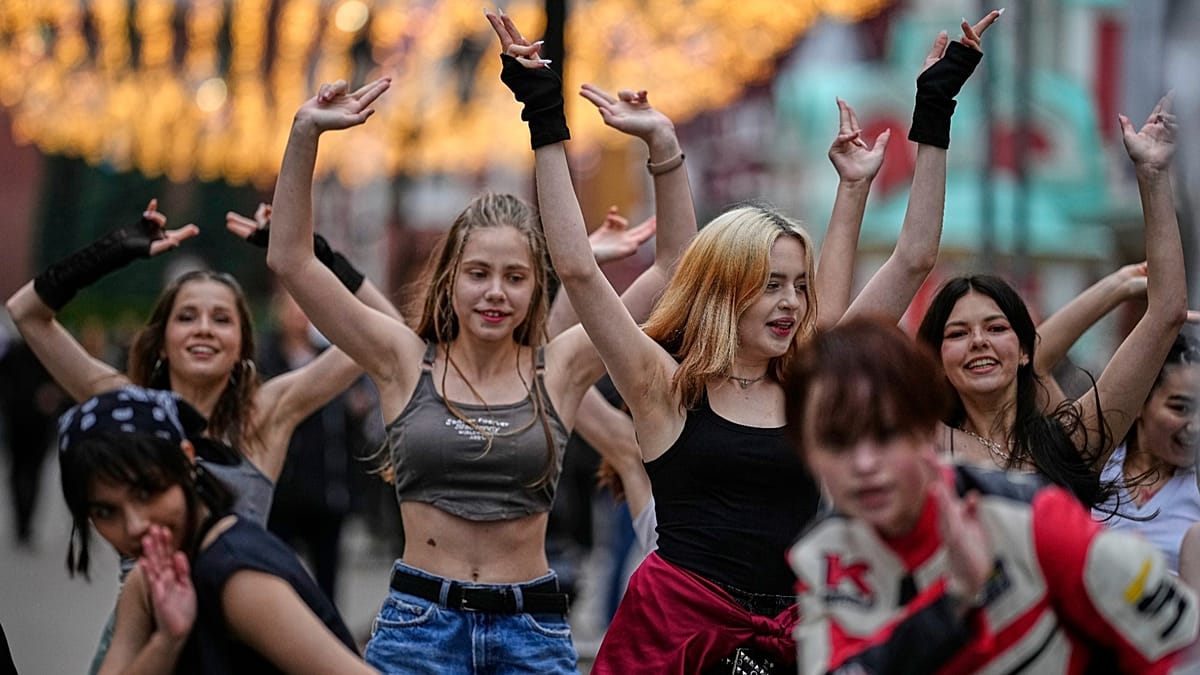
Two teenagers stand face to face, surrounded by a crowd. They stare each other down and get ready to compete. But there are no punches here, no improvised rhymes and no traditional dance battle either. To win, you have to show who has more “aura”.
The so-called ‘aura farming’ or ‘farmear aura’ battles have brought to the streets a language born on social media. Young people, mostly aged between 14 and 20, compete using gestures, poses and recreations of some of the most recognisable memes and viral videos on the internet.
The phenomenon has already led to meet-ups in several Latin American countries, including Mexico, Argentina, Brazil, Peru and Bolivia, and it has now reached Spain as well. And although for those unfamiliar with TikTok codes some of the performances can be hard to decipher, for participants, spotting the references is part of the game.
But what exactly does ‘farmear aura’ mean and why are teenagers competing to get it?
What does ‘farmear aura’ mean?
The concept comes from combining two very different terms.
On social media such as TikTok and Instagram, ‘aura’ is used to describe the style, attitude or charisma a person projects. Saying that someone has “100% aura”, for example, amounts to praising their ability to seem attractive, confident or cool almost effortlessly.
‘Farmear’, on the other hand, comes from the world of video games. The English term ‘farming’ refers to repeating certain actions in order to score points or accumulate resources.
‘Farmear aura’ therefore means doing or showing something that symbolically earns you points for charisma, style or popularity. What began as an internet expression has ended up turning into a real-world competition.
How do you win an aura battle?
At one of these competitions held recently in front of the Palacio de Bellas Artes in Mexico City, participants drew on a whole catalogue of viral references as they tried to outdo their opponents.
Carlos Irving Quintana, a 14-year-old with purple hair, won over the crowd by recreating the famous ‘Siuuu’ jump with which Cristiano Ronaldo celebrates his goals. He then turned to ‘mewing’, a trend popularised on TikTok that involves tightening the jawline and pointing at it with a finger to show off your profile.
His rival replied with the ‘6-7’, a meme popular among young people that does not have a specific meaning but has become a recognisable gesture on social media. Spectators surround the competitors and film the performances on their mobile phones while music reminiscent of a video game plays in the background.
The key is to prove you have mastered internet codes. The more memes and viral videos a participant manages to weave into their performance, the more likely they are to impress the judges and the crowd.
But knowing the memes is not enough. Attitude is crucial. “The one who looks better, shows off more, gets more laughs and has more confidence wins“, explains Aldhir Gonzalez, a 22-year-old who organised the Mexico City competition, speaking to AFP.
From Cristiano Ronaldo to a giant shoe
Virtually anything can be turned into a tool to ‘farmear aura’. The winner of the Mexican competition was Kaled Rosales Salazar, who turned up wearing Lightning McQueen trousers – the main character from the film ‘Cars’ – and clogs.
During one of his face-offs, Rosales used a huge white sandal as a prop, mimicking the gesture of lassoing his opponent and leading him away as if he were a horse. The staging worked. The teenager walked away with the 3,000-peso prize, about 177 dollars.
In other competitions, however, recognition can be much more abstract. In Argentina, the prize is being able to boast of having “infinite aura”.
The phenomenon has grown to the point of reaching professional football. Argentine club Boca Juniors jumped on the trend to post on X an image of midfielder Santiago Ascacibar celebrating a goal and joking that his aura was unbeatable.
A trend that baffles adults
Not everyone understands the phenomenon. “Aura is a lifestyle” that “almost nobody understands“, sums up the organiser of an upcoming battle in Buenos Aires.
And that lack of understanding is particularly visible between generations. While for many teenagers the poses and gestures contain instantly recognisable references, some adults see these competitions as a sign of the impoverishment of popular culture.
The reaction has even reached politics. A mayor in Honduras has banned the battles and said that, if it were up to him, there would be compulsory military service. Other experts, however, see positive aspects to the trend.
Venezuelan psychologist Maria Eugenia Tovar argues that this kind of competition can encourage in-person meet-ups between teenagers, something especially significant for a generation used to interacting through social media.
And that may be one of the keys to its success. A phenomenon born on TikTok and Instagram is managing to get young people to put down their screens for a few hours and meet up in person, even if everything ends up being recorded on a phone and posted online afterwards.
For Rosales, the winner of the Mexico City competition, the explanation is much simpler. He plans to take part in new battles, but not necessarily for the money. “More than for a prize, I do it to have fun and get out of the house“, he tells AFP.