
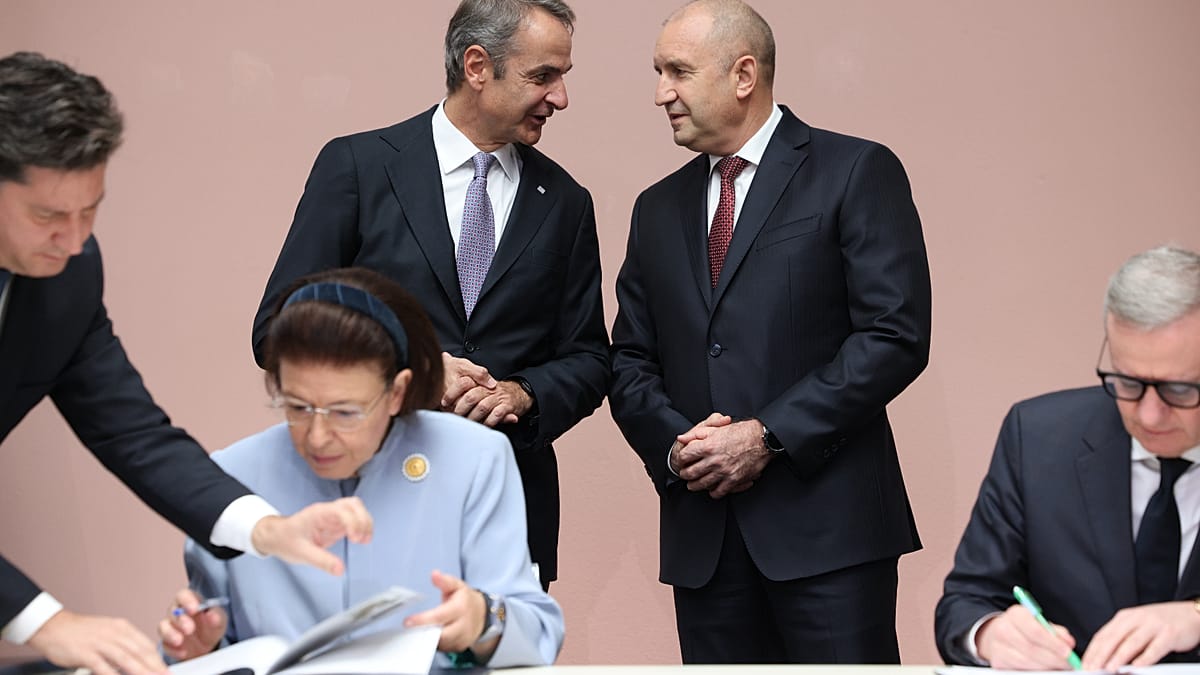
Speaking in Thessaloniki, Greek Prime Minister Kyriakos Mitsotakis made special reference to the Parthenon Sculptures on the occasion of the exchange of historic relics between Greece and Bulgaria.
“Monuments and historic artefacts cannot be treated as spoils of war, nor as victims of circumstances that arose after their creation and their inherent nature as unified works,” Mitsotakis said.
“It is precisely this same principle, the principle of a monument’s integrity, that underpins our ongoing effort to reunite the Parthenon Sculptures. Because they are not lifeless objects from the past. They are evidence in a living and unbroken connection with the natural and cultural landscape that gave birth to them,” the Greek prime minister added.
“The Parthenon is a unique and self-contained case. That is why it cannot be ‘imprisoned’ within the confines of legal or technical issues. It is about restoring the aesthetic and semantic integrity of a truly universal monument which, unfortunately, remains violently dismembered.
“My country will not accept arrangements that imply recognition of foreign ownership, nor will it borrow, supposedly, its own treasures. On the contrary, it now believes that the time has come for truth, for reason, for justice, but also for morality,” Mitsotakis concluded, speaking at the Museum of Byzantine Culture.
Radev: We have left the shadows of the past behind us
“Our joint efforts have allowed us to leave the shadows of the past behind us and to create a relationship of mutual respect and friendship,” Bulgarian Prime Minister Rumen Radev stressed in his speech at the event.
“I am pleased that our two peoples have managed to move beyond confrontation and today we enjoy a very high level of economic, political and cultural co-operation,” he said, adding: “I am full of hope that what we have achieved today will further consolidate our strategic partnership, because over the past decades we have managed to create a very strong axis of strategic co-operation between Bulgaria and Greece, an axis of stability, security, prosperity and development.”
The remains of Tsar Samuel
More than a thousand years after his death, the remains identified as those of Tsar Samuel, one of the most important rulers of the First Bulgarian Empire, are returning to Bulgaria. Their return is part of the agreement on the mutual handover of historic artefacts and anthropological material signed by Greece and Bulgaria, which the Bulgarian side has described as being of historic significance.
In exchange, Greece is receiving 48 ecclesiastical artefacts that were removed by Bulgarian troops from churches and monasteries in northern Greece during the First World War. The objects were taken away in 1917 and for more than a century remained in Bulgaria, where they were kept or displayed at the National History Museum in Sofia.
Samuel ruled from 997 to 1014 and played a leading role in the military clashes with the Byzantine Empire. Initially, he acted together with his brothers, one of whom he later ordered to be executed. Gradually, he extended his authority over a large part of the Balkans, while the region of the Prespa and Ohrid lakes, mainly in what is now North Macedonia, became the centre of his power.
From the early 11th century, however, the situation began to change in favour of the Byzantines. After 1001, the forces of Emperor Basil II intensified their pressure and in 1014 Samuel’s army suffered a heavy defeat. According to historical sources, the Byzantine emperor, who became known as “Boulgaroktonos”, ordered thousands of Bulgarian prisoners to be blinded. Tradition holds that Samuel suffered a shock when he saw his soldiers returning blind and died shortly afterwards.
The Bulgarian state finally came under Byzantine rule four years after his death, in 1018.
The remains attributed to Samuel are linked to excavations at the Basilica of Saint Achilleios in Prespa. In 1965, Professor Nikolaos Moutsopoulos uncovered four sarcophagi, together with anthropological material. In recent years, the finds have been kept at the Museum of Byzantine Culture in Thessaloniki and now form part of the exchange agreement with Bulgaria.
What Greece is receiving
On the Greek side, the 48 artefacts come from the Holy Monastery of Panagia Eikosifoinissa, the Holy Monastery of Timios Prodromos of Serres and the Holy Metropolis of Serres and Nigrita. Before their final return to the places from which they were removed, they will be on display at the Museum of Byzantine Culture until 5 November 2026.
The mutual handover took place on Saturday morning in Thessaloniki, in the presence of Mitsotakis and Radev, with the signing of the relevant delivery and receipt protocols.
The procedure marks the implementation of the memorandum of understanding signed by the culture ministers of Greece and Bulgaria, Lina Mendoni and Eftim Miloshev, after many years of negotiations and regular contacts between the two sides.