
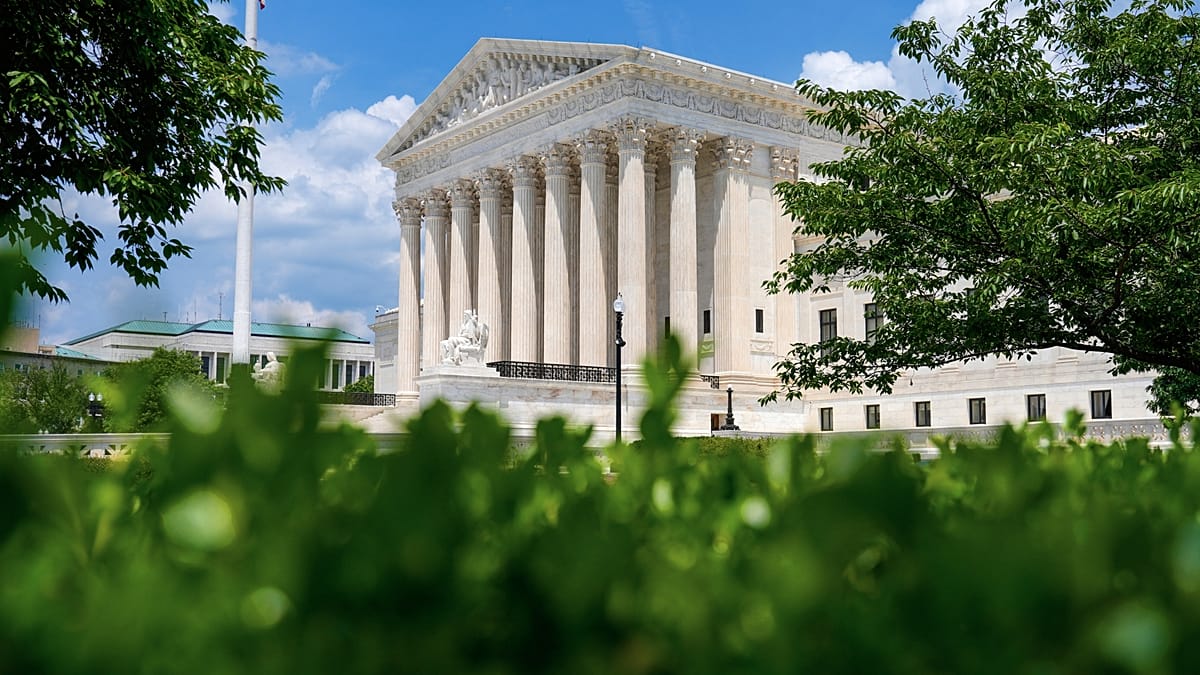
The United States Supreme Court has ruled that the Trump administration can immediately strip humanitarian protections from roughly 350,000 Haitians and 6,000 Syrians living legally in the country, paving the way for their deportation.
Thursday’s 6-3 decision in Mullin v. Doe overturned lower court orders that had blocked the removal of Temporary Protected Status (TPS), a programme created by Congress in 1990 to shield migrants from deportation when their home countries are too dangerous to return to. The ruling effectively hands immigration authorities unchecked power to end the programme, with the conservative majority finding that courts have no basis to intervene.
It is the latest in a string of Supreme Court victories for Trump on immigration, and comes on the same day the court issued a separate ruling clearing the way for the revival of a policy restricting asylum seekers.
What is TPS and who loses it?
TPS currently covers around 1.3 million people from 17 countries. Haitians were first granted the status in 2010 following a catastrophic earthquake, with protections repeatedly extended as gang violence displaced more than a million people inside the country. Syrians received it in 2012, when their country descended into civil war.
Since returning to the White House in January 2025, the Trump administration has moved to terminate TPS for 13 of those 17 countries. Thursday’s ruling gives those efforts, previously blocked by lower courts, a clear legal path forward.
The decision also carries implications for the remaining four countries with active TPS designations: El Salvador, Lebanon, Sudan and Ukraine, whose protections come up for renewal later this year. The State Department currently advises against all travel to both Haiti and Syria, citing widespread violence, crime, terrorism and kidnapping.
The court divides along ideological lines
Writing for the six-justice conservative majority, Justice Samuel Alito held that immigration authorities have exclusive, unreviewable authority to end TPS designations, meaning judges cannot block terminations even when lower courts have found them likely unlawful.
Alito also dismissed arguments that derogatory remarks made by Trump about Haitian migrants, including claims during his 2024 campaign that Haitians were abducting and eating pets, demonstrated racial bias. He described the comments as “insufficient to show that the termination of Haiti’s TPS designation was based on the race of the Haitian people.”
Justice Elena Kagan, in dissent, was unsparing. “The evidence they have offered includes statements by the President so repellent and racially inflected that the majority declines to put them in print,” she wrote, adding that the ruling means hundreds of thousands of lives “will be uprooted, most permanently.”
“Families are in limbo”
Lawyers for Haitian TPS holders said the ruling “will directly result in thousands of innocent people dying violent, needless deaths,” and urged the Senate to pass a bipartisan House bill from April that would extend deportation protections for Haitians. The bill has stalled in the upper chamber.
“Families are here, kids are going to school, parents are going into work, folks are trying to commute, and it’s like the Supreme Court just put all those activities on stop and put folks in limbo,” said Viles Dorsainvil, who runs a Haitian support centre in Springfield, Ohio.
Derrick Johnson, president and CEO of the NAACP, called it “a devastating betrayal of Haitian families who have lived, worked, and contributed to this country for years.”
Advocacy group FWD.us warned of economic consequences alongside the human toll, noting that around 200,000 Haitian TPS holders are in the US workforce, including 15,000 agricultural workers and 13,000 nursing assistants, collectively contributing an estimated $5.9 billion to the US economy.
Administration hails “win for rule of law”
DHS General Counsel James Percival welcomed the ruling. “The T in TPS stands for TEMPORARY, yet many of these designations became de facto amnesty. This is a win for the rule of law and common sense,” he said.
The administration has consistently argued that neither Haiti nor Syria require ongoing protections. Court documents filed in the case cited the killing of four Haitian women who were deported in February and later found beheaded, illustrating what lawyers described as the mortal danger their clients face on return.
Thursday’s ruling is the most significant legal win yet in the administration’s campaign to dismantle TPS. The Supreme Court had previously allowed the termination of protections for Venezuelans. Haiti and Syria are also both subject to the administration’s expanded travel ban, which came into force last June and was later extended to cover 20 additional countries in December.
For Syrian TPS holders, many of whom arrived during or after a decade of civil war, uncertainty now defines what comes next. “Today, many of our community members, they feel lost,” said Farrah AlKhorfan of Immigrants Act Now. “They are trying to understand what this decision means for them and how much time they will have to prepare for what comes next.”