
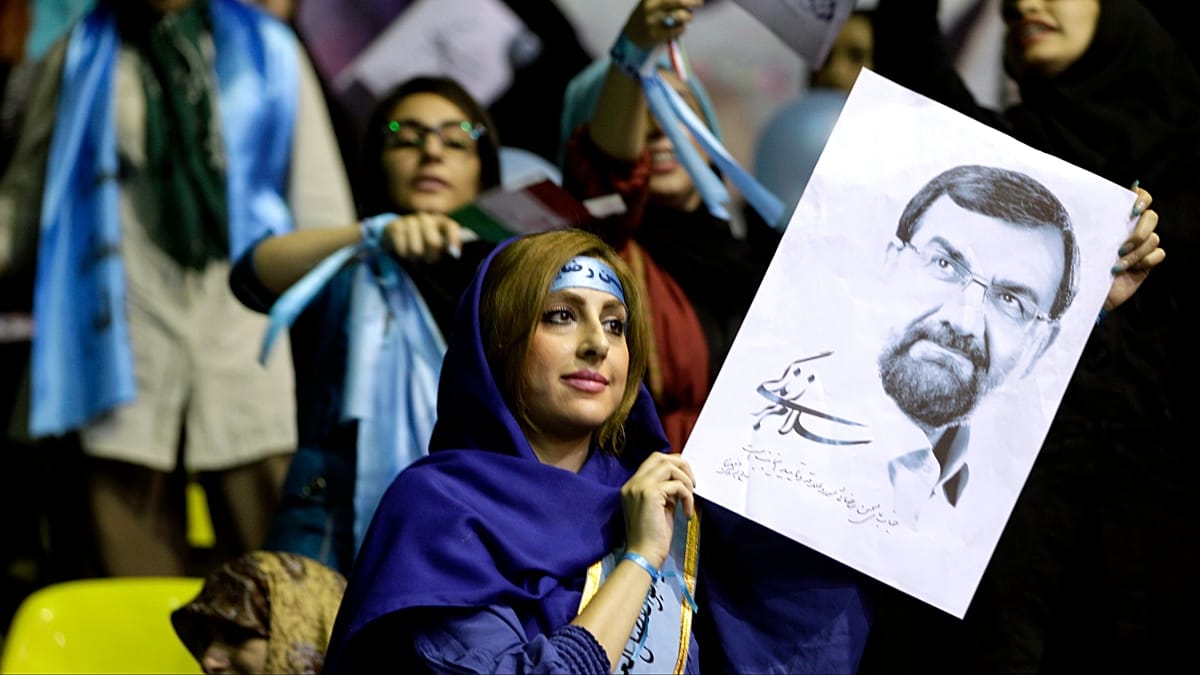
One of the founding figures of Iran’s IRGC Mohsen Rezaei has been appointed secretary of Iran’s Supreme National Security Council — giving one of the country’s most controversial senior figures formal authority over the institution responsible for Tehran’s strategic decisions.
The appointment was made in a presidential decree signed by Masoud Pezeshkian on Sunday.
Hours earlier, Ayatollah Mojtaba Khamenei had separately appointed Rezaei as his personal representative on the council.
With nearly five decades at the top of the Islamic Republic’s security and military apparatus, Rezaei, 71, succeeds Mohammad Bagher Zolghadr, a veteran IRGC commander who resigned after around four months in the post and was appointed as a political adviser to Khamenei.
Right after his appointment was announced, Rezaei has said publicly that Iran will not open a second shipping corridor in the Strait of Hormuz, that US warships entering the strait will be targeted, and that the war must end and Iran’s frozen assets must be released before Hormuz can be reopened.
Who is Mohsen Rezaei?
Rezaei, whose birth name was Sabzvar, was born in 1954 in Khuzestan province into a Bakhtiari tribal family.
Initially a political activist against the rule of Shah Reza Pahlavi in the early 1970s, Rezaei was arrested by the shah’s intelligence agency SAVAK and imprisoned in Ahvaz.
He was one of the founders of the Mansouroun militant group, which helped lay the groundwork for the Mojahedin of the Islamic Revolution Organisation.
After the 1979 revolution, Rezaei joined the central council of the Islamic Republic and served on a 12-member committee that drafted the IRGC’s constitution.
In September 1981, at the age of 27, Ayatollah Ruhollah Khomeini appointed him commander-in-chief of the Revolutionary Guards.
Rezaei held the position for 16 years — making him one of the longest-serving military commanders in the history of the Islamic Republic — before stepping down in September 1997.
He then became secretary of the Expediency Discernment Council, the body that resolves disputes between parliament and the Guardian Council and sets broad state policy, for nearly 24 years.
He was appointed deputy president for economy under President Ebrahim Raisi in 2021, a post he left in June 2023.
Despite this record of institutional prominence, Rezaei has run for president four times and lost each time. In the 2021 election, he received 3.4 million votes — fewer than the number of ballots deemed invalid in the vote.
The bombing of the Jewish centre in Argentina
Rezaei’s name has been associated internationally with the 1994 bombing of the AMIA Jewish community centre in Buenos Aires, which killed 85 people and injured hundreds in the deadliest terrorist attack in Argentina’s history.
In 2007, Argentine prosecutors sought arrest warrants for nine people in connection with the attack, including Rezaei, then IRGC commander. Interpol issued a Red Notice against him that remains in force.
Tehran and Rezaei have consistently denied any involvement in the attack, describing the allegations as politically motivated.
The case has nevertheless had practical consequences: Argentina protested his appointment as deputy economic president in 2021, previously objected to his attendance at the inaugurations of Nicaraguan presidents, and asked Qatar to arrest and extradite him during a visit to Doha — a request that was not carried out.
Operation Karbala-4
The most controversial episode of Rezaei’s military command domestically was Operation Karbala-4, a December 1986 assault during the Iraq-Iran war intended to retake parts of the Faw area that was detected and repelled by Iraqi forces, resulting in heavy Iranian casualties, including frogmen units.
In 2015, the remains of 175 divers who had participated in the operation, reportedly buried with their hands tied, were discovered and identified.
Rezaei’s subsequent claim that continuing the operation after it had been compromised was a deliberate deception ahead of the larger Operation Karbala-5 — or the siege of Basra, the largest military offensive of the war — drew sharp criticism from former officials, journalists and social media users.
Qassem Soleimani, then Quds Force commander, contradicted the account by saying Karbala-4 had been the primary operation all along.
Another controversy surfaced in November 2011, when Rezaei’s eldest son Ahmad, who had previously defected to the US and given media interviews criticising senior Islamic Republic officials, was found dead in a Dubai hotel room.
Dubai police attributed the death to an overdose of antidepressants. Rezaei’s family and the Expediency Council secretariat rejected that conclusion and described the death as suspicious. The cause of Ahmad Rezaei’s death has never been conclusively established.
War, succession and regime in flux
Rezaei’s appointment comes after one of the most turbulent periods in the Islamic Republic’s history.
The US and Israel launched broad strikes against Iranian military targets on 28 February, killing Ayatollah Ali Khamenei, Defence Minister Mohammad Reza Ashtiani and around 40 senior military and security commanders.
Ali Larijani, who had been secretary of the Supreme National Security Council since August 2025 and was regarded by many analysts as Iran’s most powerful figure on the eve of the war, was killed in a subsequent wave of Israeli strikes on Tehran.
Zolghadr then succeeded Larijani in that role. Under the constitution, an interim council of President Pezeshkian, judiciary chief Gholam-Hossein Mohseni Ejei and a Guardian Council-appointed cleric managed the country’s leadership functions until Mojtaba Khamenei was selected as the third ayatollah on 9 March.