
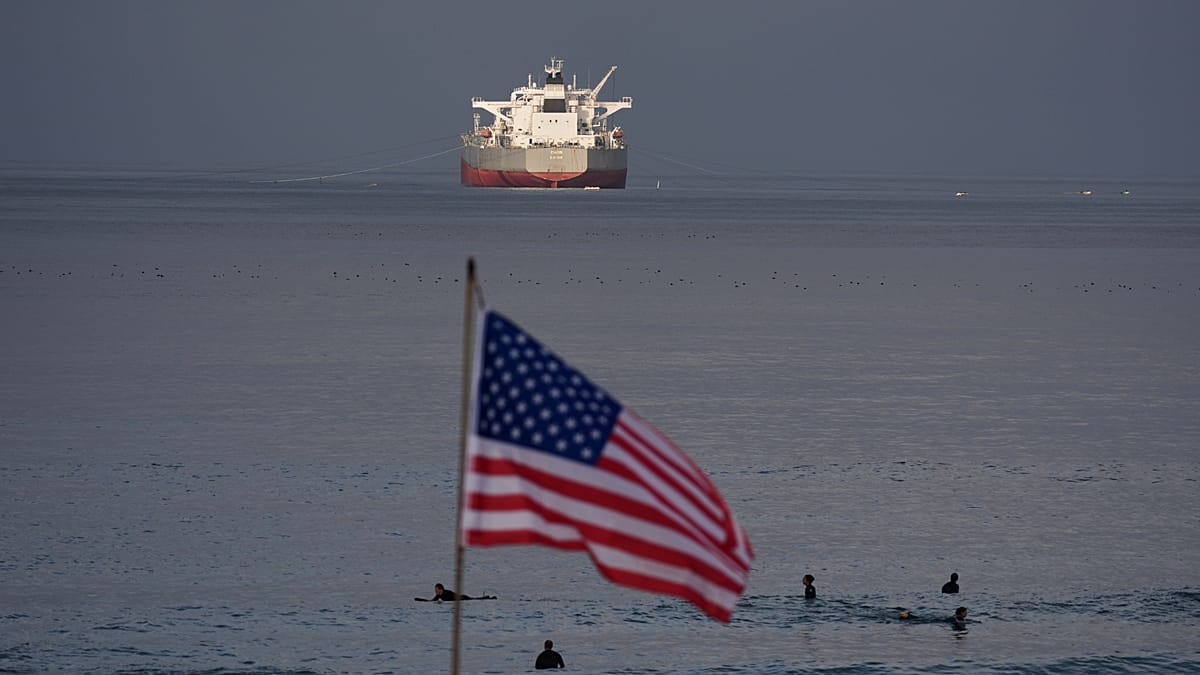
US Treasury Secretary Scott Bessent announced a 30-day waiver on Thursday allowing Indian refiners to purchase Russian oil from ships currently stranded at sea due to their regular maritime routes being closed or deemed too risky.
In a statement shared on X, Secretary Bessent described it as a short-term fix to ease supply pressures and guaranteed that the measure “will not provide significant financial benefit to the Russian government”.
The decision was made amid the blockade of the Strait of Hormuz caused by the Iran war and the substantial disruptions to global energy markets it continues to cause.
The waiver, issued by the US Office of Foreign Assets Control, covers Russian oil and petroleum products, which can now reroute towards Indian ports.
The measure expires on 4 April and does not apply to any new shipments.
This is not a broad relaxation of secondary US sanctions that India previously faced for buying discounted Russian oil. Instead, it addresses an acute one-off supply emergency, triggered by the conflict in the Middle East.
Secretary Bessent added that India, an essential US partner, is expected to increase purchases of American crude once the immediate crisis passes.
Indian refiners have already secured several million barrels of these prompt cargoes in recent days due to the current lack of alternatives.
India’s largest private refiner, Reliance Industries, has begun seeking Russian crude cargoes following the US temporary waiver, according to people familiar with the matter cited by Bloomberg.
The company plans to process these barrels at its refinery serving the domestic Indian market while continuing to run its export-oriented facilities on non-Russian grades, as global oil price benchmarks experienced significant volatility this week.
At the time of writing, Brent crude is trading above $85 per barrel while West Texas Intermediate (WTI) is over $81, the highest levels in three years.
Secretary Bessent heads to Paris ahead of Trump’s China visit
The waiver announcement comes as Secretary Bessent prepares to meet Chinese Vice Premier He Lifeng in Paris next week.
The talks will lay the groundwork for President Trump’s visit to China from 31 March to 2 April. Washington plans to press Beijing to cut purchases of Russian and Iranian oil and shift towards buying American crude and LNG, according to The Wall Street Journal.
The request, described by analysts as a significant gamble, comes at a time when China relies heavily on discounted barrels from both nations. The US military actions in both Venezuela and Iran have significantly disrupted Chinese oil supplies.
The discussions will also cover expanding China’s purchases of US soybeans and Boeing aircraft, possible easing of rare-earth export controls and AI chip imports.
In particular, tensions are expected regarding AI chips as the US government is reportedly drafting sweeping new export regulations that would require American companies like Nvidia and AMD to obtain licences for nearly all global shipments.
These reports come after the Trump administration was, allegedly, already considering a cap of 75,000 Nvidia H200 chips per Chinese customer, which is less than half of what major companies like Alibaba and ByteDance reputedly requested.
Iran conflict adds complexity to Trump-Xi summit
The Paris meeting takes place against fresh uncertainty surrounding the Trump-Xi summit in a few weeks.
China has criticised the strikes on Iran, and the death of Ayatollah Ali Khamenei has introduced new geopolitical tensions even as a fragile trade truce agreed in late 2025 seemingly holds.
For the time being, both sides appear committed to substantive economic talks.
The limited waiver for India forms part of a broader US strategy: using short-term flexibility to stabilise energy markets while pursuing longer-term realignment of global oil flows towards American producers.
The coming weeks will show whether this calibrated approach can deliver both immediate relief and meaningful progress on the ambitious US-China economic agenda.