
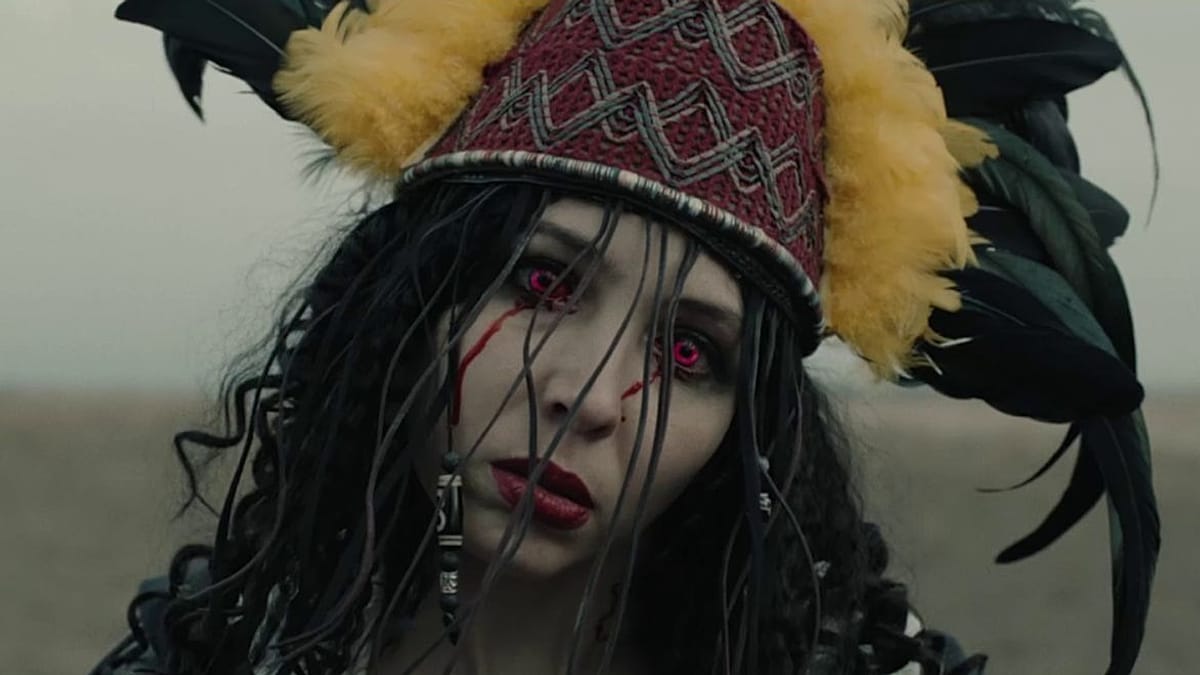
A neo-noir and folk-horror TV series dubbed Kazakh Scary Tales found its place among eager fans at festivals after being considered too scary and gory for streaming audiences.
The show by Kazakh director Adilkhan Yerzhanov premiered at the Fantasia International Film Festival in Montreal this summer and saw a local release in November.
The story follows Birzhan, a police officer reassigned to a remote village, where he has to solve mysterious deaths, while dealing with corrupt officials.
He partners up with a local witch, who helps him figure out the ancient evil, find ways to fight it, and maybe learn the truth about himself.
Too scary for spoilers?
Early test screenings raised questions about whether the show would be appropriate for wide audiences. Producers did not expect commercial success, thinking it was too niche, so they sent it to festivals instead.
“For example, the scene in the maternity ward where the characters start bleeding. Is that even appropriate for family viewing? Wouldn’t it be shocking?” Yerzhanov explains.
But the Tales exceeded expectations, when the first four episodes were released on YouTube.
“It’s precisely the combination of folklore and modernity that attracted attention. Our audience was ready to see our folklore integrated into a modern series,” the director said.
Viewers praised the series online, calling it the “Stranger Things of Kazakhstan,” and sharing eerie folk stories passed down through generations.
International reaction and social commentary
To grasp the attention abroad, Yerzhanov says Kazakh filmmakers must offer something distinct.
“You can’t come up with a Kazakh horror film built on Hollywood or Japanese models. You can’t get noticed if you’re working within established rules,” he explains.
He believes two elements of Kazakh Scary Tales resonated most with the connoisseurs of the horror genre: the unusual blend of humour and terror, and the originality of the mythical creatures.
“I realized that international audiences are drawn to the humour in the scariest moments. They find it incredibly intriguing, unique, and different,” said the filmmaker.
Many reviews highlighted Birzhan’s banter and bromance with the local pathologist, where they exchange slightly inappropriate jokes at completely random moments.
Meanwhile, the monsters rooted in Kazakh mythology felt refreshingly original to horror enthusiasts.
“As they say, monsters in Kazakh Scary Tales are less dangerous than the people who created them. They are interested in the fact that all the monsters in the series arose from injustice, from the actions of some characters, some men,” commented Yerzhanov.
This theme forms the backbone of the series, which doubles as a social commentary on violence against women. In the show, women hurt by men transform into monsters, which then devour those men (and others along the way).
The first three episodes centre on the albasty, an evil female spirit from Turkic mythology believed to torment pregnant women and infants. The director points out that, as in many Eastern mythologies, most demons in Kazakh folklore are female.
“Everything irrational, everything that any man, any warrior, is afraid of. He is afraid of the irrational , which he identifies with women,” Yerzhanov explains.
Ancient fear
A defining choice in the production was Yerzhanov’s refusal to use CGI, when making his monsters. He was looking for naturalistic representation of the ancient horror that his mom used to tell him about as a kid.
“In my childhood imagination, these monsters didn’t look computer-generated or drawn; they looked very naturalistic, I would even say physiological. It was this physiology, this homespun nature, that I wanted to express in this series,” the filmmaker said.
This is why the team created animatronic albasty operated by several people. A stunt performer wore an artificial head for wide shots.
For close-ups they created a carcass of the head covered in silicone, where one person moved the upper lip, the other moved the lower lip, the third person moved the tongue and two more people open and closed its eyes.
“Any computer graphics led the monsters towards a pasteurized Hollywood, where everything is artificial, where everything is too modern,” he said.
Yerzhanov himself is not fond of horror films, but he believes that best movies of the genre were made by non-horror filmmakers such as William Friedkin’s The Exorcist or Stanley Kubrick’s The Shining.
Unfortunately, audiences outside of Kazakhstan don’t yet have the chance to watch the show, but the director says he’s working hard on making it available on streaming services.