



In recent years, we’ve seen demonstrations at ports across Europe against the cruise industry over environmental and overtourism concerns.
But has the cruise industry unjustly become the poster child for the travel industry’s problems, and can it repair its dirtied reputation?
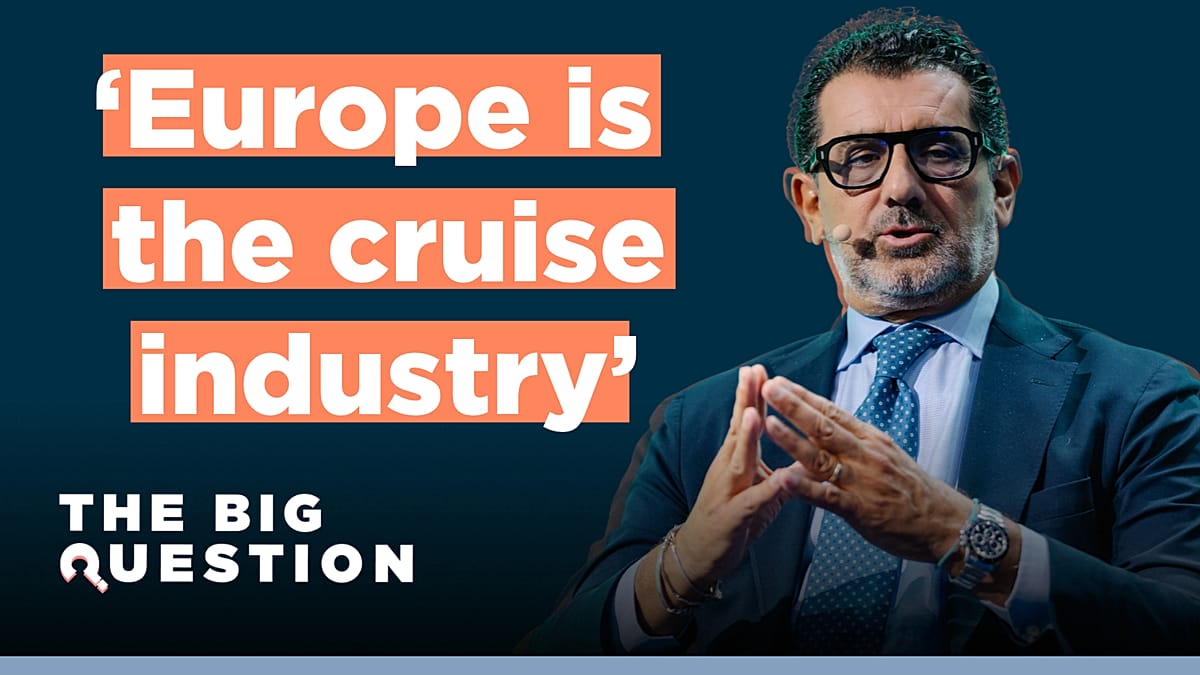
In this episode of The Big Question, Gianni Onorato, CEO of MSC Cruises, sat down with Hannah Brown to discuss how the cruise industry is responding to its biggest criticisms to ensure its survival.
How big is the cruise industry?
Gianni stressed that while their ships may be big, the cruise industry is not, with this segment making up less than 2% of the travel packages sold globally in 2025.
And while we’ve seen overtourism complaints in Barcelona blamed on cruises, their passengers only account for around 3% of the city’s daily visitors.
Despite this, cruise companies are working hard, like the rest of the travel industry, to take passengers to new destinations and spread tourist arrivals more evenly throughout the year.
Unlike airlines, which confirm their flight schedules less than 12 months in advance, cruise itineraries are set two years ahead to help destinations plan for the incoming visitors.
“The predictability of cruises allows small family businesses to decide if they want to add, for example, more tables and seats in their restaurants or in their bars because they know that it’s for sure that they will have these people coming,” Gianni explained.
And the industry has become a vital part of the European economy, providing more than 445,000 permanent jobs across the continent.
Scaling up technology to clean up cruising
But overtourism isn’t the only worry. People are also critical of the cruise industry’s carbon emissions.
The most significant development to clean up the industry is the roll-out of dual-fuel engines, capable of seamlessly switching between traditional marine fuel and cleaner alternatives.
“In 2023, one of our ships, the MSC Euribia, had a four-day cruise from Le Havre to Copenhagen using biofuel and it was proved that together with other innovative measures for fuel consumption reduction, we were able to reach the target of zero,” Gianni explained.
Members of the Cruise Lines International Association (CLIA) operate 327 ships, accounting for about 90% of global cruise capacity. Only 30, or around one in 11, are equipped with dual-fuel engines, up from a single ship in 2018.
And although this is progress, it is slow. This is partly because affordable cleaner fuels are in short supply and partly because companies have to wait until the end of a ship’s 30-year lifespan to upgrade their fleet.
Gianni was confident, however, that most of the remaining ships in service will have been decommissioned and replaced in time to meet the EU’s target of a climate-neutral maritime industry by 2050.
In the meantime, he spoke passionately about the other technologies being retrofitted in the current fleet to dramatically reduce energy consumption on board.
“The air conditioning on the ship today is through an HVAC inverter that gives the opportunity to automatically regulate the level of air conditioning according to the number of people present in the room,” Gianni told The Big Question.
Cruise passengers are changing
While technologies, fuels and destinations have been changing, so too has the cruise industry’s clientele.
“In the past, cruises had this perception for being for old people. While now, there is a much younger demographic. The average age is 35-54 and this is very good because this can ensure the future of this industry,” Gianni explained.
He also added that solo travellers are a growing market for the company, with safety becoming an increasingly important consideration. Multi-generational holidays are also growing in popularity, allowing family members to enjoy separate activities as well as spending time together.
But the industry isn’t about to suddenly boom.
Almost all of the world’s cruise ships are built in Europe, with the four major shipbuilders based in the bloc: Italy, France, Germany and Finland. But the production is limited, so demand is likely to outpace supply.
While some might see this as negative, Gianni pointed out that it means the industry has controlled growth – a good thing for investors and its long-term future.
The Big Questionis a series from Euronews Business where we sit down with industry leaders and experts to discuss some of the most important topics on today’s agenda.
Watch the video above to see the full discussion with MSC Cruises.