
From the moment early humans looked upward and tried to make sense of the sky, the sun and the moon have been at the centre of everything – faith, timekeeping, agriculture, mythology, and art.
This summer, Saatchi Gallery’s major new exhibition, The Sun and The Moon attempts something quite ambitious: to gather that entire spectrum of human fascination into nine gallery spaces across two floors, and present it through the eyes of more than 170 artists.
It’s the second in Saatchi’s series examining how the natural world feeds creative practice, following last year’s enormously popular FLOWERS – Flora in Contemporary Art and Culture.
“It’s a whole 24-hour journey through the eyes of artists and creators,” curator Katherine Benson tells Euronews Culture at the exhibition’s press viewing. “These celestial constants have been part of our lives throughout human history, and we wanted to explore all the different ways artists have been inspired by them.”
A day in nine rooms
The sprawling exhibition is cleverly structured as a complete 24-hour cycle – taking visitors from dawn through high noon, sunset, and deep into the night – with each gallery reflecting a different part of the day and the stories attached to it.
It opens with works by Patrick Caulfield, Barbara Hepworth and Sinta Tantra before moving into Dawn, which traces how early cultures understood the sun and moon as cosmic forces.
Artefacts include a Sol Invictus Celtic Bust from the 1st century BC, a replica of the Nebra Sky Disc, a large fabric from 17th century India depicting the sun, shown alongside contemporary pieces like costumes from the Royal Opera.
Further rooms explore the sun’s role in timekeeping and agriculture, the rituals of summer culture, and the emotional weight of sunset.
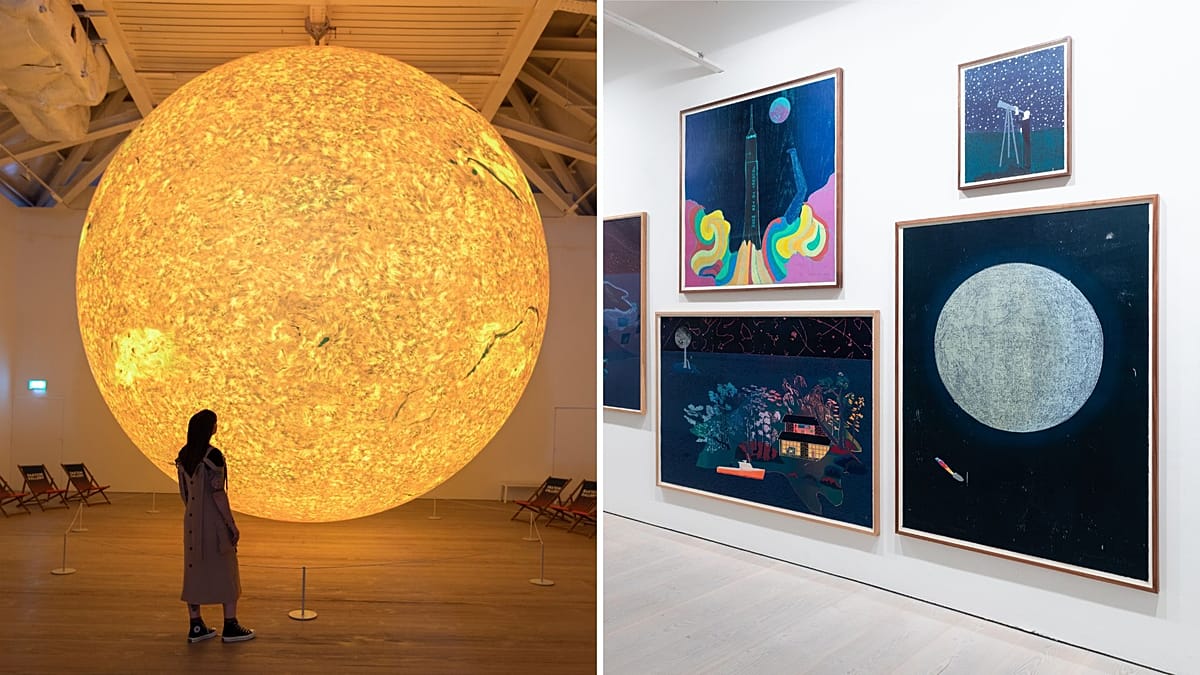
At the midway point of the exhibition is the breathtaking Helios, a giant six-metre illuminated sphere by British artist Luke Jerram. It’s constructed from 400,000 photographs of the sun provided by astrophotographer Dr Stuart Green along with NASA observations.
Visitors are invited to sink into deckchairs beneath it, and look up as the work slowly glows overhead, while a specially composed ambient soundtrack by Duncan Speakman and Sarah Anderson reverberates around the space. It’s a perfect place to contemplate the universe, or, if you’ve had your fill of art for the day, a pretty ideal spot for a nap!
“I hope that the artwork will inspire awe and wonder”, Jerram says, “and prompt visitors to consider the importance of the sun in all our lives; for light, warmth, energy for our planet and how our nearest star has inspired culture and religion throughout history.”
The women behind the moon landing
The second half of the exhibition turns to the moon, beginning with its phases and observation through history, before arriving at Walking on the Moon – a gallery dedicated to the cultural legacy of the Apollo missions and the lesser-known stories behind them.
Its centrepiece is Moon Landing, an extraordinary collaboration between textile artist Margot Selby and composer Helen Caddick. The work honours the Navajo women who wove the integrated circuits and the women at the Raytheon plant who wired the memory cores for Apollo 11 – contributions that were, for decades, largely uncelebrated.
Caddick’s score is built around the logic of weaving itself. “Margot told me she uses binary code in her weaving, which I found fascinating,” she says. “So I scored it for two harps, two cellos, and two violins – they work like a binary code. Quite often when the first harp is resting, the second is playing.” The piece runs in six sections, from the quiet settling of a weaver at her loom to the cacophony of the spacecraft landing.
The textile itself – woven by Selby and six studio members over four months, contains more than 30,000 individual threads and responds directly to the music, section by section.
“The colour choices are instinctive,” Selby tells Euronews Culture, “but the rhythms and patterns are all in direct response to the music.”
A link to listen to or download Caddick’s gorgeous composition is available here.
New voices
Elsewhere, British Zambian mixed media artist Kay Gasei, who won the Soho House Art Prize in 2021, offers a more intimate reflection on the Moon through his work Moonlight Series Number Four: Boy by the Pool.
Part family portrait and part mythological tale, the painting (one of a series of four) draws on memories of childhood adventures after dark.
“It’s about mischievousness, playing at night,” Gasei says. “I ran away as a kid more than once. I was missing for a few hours, but I knew where I was.”
The show also broadens the conversation beyond familiar Western narratives. Sakha designer and artist Aina Petrova presents her project URSUUNA – contemporary interpretations of traditional Arctic snow goggles – among the earliest forms of eye protection ever created.
Developed to prevent snow blindness during the long Arctic winters, the objects become symbols of both survival and cultural identity.
Once carved from wood and bone, Petrova reimagines them in silver and brass. Her works are shown alongside an original pair of the goggles, dating back roughly 1000 years.
“I wanted to connect with my roots and my ancestry,” Petrova explains. “It’s who I am.”
And if you happen to catch her at the exhibition, just ask – she’ll be more than happy to let you try a pair on for yourself (and yes, you can actually see through them surprisingly well).
“I’d love for people to leave wanting to learn more about the Sakha Republic and its culture. More visibility for indigenous people around the world – that feels important,” she says.
Installations that cannot be photographed
The final galleries, Midnight and The Darkest Hours, descend fully into the realms of folklore, dreams and perception.
Here, works by renowned artists including Paula Rego and Joan Miró culminate in two stunning immersive installations by the internationally acclaimed art collective teamLab. Both works are part of their “Cognitive Sculpture” series.
“It is quite hard to explain in words. The best way is to be inside the space,” says the global brand director of teamLab, Takashi Kudo.
“When you enter this installation, there are many, almost anonymous, luminous forms -like spheres. But they do not “exist” in a traditional sense. It is made of light and environment. Even if you try to touch them, you cannot. There is no physical object, but we can perceive them as if they exist,” he explains.
In their installation Massless Suns and Dark Suns, glowing spheres seem to float in the gallery space. But they cannot be photographed and are not immediately visible in a stable way. They reveal themselves only after you spend time looking.
As Takashi explains, “they exist – even though you can’t photograph them. You can only talk about them with other people who’ve been there.” This is what teamLab call “cognitive sculpture” – art that is formed not from material, but from the interaction between light and space.
It’s a fitting end to a brilliant show about the sky: something that has to be experienced in person to be believed.
“I hope audiences take away a sense of connection,” Benson from the curatorial team says.
“We’re all trying to find ourselves within the world and the universe. Hopefully seeing how people have been inspired throughout history by the Sun and the Moon leaves people feeling a bit more connected – to the world and to those around them.”
The Sun and The Moon: Art Inspired by the Celestial runs at London’s Saatchi Gallery until 8 September 2026.