
The US-Canada trade war is pushing Ottawa closer to the European Union. For European companies, that shift is already creating opportunities in defence, aerospace and industrial technology.
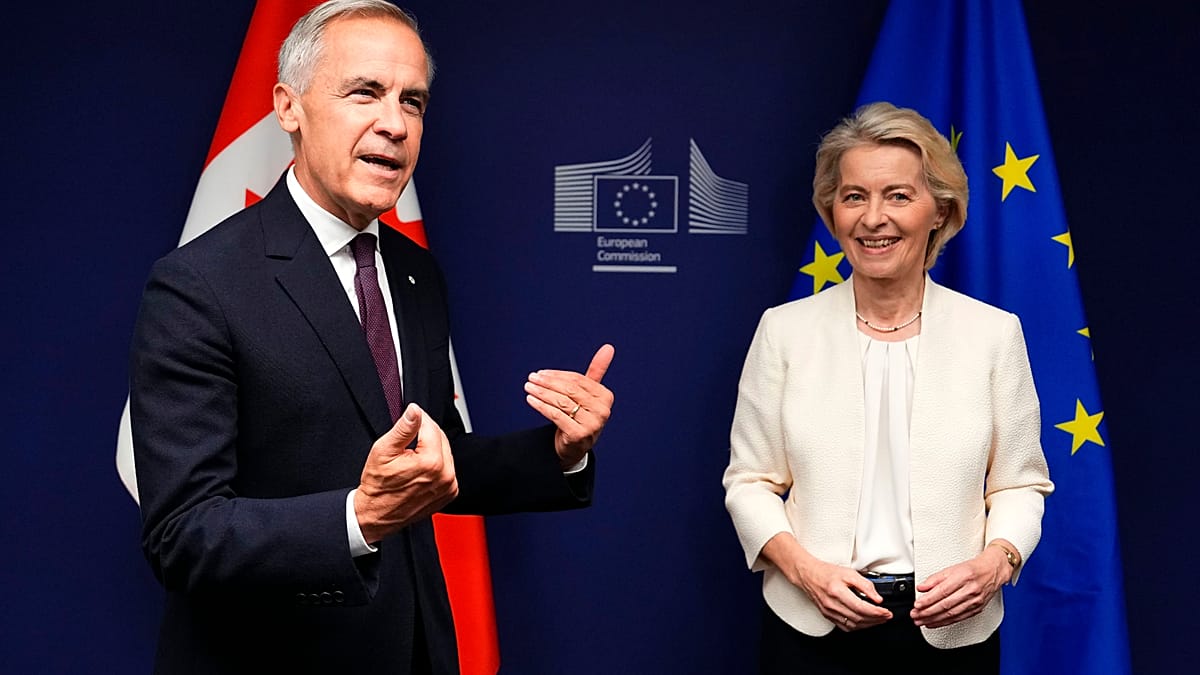
Canadian Prime Minister Mark Carney got a standing ovation in Strasbourg on Wednesday, not something that happens often to a foreign prime minister in the European Parliament.
European Commission President Ursula von der Leyen later gave that welcome a political meaning.
“I would like to work with you on opening the door for Canada to be the first associate member of the EU,” she said during the annual State of the Union address.
Von der Leyen described the broader relationship as an “Alliance for the Future”, covering defence, energy, technology, critical minerals and the Arctic.
What does an “associate member” mean?
There is no established “associate member” category in the EU treaties and no template Canada can simply join.
Creating one would require agreement among member states and complex legal negotiations.
Ten, including France and Italy, have yet to ratify Comprehensive Economic and Trade Agreement (CETA) fully, almost a decade after the trade agreement between Canada and the European Union was signed.
Carney has also said Canada is not seeking full EU membership. Ottawa instead wants a “unique alliance” that extends beyond a conventional free-trade deal.
For now, the proposal is more political signal than legal blueprint.
However, recent contracts show that the commercial relationship is already moving ahead.
EU–Canada trade already has a head start
Trade in goods and services between the two sides has grown by more than 81% since 2016, the year before the CETA took provisional effect, reaching just over €130 billion in 2025, according to the Council of the EU.
EU goods exports to Canada amounted to €48.9 billion. Services exports added another €29.4 billion.
Germany shipped roughly €12 billion of goods to Canada last year. Italy followed at €6.3 billion, ahead of France at €4.4 billion.
Machinery, chemicals, pharmaceuticals and transport equipment dominate European sales to Canada.
European machinery sales to Canada hit a record €9.5 billion last year. Electrical equipment climbed from €2 billion in 2022 to €3.3 billion, and cars rose from €2.9 billion to €4.4 billion over the same period.
Aerospace moved hardest of all. Sales of powered aircraft went from €449 million in 2022 to €1.2 billion last year.
European defence companies stand to gain
Defence provides the clearest evidence that Canada is looking beyond its traditional American suppliers.
In July, Ottawa selected Germany’s TKMS AG & Co. KGaA, the naval shipbuilder spun off from Thyssenkrupp AG last October, as preferred supplier for up to 12 new submarines.
While the final contract has not been signed yet, the decision places a European company at the centre of one of Canada’s largest military procurement programmes.
Sweden’s Saab has also gained ground. Ottawa selected the company as its preferred supplier for six GlobalEye surveillance aircraft, ahead of alternatives from Boeing and L3Harris.
The GlobalEye is built on business jets made by Canada’s Bombardier Inc. and Saab has offered to carry out much of the work in Canada, combining European sensors and mission systems with Canadian airframes.
The aircraft use jets produced by Canada’s Bombardier. Saab has offered to complete much of the work in Canada, combining European technology with Canadian manufacturing.
Canada also became the first non-European country admitted to procurement under the EU’s SAFE defence programme in June.
That gives Canadian manufacturers access to joint European purchasing, and it makes it easier for European defence groups to build supply chains that include Canadian firms.
Airbus and Siemens already have a strong foothold
The opportunity extends beyond military equipment. Air Canada has placed a firm order with Airbus for eight A350-1000 aircraft.
The government has also contracted Airbus for four new A330 tankers plus five conversions, part of a C$3.6 billion (€2.2bn) programme whose first new-build aircraft flew in July.
Ottawa has committed a further C$1.5 billion (€930mn) to keeping the fleet in the air.
Germany’s Siemens is investing C$150 million (€97 million) over five years in a Canadian research centre for AI-powered battery manufacturing.
French groups Keolis, Systra and SNCF Voyageurs are also part of the Cadence consortium selected in 2025 to develop Alto, the planned high-speed railway between Toronto and Quebec City. Canada has allocated about €2.4 billion to the project’s development phase.
Critical minerals could become the next opportunity
Canada’s reserves of nickel, lithium, copper and other critical minerals offer another potential area of cooperation.
Europe wants to reduce its dependence on concentrated and politically risky suppliers.
Canada wants more investment, processing capacity and customers outside the United States.
In March, the European Investment Bank and the Canadian government signed a letter of intent to explore financing for Canadian critical-minerals projects.
The agreement does not yet contain financial commitments.
However, it could eventually support European companies involved in mining technology, processing, recycling and battery production.
The price of deeper European access
CETA had eliminated 99% of tariff lines by 2024. A new alliance would therefore need to offer more than another reduction in customs duties.
The next gains would probably come from government procurement, investment, digital trade, professional mobility and the mutual recognition of standards.
Greater access could also require Canada to align some of its rules with the EU in the sectors covered by any future agreement.
However, it is too early to assume that Canada would adopt European rules on everything from agriculture to data protection. That will depend on what “associate membership” eventually means.
Angelo Katsoras, a geopolitical analyst at National Bank of Canada, said in an August note that Brussels is “increasingly using procurement rules, subsidies, tariffs and local content requirements to encourage more manufacturing within Europe”.
That could create difficulties for Canadian companies trying to enter the European market.
“Diversifying trade beyond the United States to regions such as the EU will likely be more challenging than many people anticipate,” Katsoras said.
The same logic applies in the opposite direction. European companies are more likely to succeed in Canada when they invest locally rather than rely entirely on exports.
Can Europe replace the United States?
The short answer is no.
The US absorbed 71.7% of Canadian merchandise exports in 2025. The EU, by comparison, represented 8.7% of Canada’s total trade in goods.
Canada cannot quickly replace the pipelines, railways, factories and cross-border supply chains built around its southern neighbour.
The more realistic outcome is a gradual redistribution of investment and government contracts.
Defence and rail can move first because governments choose the suppliers. Critical minerals, battery technology and energy infrastructure could follow as financing and supply chains develop.
Canada’s European pivot is therefore less an economic divorce from the United States than a decision to stop relying on a single partner.
For European companies, the biggest winners will not necessarily be those exporting the most.
They will be the groups prepared to turn European technology into Canadian production, investment and jobs.