
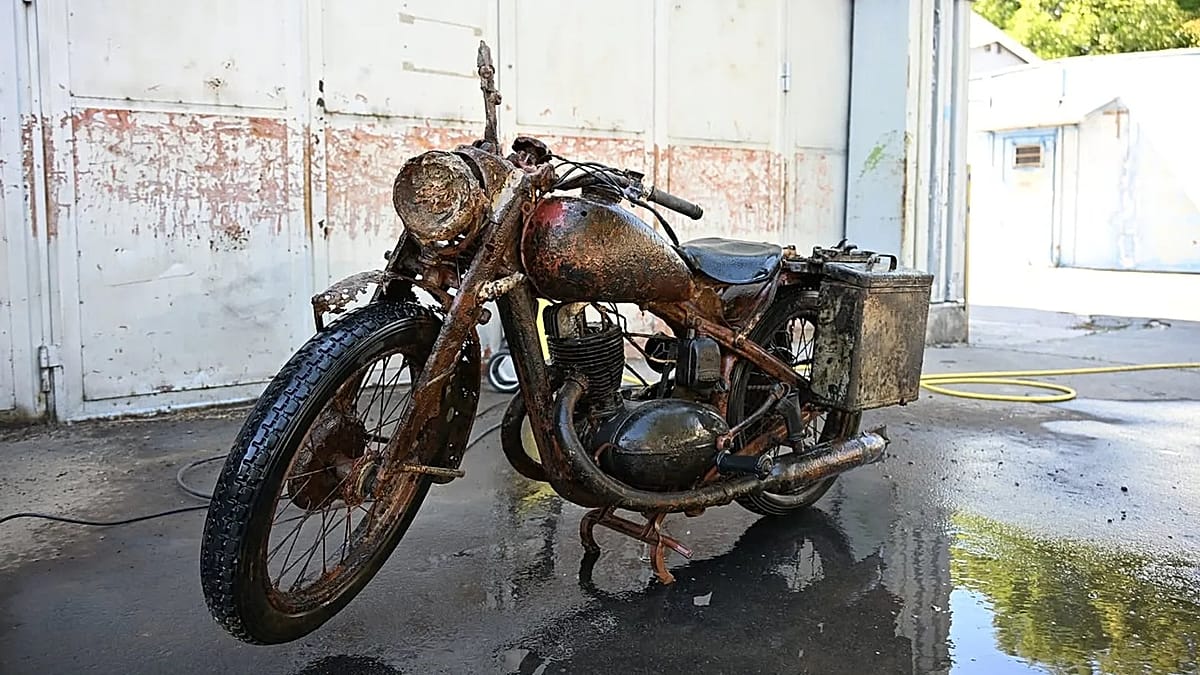
The photo of the Wehrmacht motorbike recovered in Budapest is travelling around the world: from “Times of India” and “Vietnam.VN” via British media such as the “Daily Mirror” through to US platforms like Yahoo Autos, media are reporting on the spectacular find.
According to Hungary’s Institute and Museum of Military History, the recovered motorbike is a DKW NZ 350-1.
Among motorcyclists at the time, the DKW NZ 250 and NZ 350 models were considered particularly tough and reliable. In 1944, therefore, the NZ 350-1 was introduced as a version developed specifically for wartime use.
The Hungarian museum recovered the machine on 2 August at Batthyány Square, opposite the parliament. The motorbike is almost completely preserved. Saturated with water and mud when it was raised, it weighed in at more than 200 kilograms. It is currently being cleaned and conserved in the museum’s hangar in Budapest.
The DKW NZ 350-1 was produced between 1944 and 1945, with just under 12,000 units built by the end of the war.
One of the intriguing features is a small detail that is easy to overlook today: there was a kind of fin or mud and snow scraper on the rear frame. It was designed to prevent slush and snow sticking to the tyre and then getting into the chain drive. This modification apparently drew on experience of the Russian winter.
Another striking feature was the engine block made of grey cast iron, an iron casting alloy with a high graphite content. One reason was the wartime shortage of aluminium. On the basis of the information published so far, however, this particular find still cannot be dated to a specific day or month of production.
DKW, the manufacturer of the NZ 350-1
The company DKW traces its origins back to Danish engineer Jørgen Skafte Rasmussen. In 1907 he first established a firm for mechanical engineering and steam technology in Zschopau in Saxony. The brand name DKW was coined later and originally stood for “Dampfkraftwagen”, literally “steam-powered vehicle”. In 1922 the first DKW two-stroke engine was produced in Zschopau. Over the following years the company developed into one of Germany’s most important motorcycle manufacturers.
In 1932 DKW merged with Audi, Horch and Wanderer to form Auto Union AG. Within the new group, the DKW plant in Zschopau remained the hub for motorcycle and engine production.
In the 1930s DKW was increasingly drawn into Germany’s rearmament. The NZ 350 was also produced in large numbers for the Wehrmacht.
The importance of the Zschopau plant is reflected in its output figures: as early as 1934, the 350,000th DKW motorcycle rolled off the production line, followed by the 500,000th in 1939. With the outbreak of the Second World War, civilian motorcycle production was gradually scaled back and manufacturing shifted more and more towards military needs.
The DKW NZ 350-1, now recovered from the Danube, comes from this late phase of the war.
After the end of the Second World War, the Zschopau DKW plant was dismantled by the Soviet occupying forces. Machinery and equipment were shipped to the Soviet Union, and DKW engineers from Zschopau were also taken to Izhevsk to help rebuild motorcycle production there. The story of the NZ 350 did not end there: from 1946 the IZh-350, which was largely based technically on the DKW NZ 350, was produced in the Soviet Union. More than 127,000 units were built by 1951.
In recent days, parts of the original equipment have also been found alongside the Wehrmacht motorbike in the dried-out bed of the Danube, including a petrol can, a Y-strap and a bayonet frog.
A Y-strap was a leather harness worn over the shoulders and connected at the front and back to additional straps. It served to fasten equipment to the body, such as bread bags, ammunition pouches or water bottles. The designation ‘Y’ comes from the shape of the shoulder straps.
A bayonet frog is the holder for a bayonet, attached to the belt or other gear. It carries the bayonet when it is not fixed to the rifle.
Beneath the motorbike, the remains of two German soldiers were discovered. Their identity tags, which are fully preserved, could now, for the first time in more than 80 years, provide information about who they were and what happened to them. A so-called ‘Kuban’ sleeve shield was also found.
This badge may indicate that its wearer had previously served at the Kuban bridgehead in the Caucasus.
At present it is assumed that the remains of the two men are those of the motorbike’s rider and passenger. However, there is a possible alternative explanation: the Hungarian Military History Institute (source in German) (source in Hungarian) believes that this spot may be a pit used for war rubble or waste that was created after the end of the siege. Apparently ammunition and items of equipment were among the things dumped there.
The finds alone therefore do not yet allow any definitive conclusion as to whether the two men were on the DKW at the time of their deaths.