
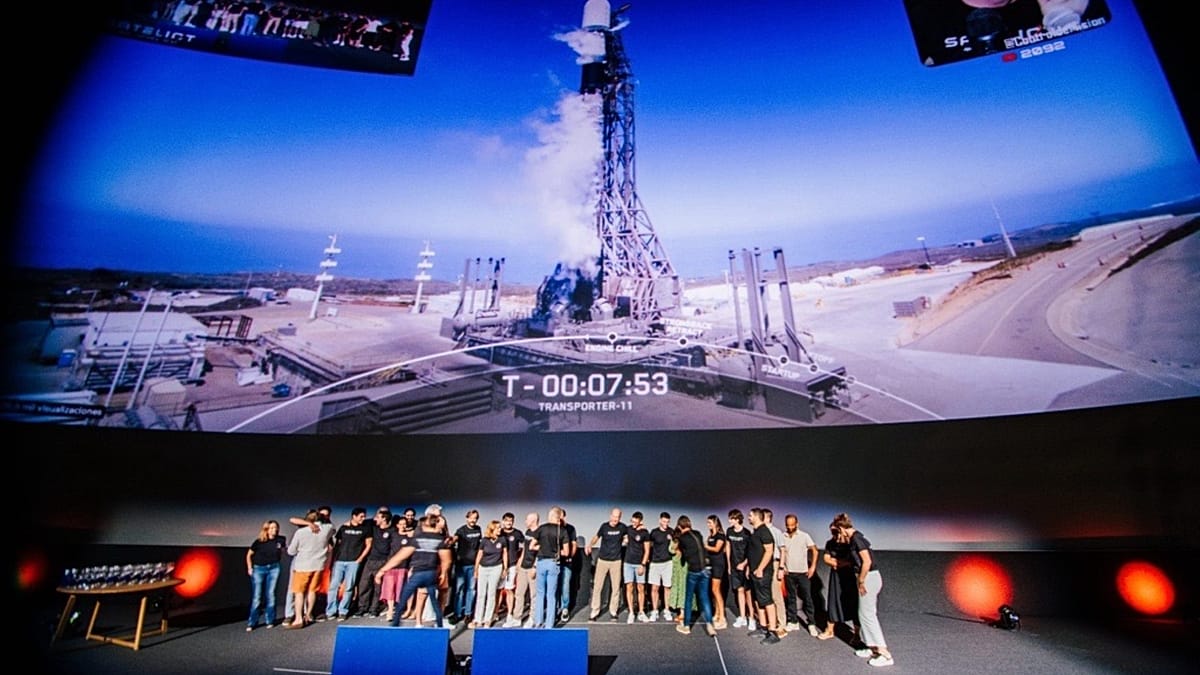
The Catalan company Sateliot will place five new satellites into orbit this Thursday on board a SpaceX Falcon 9. With this mission, called Draconis, the company will reach a total of 11 satellites launched since it was founded and, by its calculations, will on average double the number of daily passes and halve the time it takes a satellite to return to fly over the same point.
Lift-off is scheduled for 1 October at 20:18 (Spanish mainland time) from the Vandenberg base in California, as part of SpaceX’s Transporter-18 mission, although it could still shift at the last minute. The launch can be followed live from Espai Diagonal.
Sateliot is, in essence, putting mobile phone masts into space. Its satellites extend the coverage of mobile operators, which buy the service wholesale to offer Internet of Things (IoT) connectivity wherever terrestrial networks do not reach. The company says the technology, based on 5G NTN, has already been validated.
The five new units, built by Alén Space, are small: 20 x 10 x 35 centimetres and 10 kilos each, with a service life of more than five years and an orbit of up to 600 kilometres.
Compared with the four it launched in 2024, they carry an optimised payload, a more reliable system for storing data on board, improved versions of the main computer and the attitude-control system (providing greater stability and easier manoeuvres), and memory components that are more resistant to radiation. According to the company, the maturity of the design has made it possible to engineer and build them in half the time needed for the spacecraft in the previous mission.
The operation also involves Exolaunch, which has taken charge of integration and logistics; KSAT and Leaf Space, partners for the ground tracking and control stations; and Comfone, which is providing IPX connectivity services to interconnect Sateliot’s network with mobile operators.
Tritó, the next big step
These five satellites form part of a constellation that Sateliot wants to expand to more than 500, evolving from generation to generation: from massive IoT towards higher-capacity, more critical services, including direct connections to devices (D2D).
The change will come from 2027 with Tritó, which will debut 5G NR NTN technology, store-and-forward communications based on the 3GPP Release 19 standard and a digital multibeam phased-array antenna capable of dynamically managing several coverage beams. In this context fits the agreement already announced with PLD Space for a dedicated mission on board the Miura 5.
To finance this, the company is working on a 100-million-euro Series C round. So far it has raised around another 100 million and expects to reach revenues of 500 million euros in 2030.
“We have validated the technology and we are now increasing capacity and regularity so we can scale up the service together with mobile operators,” sums up Jaume Sanpera, CEO and co-founder of Sateliot. “Our goal is to turn the satellite into a natural extension of their networks wherever they do not reach,” he adds.