
Close Menu
Daily Guardian EuropeDaily Guardian Europe
  • Home
  • Europe
  • World
  • Politics
  • Business
  • Lifestyle
  • Sports
  • Travel
  • Environment
  • Culture
  • Press Release
  • Trending
What's On

Greece bets big on MAGA, as other EU countries turn away from Trump – POLITICO

May 8, 2026

Hungary, EU split over how much of its €10B funding it should get – POLITICO

May 8, 2026

Iranian media report exchange of fire with ‘enemy units’ near island in Strait of Hormuz

May 7, 2026

Einigung über US-Handelsabkommen noch im Mai möglich – POLITICO

May 7, 2026

EU meets to game plan hantavirus response as WHO calms outbreak fears – POLITICO

May 7, 2026
Facebook X (Twitter) Instagram
Web Stories
Facebook X (Twitter) Instagram
Daily Guardian Europe
Newsletter
  • Home
  • Europe
  • World
  • Politics
  • Business
  • Lifestyle
  • Sports
  • Travel
  • Environment
  • Culture
  • Press Release
  • Trending
Daily Guardian EuropeDaily Guardian Europe
Home»Business
Business

South Korean stocks suffer worst day on record amid Iran war shocks

By staffMarch 4, 20263 Mins Read
South Korean stocks suffer worst day on record amid Iran war shocks
Share
Facebook Twitter LinkedIn Pinterest Email
By&nbspQuirino Mealha&nbspwith&nbspAP

Published on
04/03/2026 – 10:45 GMT+1

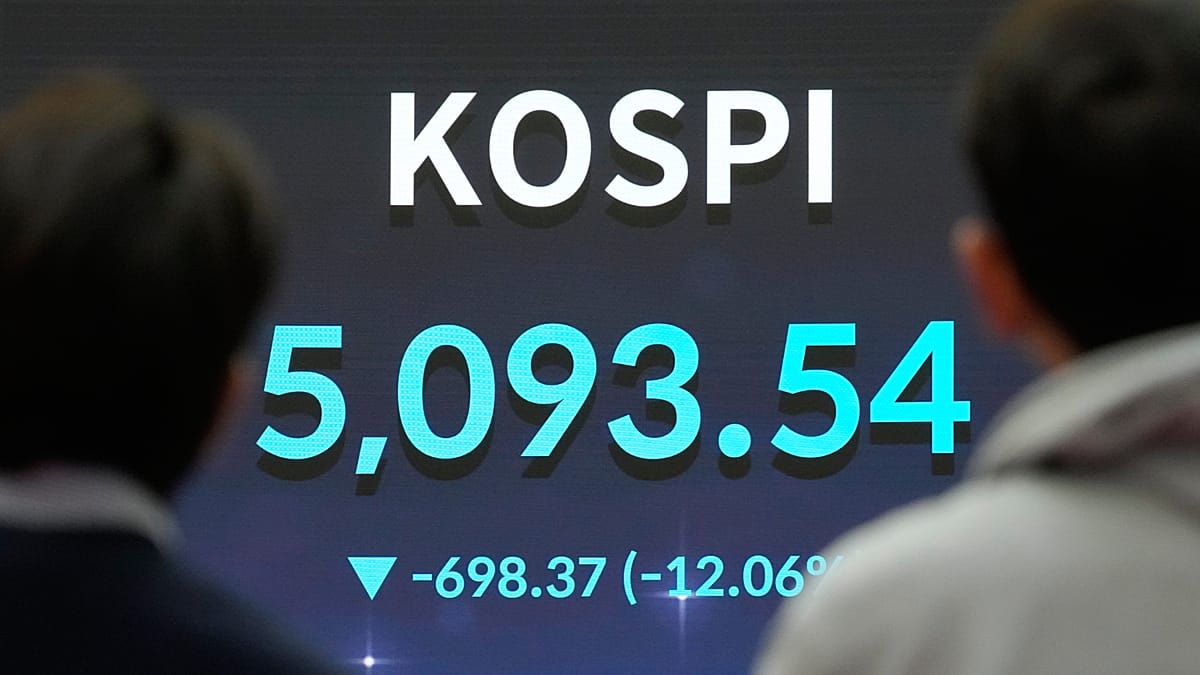
The Kospi in Seoul closed down 12.1% at 5,093.54, triggering a temporary trading halt.

A circuit breaker was also activated on the tech-heavy Kosdaq which saw an even bigger drop of 14%.

Shares in Samsung Electronics fell 11.7% and the semiconductor supplier SK Hynix lost 9.6%, as investor optimism about AI demand for semiconductors was overwhelmed by concerns over energy security.

South Korea, which imports virtually all its crude oil and sources from the Middle East, was one of the world’s best-performing stock markets earlier this year but is now particularly exposed to the interruption in maritime trade caused by the Iran conflict.

The Strait of Hormuz has emerged as a major flashpoint. About 20 million barrels pass through it per day, mainly to energy-hungry economies in Asia including South Korea, Japan, China and India, which account for roughly 75% of the oil flows via the chokepoint, according to the US Energy Information Administration.

Oil prices continued to rise, though gains moderated after President Trump announced measures to safeguard shipping.

At the time of writing, US benchmark crude is trading at $77 per barrel, while international Brent crude is above $84, the highest price since 2024. Both contracts have surged roughly 15% since the start of the week and markets remain highly volatile.

In a post shared by the White House on X, President Trump stated he ordered the US Development Finance Corporation to offer political risk insurance and guarantees for maritime trade.

“If necessary, the United States Navy will begin escorting tankers through the Strait of Hormuz, as soon as possible,” President Trump added.

Nonetheless, analysts cautioned that the steps would only partly ease risks.

Higher insurance costs alone could add between $5 and $15 per barrel, with the “war premium” likely to remain in place amid ongoing attacks.

Asian markets slump

In Tokyo, the Nikkei 225 also dropped 3.9% but has since pared most of the intraday decline. However, the index is down more than 6% this week.

Japan, similar to South Korea and Taiwan, depends heavily on oil and natural gas imports from the Gulf region.

Hong Kong’s Hang Seng fell 2% to 25,249.48, while the Shanghai Composite lost around 1% closing at 4,082.47.

Taiwan’s Taiex also shed 4.4% to 32,829.

Francis Lun, chief executive of Venturesmart Asia, a Hong Kong-based financial services company, described the situation as increasingly serious.

“I think the Iran situation is getting out of hand, and I think that US President Donald Trump miscalculated enormously,” the CEO stated while adding that “the situation is very grim”.

The sell-off reflects broader anxiety that prolonged instability in the Middle East could squeeze corporate profits and slow the global economy, particularly for trade-dependent Asian nations.

Share. Facebook Twitter Pinterest LinkedIn Tumblr Email

Keep Reading

Economic growth in the Pacific could slow as energy disruptions spread, ADB warns

How UK 30-year bonds reached the highest yield this century and why it matters

Europe’s AI Conundrum: Watch the Brussels Economic Forum 2026

Maersk profit falls sharply as firm keeps forecast despite Hormuz uncertainty

Hopes of reopening the Strait of Hormuz lift shares, as oil remains above $100

Europe’s ultra-rich club grew by 26% in five years — led by Germany

Greece moves to protect borrowers with consumer loans up to €100,000

Resilience amid ruins: Why markets are hitting record highs despite the Iran war

Asian Development Bank announces €65bn regional investment plan across Asia

Editors Picks

Hungary, EU split over how much of its €10B funding it should get – POLITICO

May 8, 2026

Iranian media report exchange of fire with ‘enemy units’ near island in Strait of Hormuz

May 7, 2026

Einigung über US-Handelsabkommen noch im Mai möglich – POLITICO

May 7, 2026

EU meets to game plan hantavirus response as WHO calms outbreak fears – POLITICO

May 7, 2026

Subscribe to News

Get the latest Europe and world news and updates directly to your inbox.

Latest News

EU critic Rumen Radev named new Bulgarian Prime Minister

May 7, 2026

Video. Local elections across UK test Starmer as Reform UK eyes major gains

May 7, 2026

Sovereignty push shouldn’t disrupt tech supply chains, EU innovation chief warns – POLITICO

May 7, 2026
Facebook X (Twitter) Pinterest TikTok Instagram
© 2026 Daily Guardian Europe. All Rights Reserved.
  • Privacy Policy
  • Terms
  • Advertise
  • Contact

Type above and press Enter to search. Press Esc to cancel.