
Close Menu
Daily Guardian EuropeDaily Guardian Europe
  • Home
  • Europe
  • World
  • Politics
  • Business
  • Lifestyle
  • Sports
  • Travel
  • Environment
  • Culture
  • Press Release
  • Trending
What's On

Trump deploys Vance to Hungary – POLITICO

April 3, 2026

Three members of Greek government quit over EU farm subsidy scandal, state TV says

April 3, 2026

‘Bridges next, then Electric Power Plants!’ Trump threatens Iran’s civilian infrastructure – POLITICO

April 3, 2026

Video. Ukraine’s ancient Easter egg art helps preserve national identity

April 3, 2026

French and South Korean leaders say they’ll work together to reopen Strait of Hormuz

April 3, 2026
Facebook X (Twitter) Instagram
Web Stories
Facebook X (Twitter) Instagram
Daily Guardian Europe
Newsletter
  • Home
  • Europe
  • World
  • Politics
  • Business
  • Lifestyle
  • Sports
  • Travel
  • Environment
  • Culture
  • Press Release
  • Trending
Daily Guardian EuropeDaily Guardian Europe
Home»Business
Business

South Korean stocks suffer worst day on record amid Iran war shocks

By staffMarch 4, 20263 Mins Read
South Korean stocks suffer worst day on record amid Iran war shocks
Share
Facebook Twitter LinkedIn Pinterest Email
By&nbspQuirino Mealha&nbspwith&nbspAP

Published on
04/03/2026 – 10:45 GMT+1

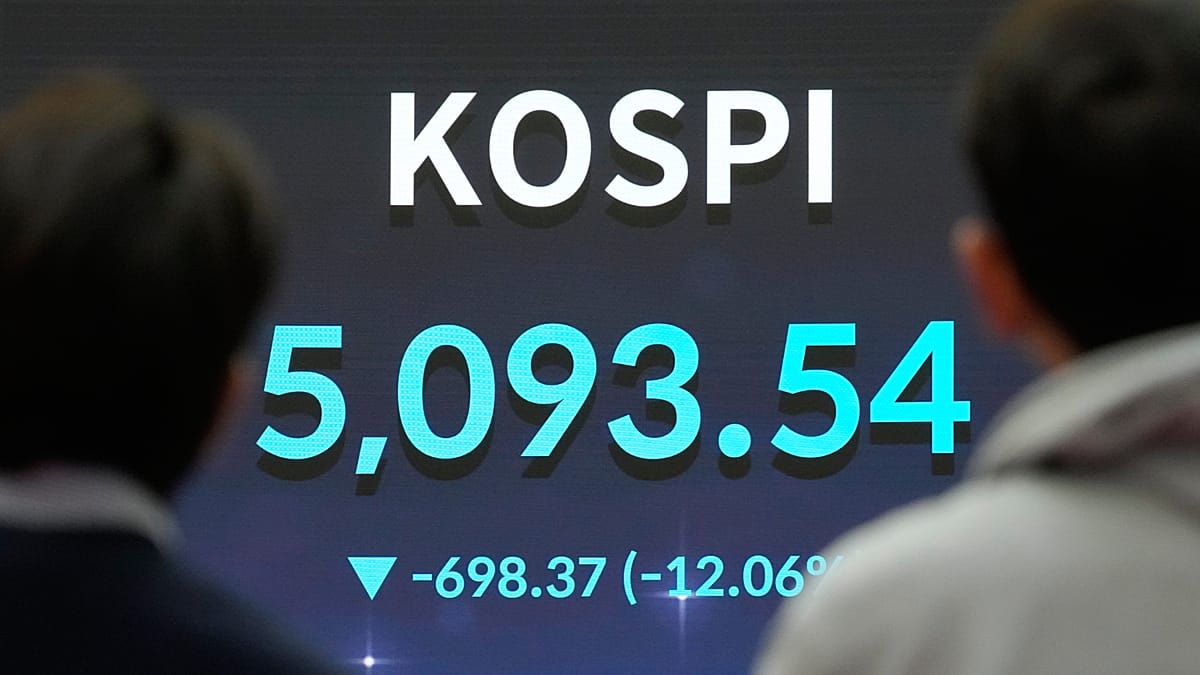
The Kospi in Seoul closed down 12.1% at 5,093.54, triggering a temporary trading halt.

A circuit breaker was also activated on the tech-heavy Kosdaq which saw an even bigger drop of 14%.

Shares in Samsung Electronics fell 11.7% and the semiconductor supplier SK Hynix lost 9.6%, as investor optimism about AI demand for semiconductors was overwhelmed by concerns over energy security.

South Korea, which imports virtually all its crude oil and sources from the Middle East, was one of the world’s best-performing stock markets earlier this year but is now particularly exposed to the interruption in maritime trade caused by the Iran conflict.

The Strait of Hormuz has emerged as a major flashpoint. About 20 million barrels pass through it per day, mainly to energy-hungry economies in Asia including South Korea, Japan, China and India, which account for roughly 75% of the oil flows via the chokepoint, according to the US Energy Information Administration.

Oil prices continued to rise, though gains moderated after President Trump announced measures to safeguard shipping.

At the time of writing, US benchmark crude is trading at $77 per barrel, while international Brent crude is above $84, the highest price since 2024. Both contracts have surged roughly 15% since the start of the week and markets remain highly volatile.

In a post shared by the White House on X, President Trump stated he ordered the US Development Finance Corporation to offer political risk insurance and guarantees for maritime trade.

“If necessary, the United States Navy will begin escorting tankers through the Strait of Hormuz, as soon as possible,” President Trump added.

Nonetheless, analysts cautioned that the steps would only partly ease risks.

Higher insurance costs alone could add between $5 and $15 per barrel, with the “war premium” likely to remain in place amid ongoing attacks.

Asian markets slump

In Tokyo, the Nikkei 225 also dropped 3.9% but has since pared most of the intraday decline. However, the index is down more than 6% this week.

Japan, similar to South Korea and Taiwan, depends heavily on oil and natural gas imports from the Gulf region.

Hong Kong’s Hang Seng fell 2% to 25,249.48, while the Shanghai Composite lost around 1% closing at 4,082.47.

Taiwan’s Taiex also shed 4.4% to 32,829.

Francis Lun, chief executive of Venturesmart Asia, a Hong Kong-based financial services company, described the situation as increasingly serious.

“I think the Iran situation is getting out of hand, and I think that US President Donald Trump miscalculated enormously,” the CEO stated while adding that “the situation is very grim”.

The sell-off reflects broader anxiety that prolonged instability in the Middle East could squeeze corporate profits and slow the global economy, particularly for trade-dependent Asian nations.

Share. Facebook Twitter Pinterest LinkedIn Tumblr Email

Keep Reading

French and South Korean leaders say they’ll work together to reopen Strait of Hormuz

Public holidays: How much does a day off cost in Europe?

FIFA raises top ticket price for World Cup final to $10,990 during glitch-hampered sales reopening

Musk’s path to $1 trillion: SpaceX files for IPO, reports say

Stocks jump and oil drops as Trump renews hopes of Iran war ending

Should you book holiday flights now considering jet fuel price spikes?

What the invasion of Ukraine and Iran war should teach Europe about air defence

EU warns oil and gas prices will not immediately return to normal even if the Iran war ends

‘People’s IPO’ is turning ordinary Central Asian citizens into shareholders

Editors Picks

Three members of Greek government quit over EU farm subsidy scandal, state TV says

April 3, 2026

‘Bridges next, then Electric Power Plants!’ Trump threatens Iran’s civilian infrastructure – POLITICO

April 3, 2026

Video. Ukraine’s ancient Easter egg art helps preserve national identity

April 3, 2026

French and South Korean leaders say they’ll work together to reopen Strait of Hormuz

April 3, 2026

Subscribe to News

Get the latest Europe and world news and updates directly to your inbox.

Latest News

From the Amazon to Antarctica: These are the best once-in-a-lifetime marathons to try

April 3, 2026

‘Easter Lily’: U2 surprise drop new EP to mark Good Friday

April 3, 2026

5 ways Trump could destroy NATO – POLITICO

April 3, 2026
Facebook X (Twitter) Pinterest TikTok Instagram
© 2026 Daily Guardian Europe. All Rights Reserved.
  • Privacy Policy
  • Terms
  • Advertise
  • Contact

Type above and press Enter to search. Press Esc to cancel.