
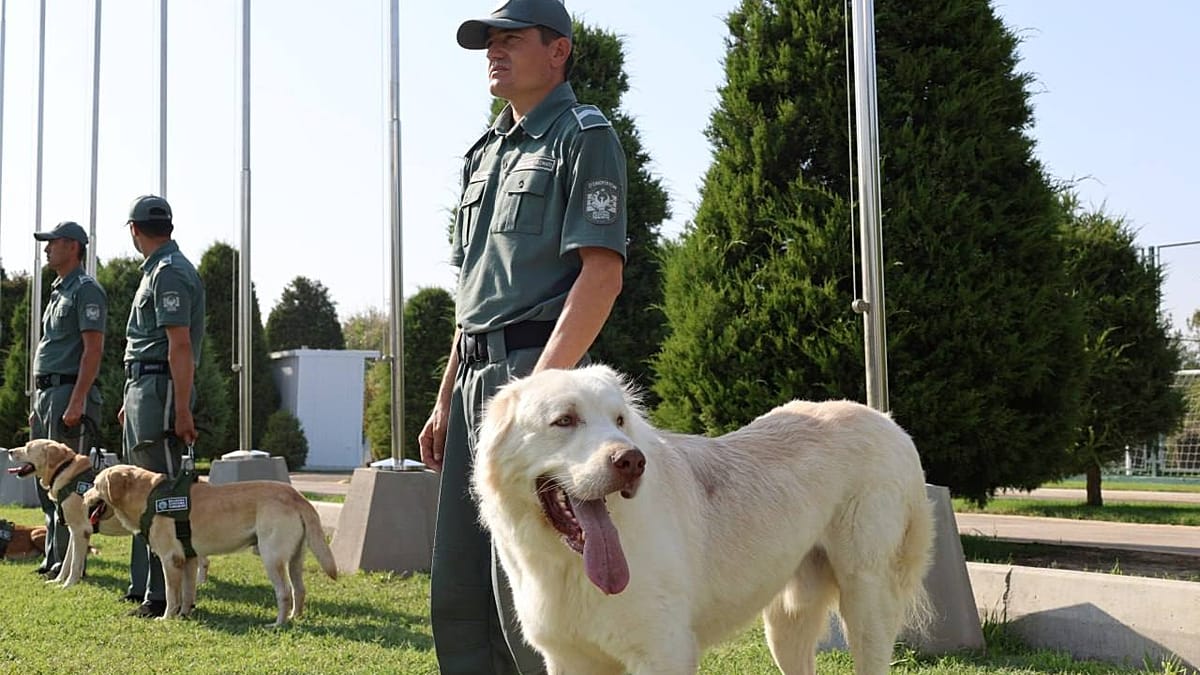
As artificial intelligence and advanced scanning systems transform border controls, customs services still rely on one of their oldest detection tools: trained dogs.
AI can analyse images and data, identify patterns and help customs officers decide which shipments or containers warrant closer inspection.
But customs officials, dog handlers, and other specialists from more than 50 countries gathered at the World Customs Organisation’s 7th Global Canine Forum in Tashkent argued that this does not remove the need for dogs trained to detect scents.
Antonio Lo Parco, head of the WCO’s Regional Office for Capacity Building for Europe, told Euronews that dogs possess detection abilities “that AI cannot substitute”.
Information from canine detection can also feed into AI systems, he added, helping customs authorities identify patterns and emerging trends.
Oliver Stolper, the UN Office on Drugs and Crime’s regional representative for Central Asia, also sees the two tools as complementary.
AI can help customs services identify containers that require additional scrutiny and analyse images for signs of illicit cargo.
“But a dog cannot be replaced,” Stolper told Euronews. “Customs organisations continue to rely on them and for good reasons, as we can see in everyday work.”
Experts explained that technology can help narrow the search, while a trained dog provides an additional form of detection.
The role of detection dogs is also evolving as illicit drug markets change.
Jonibek Yusupov, an officer at Uzbekistan’s Agency for the Control of Narcotic Drugs and Firearms, said authorities had recorded a significant rise in synthetic drugs since the pandemic.
Canine units are now training dogs specifically to recognise the scents associated with synthetic narcotic substances.
“If we rely solely on artificial intelligence or technology, we can only analyse images,” Yusupov told Euronews. “But narcotic substances have a smell.”
How a service dog is trained
Uzbekistan’s National Canine Centre has been training dogs and handlers for three decades.
Established in 1996, it trains canine teams for customs and other law-enforcement agencies. It was granted WCO Regional Canine Centre status in 2008.
Its dogs are trained for tasks including the detection of narcotics, psychotropic substances, weapons, ammunition and explosives, as well as search-and-rescue and tracking operations.
But not every puppy is suitable.
At around four months old, dogs bred at the centre begin working with instructors and are assessed for characteristics including their response to noise, unfamiliar environments and heights.
“Not every dog can become a service dog,” chief instructor Captain Ahmadjon Goyibov told Euronews.
The centre primarily works with German and Belgian Shepherds, Russian Spaniels and Labradors.
Dogs that pass the selection process are gradually introduced to environments they may encounter during operations, including vehicles and railway carriages.
Specialised training begins around eight months of the dog’s age and normally lasts six to seven months. Training is adapted to each dog’s temperament.
Dogs are also taught how to signal a detection to their handler, for example by sitting, lying down or remaining still.
Goyibov rejected a common misconception that drug-detection dogs are made dependent on narcotics or otherwise forced to perform their work.
“We never use force against the dogs,” he said. “We train them solely through positive reinforcement. We give them their favourite toy or their favourite food as a reward, but we never use force.”
Toys, including ones with food or treats inside, are used as rewards during exercises, teaching the animal to associate a successful detection with something positive.
For Goyibov, however, technique alone is not enough.
“To become a good canine specialist, first and foremost, you need to love service dogs and animals and be able to show them care and affection,” he said.
A regional training centre
Uzbekistan’s centre also trains foreign canine teams.
In recent years, 220 handlers from countries including South Korea, Tajikistan, Kyrgyzstan, Turkmenistan, Armenia and Mongolia have received training or professional development there.
More than 200 service dogs have also undergone specialised training, with some later deployed by customs authorities outside Uzbekistan.
Elpida Kasapi of the Greek Customs Service said the forum gave participants the opportunity to study WCO criteria for canine training centres and consider how to apply them at home.
“What we are doing here will be extremely useful for us,” Kasapi told Euronews, “as it will allow us to gain knowledge and information that we can then apply to the Greek context and to our practices in Greece.”
According to Uzbekistan’s Customs Committee, between 2023 and the first half of 2026, service dogs trained at the centre helped intercept more than 12 tonnes of narcotic substances.