
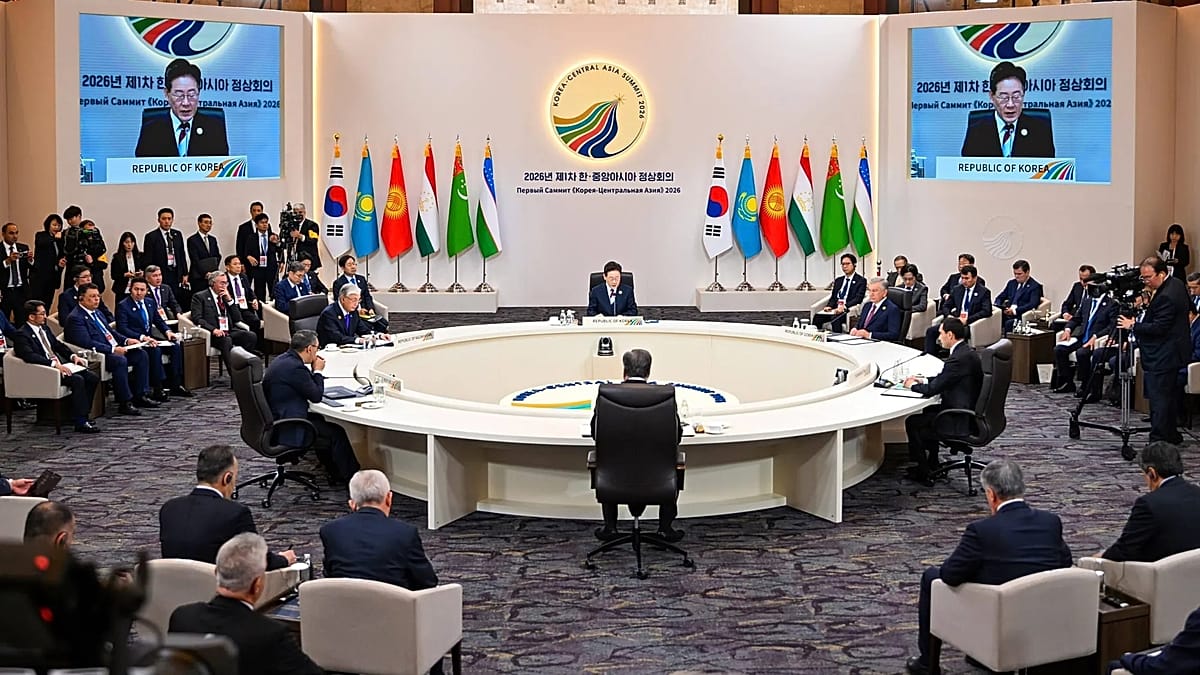
South Korea and the five Central Asian republics held their first heads-of-state summit in Seoul on Wednesday, adopting a 30-year cooperation framework targeting critical minerals, energy, supply chains and emerging technologies against the backdrop of a shared Silk Road history.
The declaration established a leaders’ summit that brings together South Korea, Kazakhstan, Kyrgyzstan, Tajikistan, Turkmenistan and Uzbekistan every two years, and a new mechanism that brings together the six countries’ industry ministers.
“The ‘Silk Road spirit’ of Central Asia that connected people, technologies and cultures of the East and West as one is needed more than ever,” South Korean President Lee Jae-myung said.
The six countries share common goals: Seoul needs more diverse sources of critical materials and more resilient supply chains, while Central Asian governments want technology, investment and a larger role in manufacturing the products made from their resources.
On critical minerals, South Korea is looking to diversify supplies for industries including semiconductors, batteries and electric vehicles, while Central Asian countries want more processing and manufacturing to take place inside the region.
The Seoul Declaration, which builds on a dialogue launched at the vice-ministerial level in 2007 and later elevated to the ministerial level, calls for “mutually beneficial value chains” that combine Central Asian resources and local production with Korean technology and manufacturing expertise.
“Today, Central Asia is no longer merely a supplier of raw materials,” Uzbek President Shavkat Mirziyoyev said. “Our countries are actively integrating into global value chains while expanding opportunities for innovation and technological cooperation.”
President Kassym-Jomart Tokayev said Kazakhstan has all 10 minerals classified by South Korea as strategic, and called for cooperation extending into semiconductors, batteries, electric-vehicle components and robotics.
Mirziyoyev proposed a Regional Investment Alliance for Critical Minerals covering the full production cycle, and set a $20 billion (€17.3 billion) target for trade between South Korea and Central Asia by 2030.
Kyrgyz President Sadyr Japarov pushed the regional approach further, proposing a joint investment fund to finance priority projects and make it easier for Korean companies to enter Central Asian markets.
Transport chain reaching Europe
Transport was another key segment to the summit, with Tokayev proposing an “end-to-end transport and logistics chain extending from Korea, through Central Asia, to Europe”.
Central to that idea is the Middle Corridor, formally known as the Trans-Caspian International Transport Route. It moves freight through Central Asia, across the Caspian Sea to Azerbaijan and Georgia, and onwards towards European markets through Turkey or the Black Sea.
The corridor has attracted growing attention as companies and governments seek alternatives to routes through Russia. Tokayev said its freight volumes had increased fivefold over the past six years.
Mirziyoyev also described Central Asia as an emerging “hub of global connectivity”, while Japarov highlighted the China–Kyrgyzstan–Uzbekistan railway and invited Korean companies to participate in industrial and logistics facilities along the route.
Turkmenistan put transport, logistics, energy and industrial cooperation among its priorities for deeper ties with South Korea.
Tajik President Emomali Rahmon, meanwhile, focused on water security, climate change and sustainable development.
From political strategy to business
The regional agenda moved from the leaders’ table to the business community later in the day, when more than 500 government and company representatives gathered for the first Korea–Central Asia Business Summit.
Lee Jae-myung described the priorities in practical terms: broader trade and investment, cooperation across the critical-minerals value chain and new infrastructure connecting the region with international markets.
Tokayev pointed to Central Asia’s combined GDP of nearly $550 billion and growth of more than 6%.
“Combining these advantages with Korea’s industrial, technological and financial capabilities opens up broad prospects for mutually beneficial cooperation,” he said.
Mirziyoyev similarly urged Korean companies to view Central Asia as a single market of more than 80 million people, with opportunities in AI, semiconductors and advanced manufacturing.
Tokayev, meanwhile, pointed to transport infrastructure and technology as areas where Korean investment could strengthen connections across the Eurasian continent.
Nineteen memorandums of understanding were signed during the regional business summit in sectors including critical minerals, industry, infrastructure and digital technologies. They set out areas for future cooperation but are not, in themselves, final investment contracts.
The regional meetings in Seoul ran alongside separate bilateral talks and business programmes between South Korea and individual Central Asian states.
Kazakhstan and Uzbekistan were among the countries announcing national agreements and investment projects during their leaders’ visits.
The new C5+Korea format will meet again at the leaders’ level in Kazakhstan in 2028.