
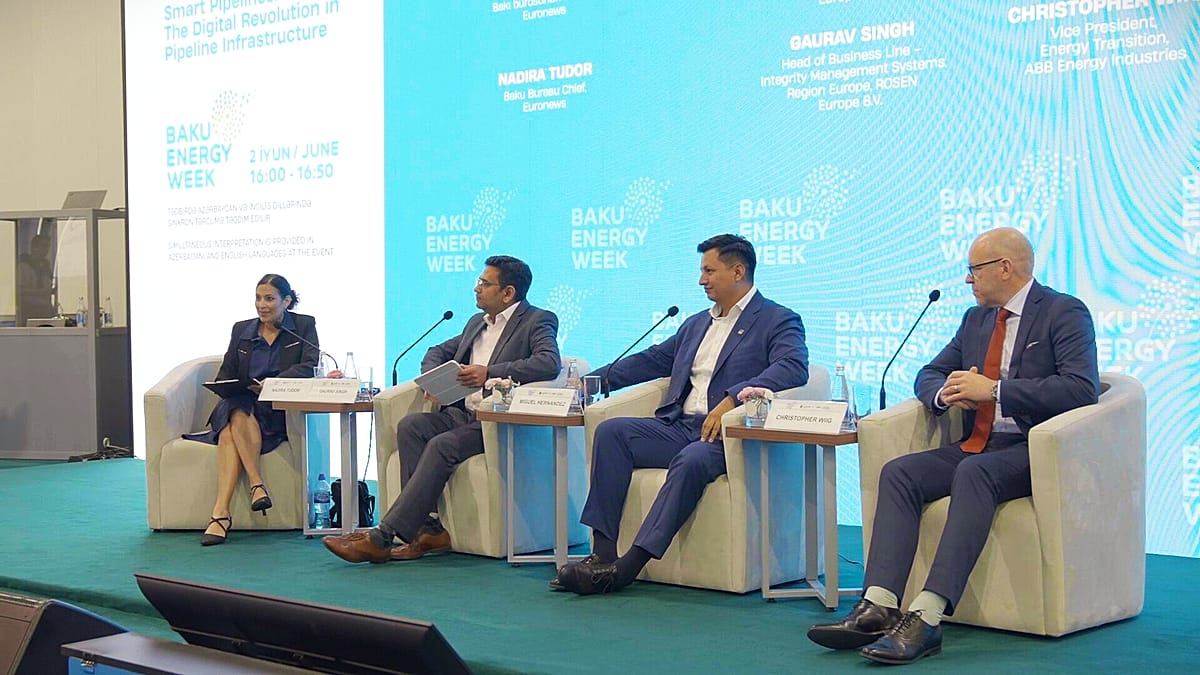
Around 500,000 kilometres of oil and gas pipelines worldwide need to be renovated, rebuilt or upgraded, while leaks, ruptures and incidents already cost the sector more than $7 billion (€6bn) a year — and roughly 40% of failures go undetected in the first 24 hours, according to industry experts speaking at the Baku Energy Forum.
The scale of the problem is driving rapid adoption of sensors, machine-learning and real-time monitoring systems designed to shift pipeline management from responding to failures to anticipating them.
At the Euronews-led panel, experts described this shift as one of the most significant technological transformations facing the energy sector.
They insist that modern, smart pipelines can provide real-time awareness, predictive maintenance, leak detection, and operational optimisation, creating what industry leaders describe as an intelligent infrastructure ecosystem.
However, speakers at the forum also warned that the industry faces a deeper challenge alongside the ageing infrastructure: the people who know how to manage it are leaving.
“We believe there is a silver tsunami happening in our industry,” said Gaurav Singh, Head of Integrity Management Systems for Europe at ROSEN.
Experienced engineers and specialists are retiring, while fewer young professionals are entering the sector. So, there is a concern that decades of practical knowledge built through field experience will be lost.
“If we don’t utilise that knowledge, we’re losing 80 years of experience that has been built over time,” Singh told Euronews.
For Singh, digitalisation is about preserving the accumulated expertise on which technology depends.
AI relies on historical data and accumulated knowledge to recognise patterns and generate accurate predictions. Without that knowledge base, machine-learning systems become significantly less effective.
“Knowledge is data,” Singh explained. “It feeds into the system and helps create the efficiency around these new digital solutions.”
Companies such as ROSEN are already building vast data warehouses containing information from more than 26,000 inspection runs, billions of recorded anomalies and millions of kilometres of inspected pipelines.
That information can then be used to train predictive models capable of identifying corrosion risks, estimating the condition of uninspected pipelines and supporting future decision-making.
Security, resilience and trust
The growing dependence on digital systems raises its own questions.
As experienced workers retire and their expertise is encoded into software, operators risk becoming dependent on tools they no longer fully understand — a development debated across aviation, healthcare, defence and manufacturing.
Christopher Wiig, Vice President of Energy Transition at ABB Energy Industries, believes the answer lies in balance.
“The fear that machines will take over has existed since the Industrial Revolution,” he told Euronews.
Rather than replacing people, he argued, digital systems should support them. “We actually need more people to do more jobs than we currently have the capability to do,” Wiig said.
The conversation around smart pipelines extends far beyond maintenance to include security, resilience and trust.
“I think there are three aspects mainly to look into,” said Wiig. “Personnel security, physical security and cyber security.”
“In the end, it’s about financial benefits,” he said.
Major energy corridors such as the Baku-Tbilisi-Ceyhan pipeline and the Southern Gas Corridor are critical components of international energy security, carrying oil and gas across thousands of kilometres to global markets.
Industry forecasts suggest that smart pipeline investment across the region could reach $2.4 billion (€2bn) by 2030, while predictive analytics may reduce operating costs by up to 30%.