
Close Menu
Daily Guardian EuropeDaily Guardian Europe
  • Home
  • Europe
  • World
  • Politics
  • Business
  • Lifestyle
  • Sports
  • Travel
  • Environment
  • Culture
  • Press Release
  • Trending
What's On

UK rules out Trump Greenland tariff retaliation — for now – POLITICO

January 19, 2026

Freezing EU–US trade deal ‘inevitable’, Italian MEP Brando Benifei says

January 19, 2026

Hackers target Iran state TV’s satellite transmission to broadcast exiled crown prince

January 19, 2026

European markets drop, gold rises as Greenland tariff threat looms

January 19, 2026

Norway’s PM says Trump sent letter tying Nobel prize snub to Greenland ambitions – POLITICO

January 19, 2026
Facebook X (Twitter) Instagram
Web Stories
Facebook X (Twitter) Instagram
Daily Guardian Europe
Newsletter
  • Home
  • Europe
  • World
  • Politics
  • Business
  • Lifestyle
  • Sports
  • Travel
  • Environment
  • Culture
  • Press Release
  • Trending
Daily Guardian EuropeDaily Guardian Europe
Home»Lifestyle
Lifestyle

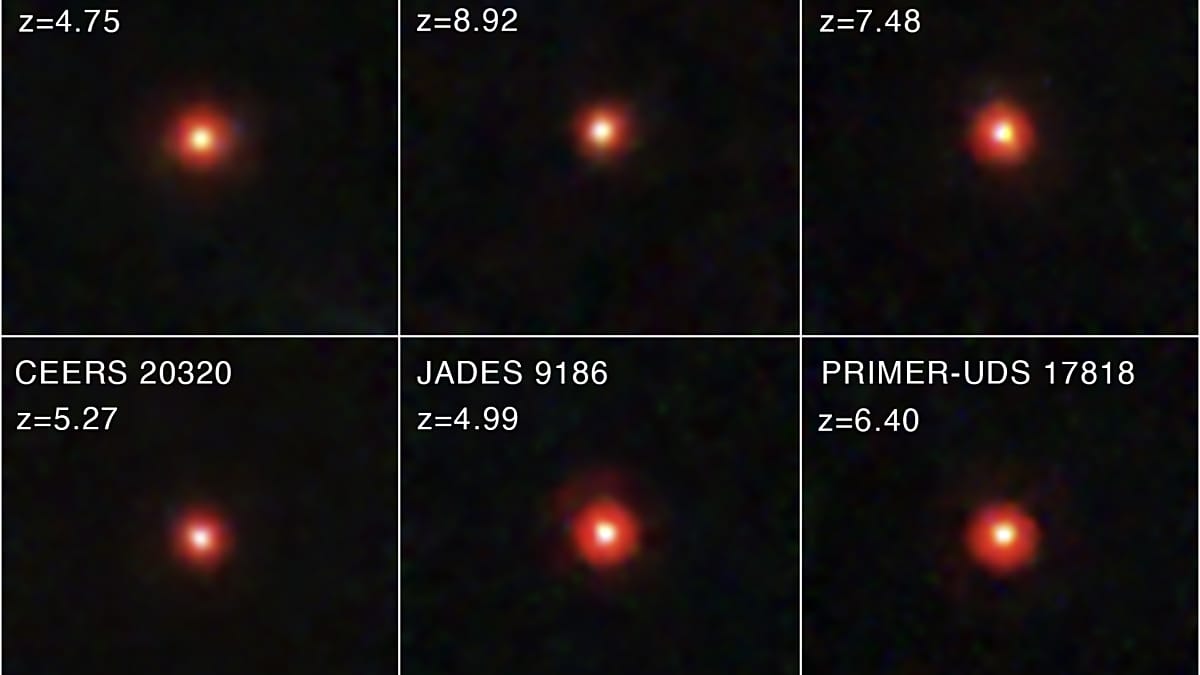
Scientists solve mystery of little red dots seen by James Webb Space Telescope

By staffJanuary 16, 20262 Mins Read
Scientists solve mystery of little red dots seen by James Webb Space Telescope
Share
Facebook Twitter LinkedIn Pinterest Email

Published on
16/01/2026 – 7:01 GMT+1

Astronomers say they have finally figured out the mysterious “little red dots,” first spotted in 2022 in images from NASA’s James Webb Space Telescope.

The objects puzzled researchers because their unusual light made it unclear what was powering them.

Early studies suggest the little red dots are extremely compact, distant galaxies and they were seen at very early times in the universe’s history, which become much rarer as the universe evolves.

The new analysis suggests the red dots are actually young supermassive black holes, a type of gigantic black hole, wrapped in gas.

Using James Webb’s advanced instruments, scientists examined how light from the galaxies is spread across different colours.

They found signs that the light is being scattered by dense, ionised gas, a process that can occur only very close to a black hole that is actively pulling in material.

As gas falls towards the black hole, it heats up and shines through the surrounding cocoon of gas, producing the red glow seen by the Webb Telescope.

The black holes are buried in dense material and therefore emit very little X-ray or radio radiation. This helps explain why they have only been seen by the Webb telescope.

The new study suggests the black holes have masses between about 100,000 and 10 million times that of the Sun.

While still enormous, they are far smaller than scientists previously thought and are the lowest-mass black holes known at such early times in the universe.

The study was published in the journal Nature.

Share. Facebook Twitter Pinterest LinkedIn Tumblr Email

Keep Reading

NASA rolls out Artemis II rocket for historic Moon mission

Astronauts return to Earth after first-ever medical evacuation from International Space Station

Elon Musk’s X will block Grok AI tool from creating sexualized images in places where it is illegal

Level 4 self-driving cars may come to Europe next year, says Nvidia executive

Iran could be blocking Starlink during internet blackout with methods similar to Russia

Malaysia to take legal action against Elon Musk’s X and xAI over misuse of Grok chatbot

US Pentagon embraces Elon Musk’s Grok AI chatbot despite global backlash

Google Gemini to power Apple’s struggling Siri as iPhone maker plays AI catch-up

UK watchdog investigates Elon Musk’s X over sexualised AI Grok images

Editors Picks

Freezing EU–US trade deal ‘inevitable’, Italian MEP Brando Benifei says

January 19, 2026

Hackers target Iran state TV’s satellite transmission to broadcast exiled crown prince

January 19, 2026

European markets drop, gold rises as Greenland tariff threat looms

January 19, 2026

Norway’s PM says Trump sent letter tying Nobel prize snub to Greenland ambitions – POLITICO

January 19, 2026

Subscribe to News

Get the latest Europe and world news and updates directly to your inbox.

Latest News

Trump tells Norway’s PM he has no obligation to ‘think purely of peace’ after Nobel snub

January 19, 2026

Why Starmer is saying Trump is wrong – POLITICO

January 19, 2026

Death toll in Karachi shopping plaza fire rises to 11 as search continues for 60 missing

January 19, 2026
Facebook X (Twitter) Pinterest TikTok Instagram
© 2026 Daily Guardian Europe. All Rights Reserved.
  • Privacy Policy
  • Terms
  • Advertise
  • Contact

Type above and press Enter to search. Press Esc to cancel.