
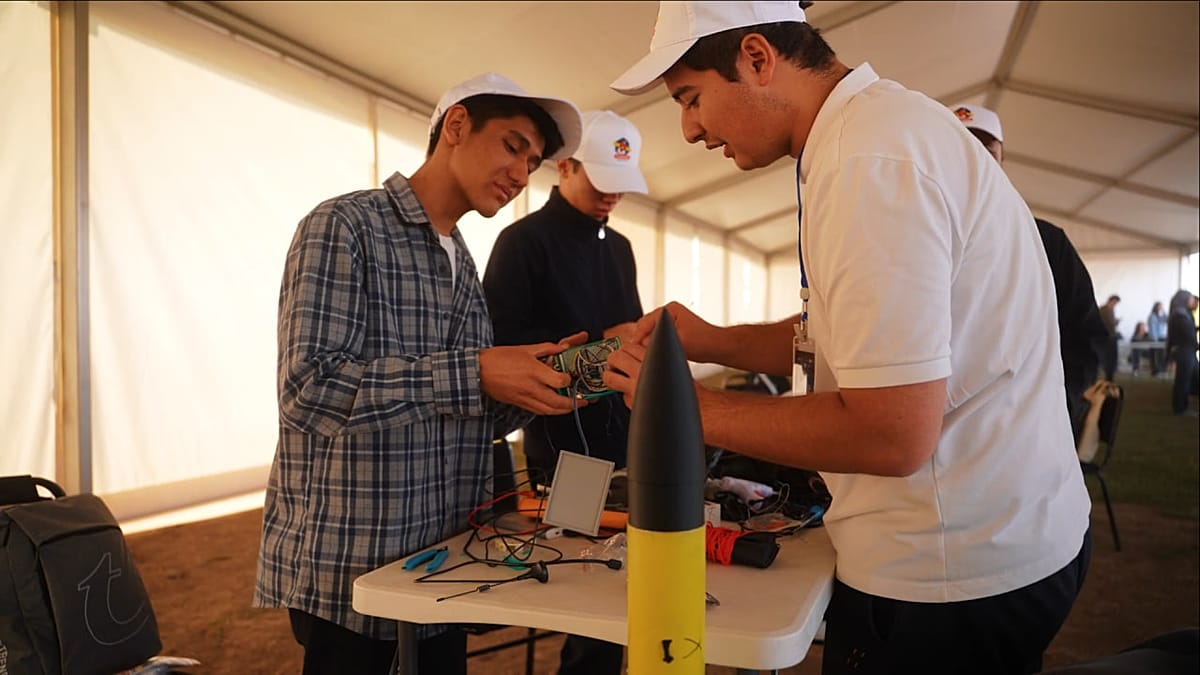
Building a satellite usually takes years, specialist facilities and substantial funding. But at an airfield outside Uzbekistan’s capital, Tashkent, young engineers from 15 countries faced a different challenge: building a miniature satellite model small enough to fit inside a drinks can, then sending it into the sky.
Their creations, known as CanSats, carried sensors, electronics and communications systems designed to collect measurements during flight. Launched aboard rockets and released to descend by parachute, they offered students a chance to put their engineering skills to the test without ever leaving Earth’s atmosphere.
Unlike conventional satellites, CanSats do not enter orbit. Instead, they simulate selected functions of a space mission under real flight conditions.
Teams spent several days assembling electronics, configuring sensors and programming their devices at Turin Polytechnic University in Tashkent before preparing them for launch. The programme brought together 50 international participants and more than 100 students from Uzbekistan.
From design to flight
During the descent, the challenge was to keep the CanSats operating independently while their sensors collected measurements and their communication systems transmitted data to ground stations.
One Uzbek team added a camera to its device alongside sensors measuring temperature and air pressure, attempting to transmit live video during the flight.
“The main challenge here is to make sustainable telemetry. It should connect the ground station and the CanSat itself,” Ahmadkhon Latipov told Euronews.
The devices also stored information onboard, allowing teams to recover data even if communication with the ground station was interrupted.
Baris Beynek, an instructor from Istanbul Technical University, said this reproduces a fundamental part of real satellite operations.
“In the real satellite project, there is a satellite which sends the data to ground station and also stores inside, which we also do,” he said.
After landing, teams recovered their devices and analysed the information recorded during flight. This allowed them to compare their calculations with the actual performance of the electronics, sensors, communications and parachute systems.
According to the organisers, 14 teams competed in the final stage, with Team Nebula taking first place, followed by Pegasus and Sky Lab.
Space skills beyond satellites
The competition formed part of the fifth international CanSat training workshop, organised by Uzbekistan’s space agency, Uzcosmos, the Islamic World Educational, Scientific and Cultural Organization (ICESCO), and Turin Polytechnic University in Tashkent.
Dr Muhammad Sharif, an adviser for science and environment at ICESCO, said the growing use of satellite technology is creating demand for skills beyond traditional aerospace engineering.
He highlighted Earth observation, satellite communications and artificial intelligence, alongside applications in agriculture, food security and climate monitoring.
The programme also puts international teamwork at the centre of the engineering challenge.
“They need to use their own skills, and they need to cooperate with other people,” Beynek said. “In space, international cooperation is the most important thing.”
For Uzbekistan’s space agency, the programme is also an opportunity to train young specialists for the country’s developing space sector.
Muhiddin Ibragimov, Deputy Director of Uzcosmos, said that involving young people in space technology is essential, stressing that even the most advanced projects depend on having the right skills and teams.