
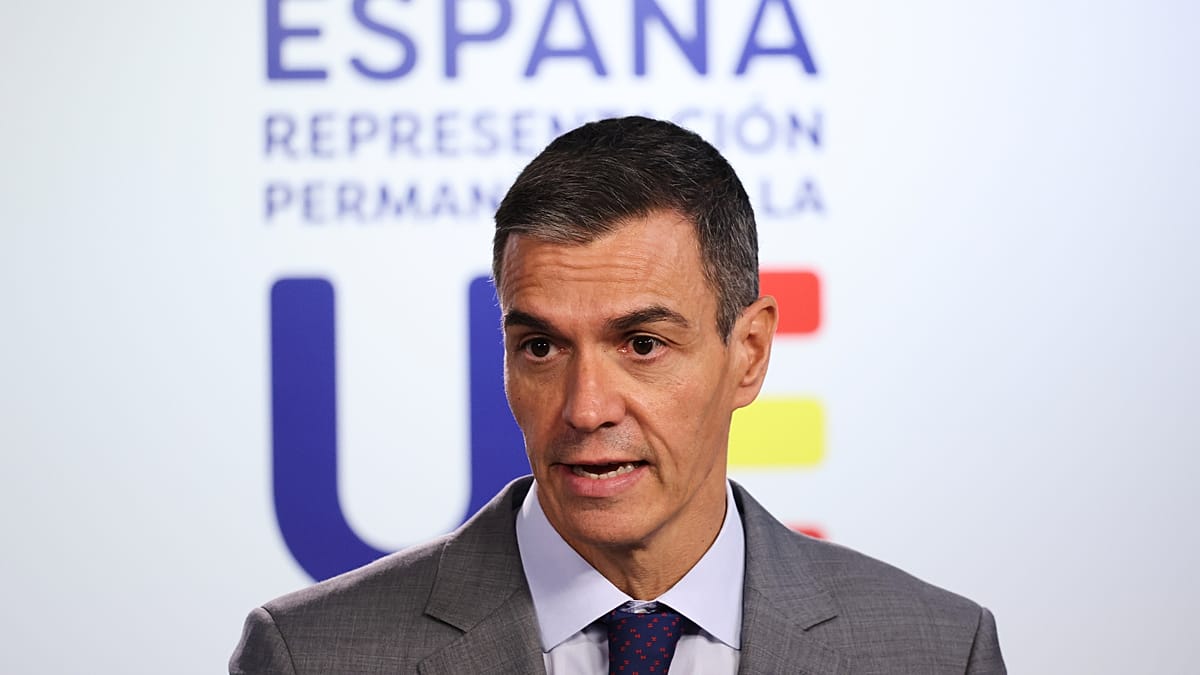
Spanish Prime Minister Pedro Sanchez on Friday rejected criticism from several European leaders over Spain’s migration policy and defended his government’s approach to tackling irregular immigration and managing migration flows.
“If you look at the facts, at the figures – which is kind of always what happens with the far right – it’s like night and day,” he said in Brussels, where he is attending the European Council summit. “What is being said has nothing to do with reality (…) one thing is the blah, blah, blah and another is reality.”
Sanchez was responding to comments by Czech Prime Minister Andrej Babis, Danish Prime Minister Mette Frederiksen and Austrian Chancellor Christian Stocker, who have questioned the Spanish government’s migration policies, particularly its extraordinary regularisation plan for migrants.
Sanchez drew a distinction between his disagreements with the Danish prime minister and the Czech leader’s criticism, which he likened to far-right rhetoric.
“With the Danish prime minister we have disagreements, but indeed, it has nothing to do with what the prime minister of the Czech Republic said, which, by the way, sounds very much like what the far-right Vox says in Spain,” he said.
Babis had accused some European leaders of being willing to “replace the population” to stay in power and warned that his country could tighten border controls to prevent migrants from arriving from other EU countries.
Stocker, meanwhile, described Spain’s regularisation plan as a “bad signal”, arguing that it could have consequences for the EU as a whole. Frederiksen has called on the European Commission to examine the implications of Spain’s measures.
Sanchez points to Spain’s record
In response to the criticism, Sanchez argued that Spain is making progress in controlling irregular arrivals and cooperating with countries of origin and transit.
“The migration and asylum pact that we secured under the Spanish presidency is working,” he said, adding that Spain is “a model pupil” in the fight against irregular immigration.
The prime minister cited interceptions in the Atlantic, returns and refusals of entry at airports as examples of Spain’s migration policy. He also rejected claims that Spain is part of routes used for secondary movements of migrants within the European Union.
“The reality, the data show that Spain is pursuing a very responsible policy in the fight against irregular migration, in managing regular migration flows and in cooperation with transit and origin countries,” he said.
Sanchez also stressed the importance of maintaining a progressive government in Spain, arguing that “because Europe indeed needs a contrast of opinions and political positions”, and urged his European partners to continue implementing the migration and asylum pact.
Von der Leyen calls for stronger external borders
European Commission President Ursula von der Leyen stressed the need to move forward with implementing the EU migration and asylum pact and strengthening cooperation between member states. She noted that irregular crossings of the EU’s borders have fallen by more than 56% over the past two years.
Von der Leyen outlined three priorities for EU migration policy: fully implementing the migration and asylum pact, strengthening the management and protection of external borders, and improving preparedness for potential border crises.
She also announced that the Commission will propose strengthening Frontex, the EU’s border agency, to expand its capacity to support member states when needed. She stressed that responsibility and solidarity must go hand in hand, while acknowledging that more work remains to be done.
“To succeed, it is necessary to continue acting together,” von der Leyen said, as European leaders remained divided over how to manage migration and tackle irregular arrivals.
Some countries push for changes to summit conclusions
Denmark, Poland and Italy pushed for changes to the summit conclusions, including an indirect reference to Spain’s plan to regularise the status of 600,000 undocumented migrants. Spain and France opposed the proposed changes.
A revised draft seen by Euronews urged member states to avoid “measures that may create incentives for illegal migration”. However, the broader wording was ultimately rejected in favour of a shorter, less forceful version.
The draft also called on the European Commission to strengthen coordination between national migration policies that could affect other member states. The proposal, jointly backed by the three countries, was seen as an implicit criticism of Spain’s left-wing government.
Macron backs Spain
French President Emmanuel Macron said after the summit that “ideological divisions” between EU member states over migration were making them “ineffective”, while expressing support for Spain over the Ceuta crisis.
“We have had a bad debate,” Macron said. “My assessment is that when we politicise this debate at the table, we create divisions. And when we are divided and fall back on national solutions, we become ineffective,” he added.
Macron described the Ceuta crisis as a “humanitarian tragedy” and noted that France had not signed the letter sent to Brussels by 22 EU countries.
“Spain was the target of a hybrid attack,” he said, adding: “There was no need to wait until today to know who attacked Spain just after what happened in Ceuta.”