
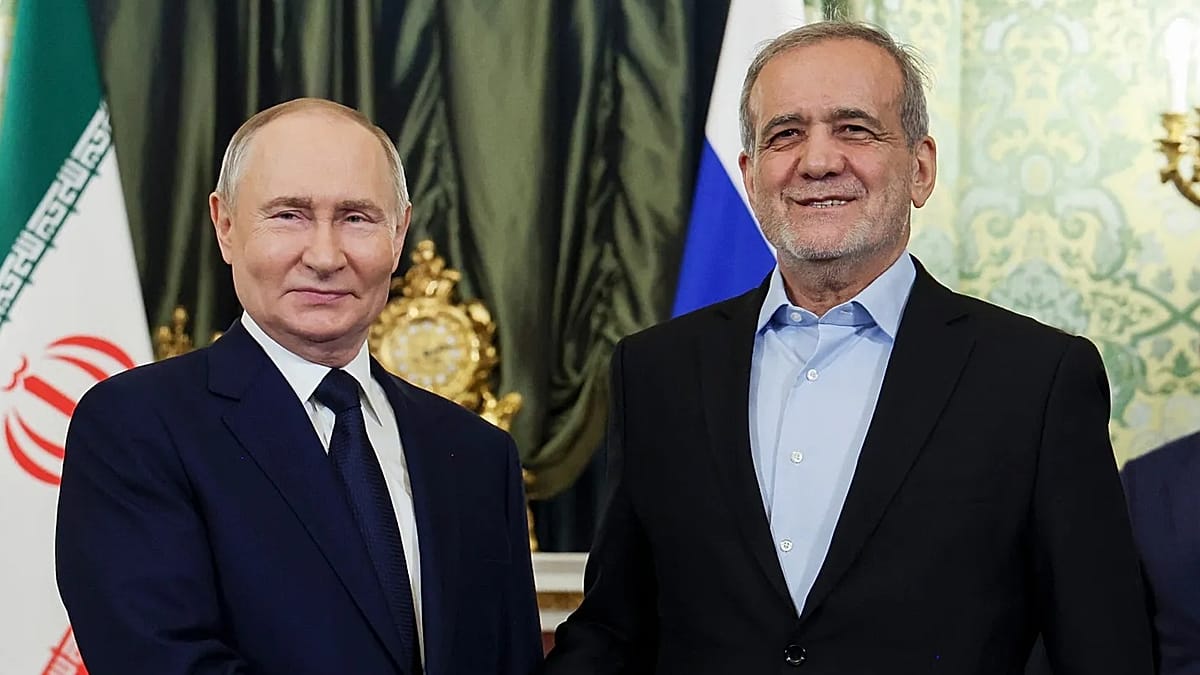
Russia remained largely silent for almost two weeks after mass protests erupted in Iran, with Foreign Minister Sergei Lavrov saying Thursday that “no third party can alter the fundamental nature of relations” between the two countries.
Russian Foreign Ministry spokeswoman Maria Zakharova commented on the situation in Iran — which has been steadily escalating for nearly 20 days — for the first time on Tuesday, blaming what she called the West’s “illegal sanctions pressure” which, in her words, “creates economic and social problems.”
She stated “public tension” is being used “to destabilise and destroy the Iranian state.” Zakharova also repeated the Kremlin’s talking points about “colour revolutions.”
Political analyst Nikita Smagin told Euronews that since protests began, Russia had addressed the issue “very cautiously, in other words, there were very few statements,” and then only at the level of the Russian embassy in Iran.
“This measured response was due to Russia watching the situation and weighing the possibility of a change of regime or other radical shifts,” Smagin said. In her statement, Zakharova “categorically backed” the Islamic Republic, he added.
Smagin noted this reflects Moscow’s conclusion, amid the suppression of protests, that Iranian authorities are not under threat and can therefore be openly supported to further facilitate development of relations between the two countries.
How binding are Moscow-Iran ties?
Moscow and Tehran drew closer after Russia’s full-scale invasion of Ukraine.
Russia and Iran signed a strategic partnership agreement exactly a year ago, whose main pillars are military cooperation and economic cooperation, particularly in energy, as well as efforts to mitigate the impact of sanctions.
Yet Smagin noted that Russia and Iran are not allies in the most straightforward sense. They are better described as strategic partners, given significant mutual distrust and a rapprochement driven by necessity, with both sides having few avenues for engagement on the international stage.
“They operate within this narrow corridor, which makes their relationship fairly stable,” Smagin said. “In fact, economic ties have not grown much since 2022, despite all efforts. Trade turnover figures have changed only marginally.”
Smagin explained there are potential projects to deepen ties, but they are still in the works: preliminary agreements for Russia to build new nuclear power plants in Iran, activation of the North-South transport corridor and construction of a railway line, and Russian investment and participation in the oil and gas sector, including efforts to turn Iran into a gas hub for the transit of Russian gas.
Military cooperation expanding
Since the start of the full-scale invasion of Ukraine, Russia has been using Iranian Shahed drones to carry out strikes on civilian infrastructure. In 2022, the European Union imposed sanctions on officials and the drone manufacturer in Iran.
According to Bloomberg, since October 2021 — several months before the full-scale invasion of Ukraine — Russia has purchased over $4 billion worth of weapons from Iran, including ballistic missiles.
“As for military cooperation, it is indeed expanding,” Smagin noted.
Russia is now producing Shaheds on its own territory, renaming them “Geran-2,” after buying the technology from Iran in 2023.
“Russia has largely localised production of these drones and, beyond that, has begun making its own. The peak of Iran’s importance as a military partner for Russia is long past; it was in 2022 and 2023,” Smagin said.
The dynamic is reversing: Russia is increasingly seeking to supply arms to Iran.
“This includes various types of weaponry such as Su-35 fighter jets and Mi-28 attack helicopters. There is information that the first such helicopters arrived in Iran during the protests,” Smagin explained.
“There are also other categories that are not publicly declared but have surfaced in reports, including Spartak armoured vehicles, electronic warfare systems and radar,” he added.
Iran is becoming an increasingly significant recipient of Russian military exports, but Smagin stressed Russia “has not committed its full capacity in this direction, as it is absorbed by the war with Ukraine and, in that sense, has limited capabilities.”
Despite recent setbacks in Syria and Venezuela, Moscow retains the ability to assist partners in difficulty. In an article for Foreign Policy, Nicole Grajewski, a researcher with the Carnegie Endowment’s nuclear policy programme, noted that in Iran’s case, Russia is not seeking direct intervention but is bolstering the regime’s internal security apparatus.
In an interview with Euronews, Smagin said there are suspicions that Russian electronic warfare systems are helping Iran to jam Starlink or, at the very least, to disrupt the functioning of Elon Musk’s satellite internet service.