
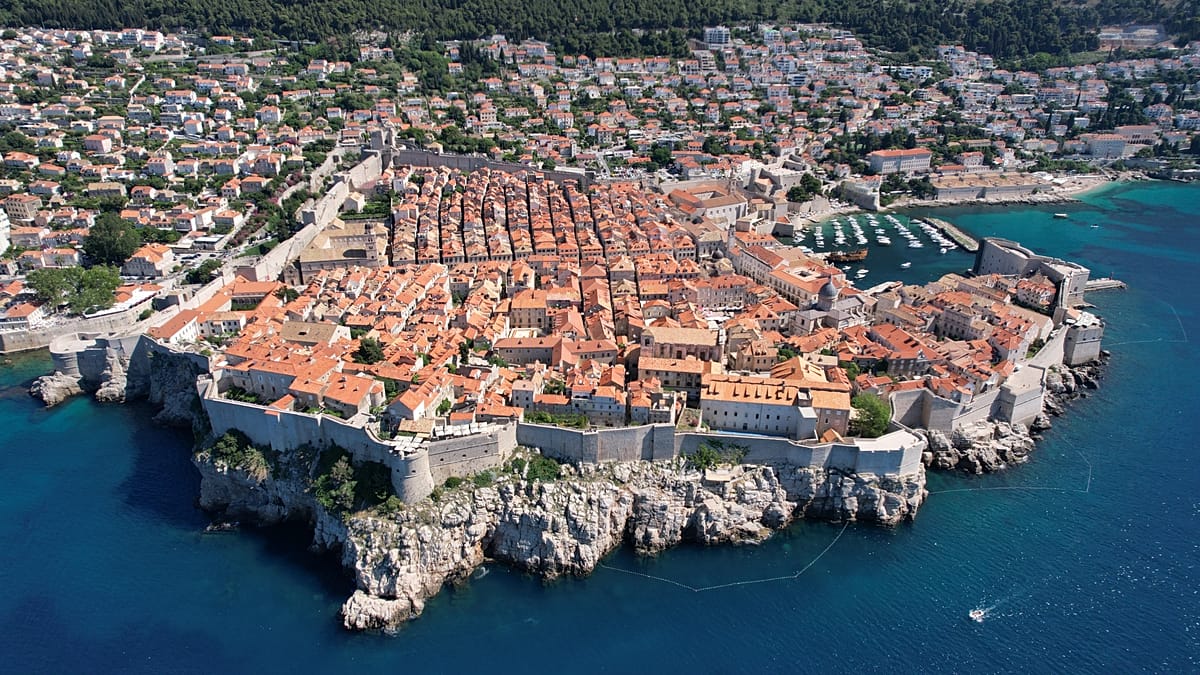
Dubrovnik has spent almost a decade tackling one of modern tourism’s biggest challenges: how to remain a popular destination without being overwhelmed by its own success, especially when popularity shows no signs of slowing down.
Over that time, city officials have shifted focus from responding to crisis-mode overtourism to sustainable management.
From the start of the year until mid-July, the city has already welcomed almost 650,000 arrivals and two million overnight stays. Travellers from the UK, US, France, Germany, Poland, Ireland, Spain, Canada and Australia are among the largest markets so far, with the city also proving popular as a domestic tourism destination.
So, the trouble isn’t attracting visitors. Instead, the city’s leaders are focused on ensuring tourism can grow sustainably while protecting its heritage and preserving locals’ quality of life.
“Here, it’s not just about the numbers,” Mato Franković, Mayor of Dubrovnik, told Euronews Travel. “Also important is how the flow of numbers is spread throughout a day and across the week.”
According to the city’s mayor, tourism once grew with little coordination.
“For years, tourism in Dubrovnik wasn’t managed, it simply just ‘happened’ on its own,” he said.
“Previously, there would be days where five or six cruise ships would arrive at once, bringing with them so many day-trippers from nearby destinations. That’s when we realised we needed to manage tourism differently, so we divided it into different sectors.”
The Dubrovnik native, who has been in the role since 2017, has centred much of his tourism strategy on the “Respect the City” (RtC) initiative, which initially launched that same year in response to the immense strain on the UNESCO-listed Old Town.
“Respect for Dubrovnik is something we ask of everyone: citizens, people working in the city, those who come to enjoy Dubrovnik – this is our message to everyone,” he said.
Balancing popularity with preservation
Throughout the 2010s, the Old Town, which stands as a living stage of Dubrovnik’s history along the Dalmatian coast, bore the immense brunt of the city’s increasing popularity.
Through an influx of cruise arrivals, wallet-friendly flight tickets, and the destination’s global profile boosted by the success of HBO’s Game of Thrones series, this created summers of severe congestion and left the “Pearl of the Adriatic” struggling to cope with peak visitor numbers. “So much so, you could hardly walk or go around to enjoy the city,” Franković told Euronews Travel.
Rather than treating tourism in a catch-all fashion, the Dubrovnik mayor explained that it is instead managed across different sectors: namely cruise tourism, day visitors and overnight stays.
As part of the RtC initiative, no more than two cruise ships can dock at the city’s port at a time with a maximum of 4,000 passengers. Cruise calls must also last for at least eight hours.
By encouraging longer port stays, Franković explained that passengers are more likely to spread their travels across the city and surrounding region, rather than converging on the historical centre all at once.
“We’ve seen that visitors are now choosing to explore more excursions elsewhere,” he said. “Of course, they still visit the Old Town at some point, but the traffic is now not all at the same time, compared to previously when six cruise ships would arrive and dock for just four hours.”
Figures from the Dubrovnik Port Authority show cruise tourism remains resilient, with 2026 expecting to receive more than 661,000 cruise passengers across 461 ship calls by the end of the year.
Beyond cruise tourism, Dubrovnik’s RtC initiative also turns its attention to how day visitors and overnight guests move through the city.
Coach operators bringing visitors from neighbouring Bosnia and Herzegovina, Montenegro and nearby Croatian islands must now reserve arrival slots before entering the city under the bus webshop scheme. The booking system allows officials to stagger arrivals throughout the day and adjust capacity depending on when events are being held and as arrival demand fluctuates.
While for visitors staying longer, the city’s Dubrovnik Pass is both a gateway to sightseeing as well as a visitor management tool. Alongside entry to the city’s museums and granting access to public transport, the pass also allows Dubrovnik to recommend the best times to visit popular attractions.
“Because it’s digitalised, we are able to message visitors with the best times to visit attractions, such as the Old City,” Franković said.
“This is something we are especially working to fine-tune: avoiding situations where hundreds and hundreds of people are walking the city at the same time. We want people to choose the best times so they can enjoy the city with their families.”
Franković also said the city is increasingly relying on data to shape coming policies. People counters have been installed throughout the Old Town to monitor footfall. Tourism data is then shared with and analysed by the University of Dubrovnik to identify trends and recommend further improvements to the city’s visitor management.
What’s next for sustainable tourism?
Despite Dubrovnik’s global appeal, Franković said that there are still corners of the city and its surroundings that remain overlooked by visitors. He said: “There are many areas that are still undiscovered, take Mount Srđ, for example.”
Rising above Dubrovnik, the hills offer sweeping views across the Old Town, Adriatic Sea and surrounding islands, with the AllTrails outdoor activities guide platform recommending hikers to venture out closer to the end of the day to catch the sunset.
Rather than creating new tourist hotspots, the mayor said the city’s priority is encouraging visitors to explore what already exists while improving the overall quality of offerings.
This is also the framework shaping future development plans, as the city earmarks underdeveloped tourism zones to be replaced with affordable housing for locals and residents to sustainably inhabit. A challenge Franković said extends beyond Croatia.
While other cities across Europe also grapple with overtourism, he argued that a broader challenge lies in protecting communities from the influx of too many holiday homes.
“Short-term rentals are killing cities because step by step, they push residents out and turn living neighbourhoods into tourist apartment zones,” he said. “It’s going to be just like a generic Disney-land experience, and who wants to visit a ghost town?
“That’s not what people want – they want to see and meet the citizens. But if we let this continue, our citizens will be forced out of the major cities and into the far away suburbs.
“I hope in the future this won’t continue to be an issue where locals struggle to find good places to live. In fact, there are many villages around us that are now abandoned and they have potential to become great living zones.”
In the Old Town, for example, the permanent population has dropped to just 1,500 people in stark comparison to 1991’s figures of 5,000.
Croatia’s approach has drawn interest elsewhere across the continent and Franković said that European cities are increasingly learning from one another’s experiences, saying that his office collaborates a lot with other regional counterparts.
For the future of the city, his ambition is not for Dubrovnik to necessarily become bigger, but to remain recognisably itself. He said while he looks forward to the country developing a comprehensive, reliable nationwide rail system, he also wants most of its charm to remain intact.
“My hope is that someone will return in 30 years’ time and find the same Dubrovnik. The same beauty, the preserved historical site and clear sea.”