
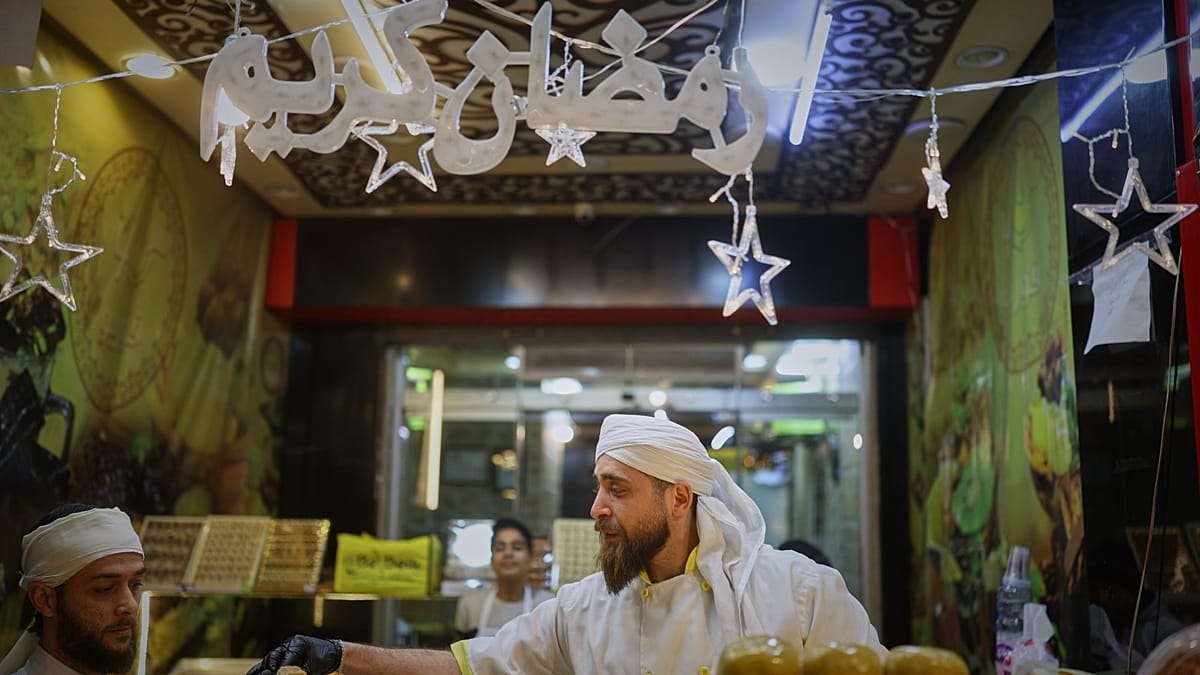
During Ramadan, Syrian generations pass down rituals unlike those found in any other country, with a distinctive flavour in every detail as the scent of incense mingles with the colours of dishes and sounds of traditional songs.
Over the month, daily life turns into a complex work of art, where worship blends with social and sacred traditions that share the stage with a festive, joyful atmosphere.
Although Syrians share the spiritual essence of the month of fasting, every governorate – and indeed every neighbourhood – has its own distinctive stamp that may seem ‘strange’ or ‘quirky’ to some, but in reality reflects the genius of place and the diversity of Syria’s social fabric.
Welcoming the month: ‘Hajjat Ramadan’ and pre‑Ramadan rituals
This unique fingerprint begins to show itself days before the month arrives, in welcoming rituals that are as unusual as they are beautiful. Before the new crescent is sighted, Syrian markets witness an unusual bustle, known locally as ‘Hajjat Ramadan’. It is more than ordinary shopping: a collective buying ritual with a celebratory air, when families stock up on everything they will need for the holy month.
One enduring and rather curious custom is the rush by families to buy new copper cookware or have the old pots polished, in the belief that the gleam of copper brings blessing to the table.
In the Syrian countryside, a tradition now close to disappearing was the ‘whitening of the walls’ a day or two before Ramadan, when women would gather to paint the houses of the neighbourhood with white limewash, convinced that outward cleanliness reflected inner purity in this month. At the same time, traditional lanterns in their familiar shapes would spread through the streets.
The iftar cannon: a blast that unites Syrians despite their differences
Once homes are full of provisions and the walls are decorated, comes the sound that has long united the hearts and clocks of Syrians.
One of the most widespread and carefully preserved rituals is the Ramadan cannon, with its distinctive character.
It was historically fired from the Citadel of Damascus, but after the fall of Bashar al‑Assad’s regime it was fired this year from the slopes of Mount Qasioun.
This ritual dates back to the Mamluk and Ottoman eras. What remains particularly charming is how people interact with it: children race to hear the blast, while older people hurry to set their old watches by it, as if it were the very sound of time itself.
‘Bedna nebayyda’: the yoghurt ritual at the start of Ramadan
On the first days of the month, Syrians do not just listen out for the iftar cannon; they also begin a distinctive food ritual known in Syrian dialect as **’**Bedna nebayyda’ or ‘whitening the table’.
In Levantine popular tradition, this period – the very first days of Ramadan – is one of the most unusual and distinctive culinary rituals: in Damascus and the wider region, families devote the start of the month almost exclusively to dishes cooked with yoghurt.
The Syrian table turns into a spotless white tableau of dishes in which yoghurt is the main ingredient, on a scale seen nowhere else. Hence the popular name ‘Bedna nebayyda’ – literally ‘we want to make it white’ – by making the food white with yoghurt.
During these days, the yoghurt‑based dishes are enormously varied. At the top of the list is the Syrian ‘shakriyeh’, a rich dish combining tender chunks of meat with yoghurt, garlic and mint.
Next comes kibbeh labaniyeh in its many forms, from rolled, spiral kibbeh to fried kibbeh balls dipped in hot yoghurt, and ‘sheikh al‑mahshi’, courgettes or aubergines stuffed with minced meat and pine nuts then carefully cooked in boiling yoghurt.
‘Shish barak’ also has pride of place on the ‘whitening’ table: small parcels of dough filled with meat and cooked in yoghurt with garlic.
What makes this ritual even more striking and beautiful is the advance preparation. Dairy shops in Syrian neighbourhoods experience an extraordinary rush in the days before Ramadan, as families reserve large quantities of both set and fresh yoghurt specifically for the first days.
In some districts of Damascus and Aleppo, families arrange a fixed daily deliveries with the yoghurt seller throughout the ‘whitening’ period, to ensure the white table never falls short.
This popular tradition is linked to inherited dietary wisdom: it is believed that beginning with light, yoghurt‑based dishes after long hours of fasting helps the stomach gradually regain its activity.
Iftar tables: geographical diversity and a distinctive taste
Once the stomach has grown accustomed to yoghurt dishes in the first few days, the Ramadan table widens to include an impressive variety of juices and sweets. No iftar is complete without special drinks, most notably qamar al‑din (apricot juice), jallab, tamarind and liquorice, in addition to fresh fruit juices.
The way sweets are served differs from one Syrian governorate to another. In Homs, tamriyyeh takes centre stage: thin pastries filled with dates or cheese, fried in oil and then soaked in sugar syrup.
In Aleppo, cotton candy with Aleppo pistachios is considered essential on the table. In other governorates, housewives excel in preparing meshabbak, awameh (sweet fritters), qatayef and nahsh (thin pastry filled with traditional Arab clotted cream).
One of the standout Ramadan specialities is ‘ma’arouk’, which appears on Syrian tables in every governorate. It was once seen as the bread of the fasting person and of the poor, baked exclusively in Ramadan. Today its fillings range from custard and Lotus spread to date paste and cream.
Restaurants fast too: first 15 days off for maintenance and upgrades
In striking contrast to the crowds at traditional eateries serving classic Ramadan dishes, modern restaurants follow a completely different pattern during this month. One of the quirky features of Ramadan in Syrian cities is that most modern fast‑food restaurants close during the first half of the holy month.
This seasonal shutdown is not just a pause in business; it has become an annual ritual when these restaurants carry out full maintenance, refurbish their interiors and upgrade equipment in preparation for welcoming customers after Eid.
With demand for fast food falling during Ramadan, as families prefer to break the fast at home or in traditional restaurants, owners have found the first half of the month the ideal opportunity to overhaul their premises.
Curiously, this practice has turned into an unwritten calendar: Syrians know that the first 15 days of Ramadan mean fast‑food restaurants will be closed, and that they will reopen as Eid approaches or once the month has ended. Some young people even save their visits to these restaurants for after Ramadan, waiting for them to return in their new guise.
‘Al‑skabeh’ in Ramadan: sharing food and bringing hearts together
Generosity is not limited to what the housewife cooks for her own family; it extends to neighbours through an age‑old social ritual known as ‘al‑skabeh’.
Considered one of Syria’s most refined social traditions, al‑skabeh is the exchange of dishes between neighbours, especially on Ramadan evenings.
This ritual begins hours before the maghrib call to prayer, when each family prepares a special dish it is particularly good at and sends it to its neighbours via the children or another family member.
Al‑skabeh is not confined to iftar; it also extends to sweets during the nights of Eid, when families exchange plates of maamoul, knafeh and qatayef. A charming detail of this custom is that dishes are returned to their owners washed and decorated with a piece of sweet or a flower, as a token of thanks and appreciation.
Mawaed al‑Rahman: from public banquets to food baskets
One of the most prominent expressions of social solidarity that used to distinguish Ramadan in Syria were the ‘Mawaed al‑Rahman’, the public tables that once stretched along streets and in squares where fasting passers‑by and the poor would gather around a single meal, as if it were a banquet for everyone without exception.
Old neighbourhoods competed to host them, and families vied to donate food, creating scenes that embodied the highest meanings of brotherhood and solidarity.
But like many aspects of Syrian life, these tables have changed form in recent years. With the country’s severe economic hardship and a large part of society now in need, ‘Mawaed al‑Rahman’ are no longer what they once were. In many cases they have shifted from open banquets bringing people together to food baskets discreetly distributed to families in need.
What used to be a joyful scene bringing rich and poor together around the same food has now become a ritual behind closed doors, with charities and neighbourhood initiatives taking charge of distributing food parcels directly to people’s homes. The giving has not disappeared, but its form and rituals have changed, leaving a gap in the public Ramadan scene.
Evenings and visits: nights that never sleep
Once stomachs are full and dishes have been exchanged between homes, Ramadan evenings continue late into the night. In Syria, going to bed early during Ramadan is not considered socially acceptable. The tradition still holds that families gather in the home of the eldest relative until the pre‑dawn meal.
With rapid technological development, the musaharati has almost disappeared from the Ramadan scene, after his voice once brought a special joy to the old quarters. He was the man who roamed the streets at night carrying his small drum, chanting popular rhymes – the most famous being ‘Ya naim wahhad al‑da’im… irham man nam wahajjad aynayh’ – to announce that the time for suhoor was drawing near.
The musaharati, who woke people up for suhoor, was usually a volunteer seeking divine reward before people’s thanks.
But with the spread of electronic alarm clocks and smartphones, and changes in lifestyles in major cities, the musaharati has gradually disappeared and now survives only in a few working‑class neighbourhoods or in Ramadan television dramas that evoke the past.
As the month of fasting draws to a close, the lively tone of evening gatherings softens and the sounds of spiritual retreat rise in historic mosques such as the Umayyad Mosque in Damascus and the Great Mosque of Aleppo.
Yet through all these changes, Syrian Ramadan rituals remain remarkably resistant to extinction: they are not mere habits, but a moral shield that helps Syrians withstand the harshness of the reality in which they live.