
By Alima Assylbek
Published on
Across Kazakhstan, tattoo studios are seeing a noticeable rise in requests for traditional Kazakh ornaments. These motifs, originally meant to protect households and ward off evil spirits, have found new lease of life across fashion, branding, architecture, and urban design.
National patterns have become part of corporate identities and contemporary visual culture, reflecting a broader revival of cultural heritage. To these traditional spheres of use, another has now been added – tattooing.
And if once ornaments were woven into fabric, carved into wood, or engraved in metal, they are now increasingly becoming part of yet another surface – the human body.
When demand turns into rediscovery
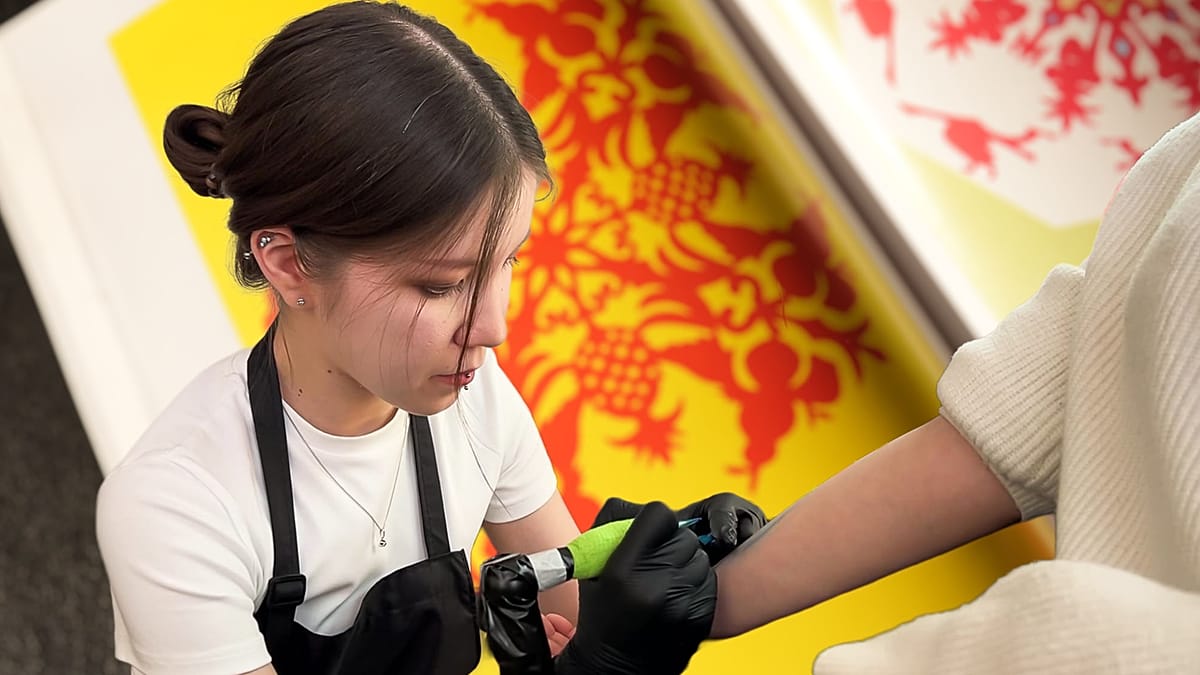
Sabina Sabyrbayeva’s career in the tattoo industry began in 2019. In recent years, she has noticed a clear shift in client preferences.
“Demand creates supply. When more clients began asking for them, I felt the need to study the subject more deeply,” she says.
The first ornament Sabyrbayeva tattooed was koshkar muyiz (ram’s horn) an ornament that symbolises strength, prosperity, and protection. A young woman came with the idea of placing it on her chest, and the tattoo artist gladly embraced the challenge.
“Zoomorphic ornaments are requested most often – symbols associated with strength, freedom, harmony with nature, love, and well-being. Among them are koshkar muyiz, kus kanat (bird’s wings), and kusmuryn (bird’s beak),” the tattoo artist explains.
The interest extends beyond locals. One tourist, before leaving Kazakhstan, chose to tattoo kus kanat on his calf. As Sabyrbayeva explains, he wanted to carry a fragment of the country’s culture with him.
A personal choice: Ornaments as a form of self-expression
For Alua Sadbekova, getting an ornamental tattoo was a conscious decision. She chose kus kanat, a motif symbolising freedom, upward movement and aspiration.
“I spent a long time choosing the design. Back in school, when we studied traditional ornaments, this particular motif caught my attention. I think this tattoo fully reflects who I am and the path I am on,” she explains.
According to her, many young people today are becoming more interested in their cultural roots. At the same time, traditional ornaments appear minimalist and contemporary, which makes them especially appealing.
For Sadbekova, however, aesthetics came second.
“I chose it for its meaning. Freedom is essential to me. Yes, the ornament is beautiful, but what matters most is what it stands for,” she says.
The enduring journey of Kazakh ornaments
The Kazakh ornaments, first recorded in written sources at the beginning of the 16th century, represent a remarkable layer of cultural heritage of the nomadic peoples of the Great Steppe.
A defining feature of Kazakh ornament is its flowing lines and curved patterns reminiscent of animal horns or waves.
Zoomorphic motifs (horns, wings and hooves) represented strength and prosperity. Floral elements reflected ideas of fertility, while geometric forms such as diamonds, circles and zigzags were associated with protection and harmony.
Cosmological signs, including spirals, crosses and circles, referred to the sun, the earth and the concept of an eternal cycle of life.
Ornaments accompanied people throughout their lives. They decorated clothing, carpets, felt pieces, wooden and metal utensils.
Patterns appeared in the interior of the yurt, on weapons and horse harnesses, signaling status and, according to nomadic beliefs, serving a protective function, warding off evil spirits and attracting good fortune.