
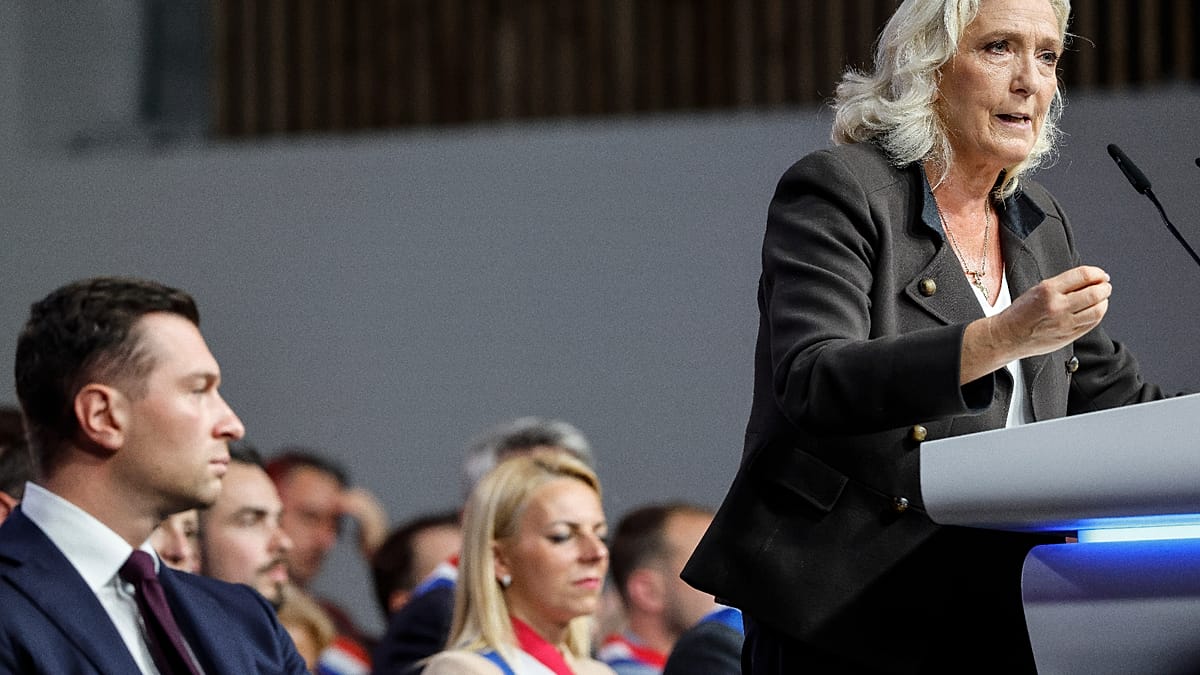
Marine Le Pen, leader of the far-right National Rally, is seeking to become France’s next president on a hardline anti-EU platform, pledging to cut the country’s contributions to the EU budget and end funding for Ukraine.
On Ukraine, Le Pen has repeatedly pledged to end financial assistance. Speaking to reporters in Brussels on Wednesday, she said that if elected, France could only sustain funding for six months because of the “perilous” state of its public finances.
“This funding will stop, and it is a matter of honesty to tell [Ukrainian President Volodymyr Zelenskyy] the truth,” she told Euronews.
Zelenskyy hit back in an interview with the Financial Times on Thursday. “The price to pay is not as high as the value of people’s lives,” he said. “That is why I think Ms Le Pen is not fully familiar with certain details.”
He added that, if Le Pen were elected president, she should have access to “the most powerful European system that works”, stressing that Ukraine’s battlefield experience could benefit European countries.
Le Pen has also called for an end to EU sanctions against Russia, while saying France could continue training Ukrainian troops and supplying military equipment to Kyiv.
Her comments signal that Le Pen is prepared to take a hardline stance, pledging to end French funding for Ukraine in a position similar to that of US President Donald Trump.
Her stance also contrasts sharply with that of Italian Prime Minister Giorgia Meloni, who is often compared to Le Pen but has advocated continued support for Kyiv.
Speaking in the Italian Senate on Wednesday ahead of an EU summit in Brussels, Meloni delivered a forceful defence of Ukraine’s right to self-defence.
“Supporting Ukraine is not an alternative to peace, it’s what makes it possible,” Meloni said. “The peace we want is one that is sustainable, just and also safeguards Europe and our interests.
“Therefore, the position of this government will not change: support for Ukraine, pressure on Russia and Euro-Atlantic unity.”
‘France’s support for Ukraine goes far beyond aid’
“France’s support for Ukraine goes far beyond aid alone. It is primarily diplomatic,” Elie Tenenbaum, director of the French Institute of International Relations’ Centre for Security Studies, told Euronews.
He highlighted France’s leading role in initiatives such as the Coalition of the Willing, launched alongside the United Kingdom, as well as other mechanisms that “help keep Ukraine afloat”.
These include the €90 billion Ukraine Support Loan (USL), whose implementation and disbursement depend on the political backing of major countries, including France.
Tenenbaum stressed that cuts to EU-level funding would have a greater impact on Ukraine than a reduction in France’s bilateral aid.
“If France were not only to stop providing bilateral aid and contributing to the EU budget, but also to actively oppose these kinds of mechanisms, then the entire framework of European assistance to Ukraine would be put at risk.”
According to figures from the German think tank Kiel Institute, France has committed an estimated €27 billion to Ukraine since Russia launched its full-scale invasion in February 2022. This includes €7.9 billion in bilateral aid and €19 billion through European mechanisms.
Germany remains Europe’s largest provider of aid to Ukraine in absolute terms, having pledged more than €50 billion since February 2022, well ahead of France, Italy and the Netherlands. Relative to GDP, however, Denmark and Estonia provide the highest levels of bilateral aid.
Cutting France’s contributions to the EU budget
With six months to go before France’s presidential election, Le Pen is campaigning on a platform centred on tighter immigration controls, greater national sovereignty and measures to tackle the cost-of-living crisis, as rising fuel prices fuel public discontent.
Her party has backed capping France’s net contribution to the EU budget at €5 billion a year, down from €8 billion, according to figures published by the French Senate. Such a move would mark a departure from recent years, during which France’s contributions have generally increased, despite annual fluctuations.
Under President Emmanuel Macron, France has backed a larger EU budget, unlike countries such as Germany, which favour tighter spending limits. Paris has also called for new EU own resources, meaning additional sources of revenue beyond member state contributions.
Although France is a net contributor to the EU budget, it also receives substantial funding for its farmers through the Common Agricultural Policy (CAP).
“France stands out among the major contributors as it is the only one that has so far supported an ambitious EU budget,” Eulalia Rubio, a senior research fellow at the Jacques Delors Institute, told Euronews.
She said Le Pen’s proposals reflected a “lack of understanding” of EU institutions.
“Spending varies slightly every year, so you can’t say, ‘We’re only going to pay €5 billion every year from now on’,” she commented.
Rubio warned that if France overcame the legal obstacles to cutting its contributions, other member states would have to make up the shortfall. Such a prospect could prove particularly contentious given that France is the largest recipient of farming subsidies.
On Wednesday, France’s National Assembly rejected the National Rally’s proposal to unilaterally reduce the country’s contributions to the EU budget for 2027, instead backing the government’s planned level of funding.
Thierry Chopin, an adjunct professor of European studies at Sorbonne University, said a National Rally victory could mark a break with France’s traditional role as a driving force within the EU and with the “intellectual contributions championed by Paris” in recent years, which had gained traction in response to global events.
Chopin pointed to France’s role in promoting European sovereignty, strategic autonomy in defence and trade protection measures. However, he said France’s influence had waned during Macron’s second term as its economic credibility declined.
“This credibility was not particularly strong to begin with, but it has worsened given the country’s budgetary situation, public debt and the difficulties facing its public finances. And then, once again, there are political considerations, because the executive branch has been weakened,” he said.
EU budget for 2028-2034
Speaking to the Financial Times on Wednesday, Le Pen described efforts to reach an agreement on the EU’s 2028-2034 budget by the end of 2026 as “anti-democratic.”
She accused the European Commission of undermining “democratic processes” by advancing the budget ahead of elections in France, Spain, Italy and Poland.
Ahead of the vote, Macron has moved to secure key positions, including at the central bank, by appointing allies. On Thursday, the French president told EU leaders during a closed-door meeting that Paris favours reaching a deal this year.
Beyond the timeline, Le Pen is also focused on the substance of the EU budget. Speaking to reporters on Wednesday, she said she hoped to “build new coalitions” with like-minded parties to challenge what she described as an anti-growth mindset in Brussels.
She also suggested that the European Central Bank (ECB), led by Christine Lagarde, should revise its mandate to give greater weight to economic growth. The ECB is independent and its primary mandate is to maintain price stability.
Experts told Euronews they are sceptical that member states would support another major overhaul of EU fiscal rules following the sweeping reform of the Stability and Growth Pact in 2024.
“In my view, member states show little appetite for another major reform,” Andreas Eisl, a senior research fellow in European economic policy at the Jacques Delors Institute, told Euronews.
He added that “future changes are likely to involve reinterpretations of the existing rules rather than a fundamental overhaul of their legal foundations”.
Le Pen has repeatedly criticised EU regulations and standards, describing them as “regulatory hell” or a “regulatory shantytown”, and has pledged to strip them back to the bare minimum. Such an approach could undermine the bloc’s legal framework if adopted across member states.
“Obviously, if every member state does this, the EU can no longer function as a union based on the rule of law,” Chopin said.
The National Rally leader has also vowed to “stop” the European Green Deal, the EU’s flagship programme to cut emissions and achieve climate neutrality by 2050.
Le Pen argues that the Green Deal undermines economic growth. She has also proposed abolishing institutions such as the European Committee of the Regions (CoR), an advisory body representing local and regional authorities involved in implementing EU policies, including climate measures.
“The dismantling of the European Green Deal is already underway. If Marine Le Pen were to be elected, this would only be further accentuated, according to certain analyses,” Phuc-Vinh Nguyen, head of the Energy Centre at the Jacques Delors Institute, told Euronews.
Maria Tadeo contributed to this report