
Good morning from Brussels. I’m Mared Gwyn, writing from the early hours of Friday morning after marathon talks among EU leaders last night.
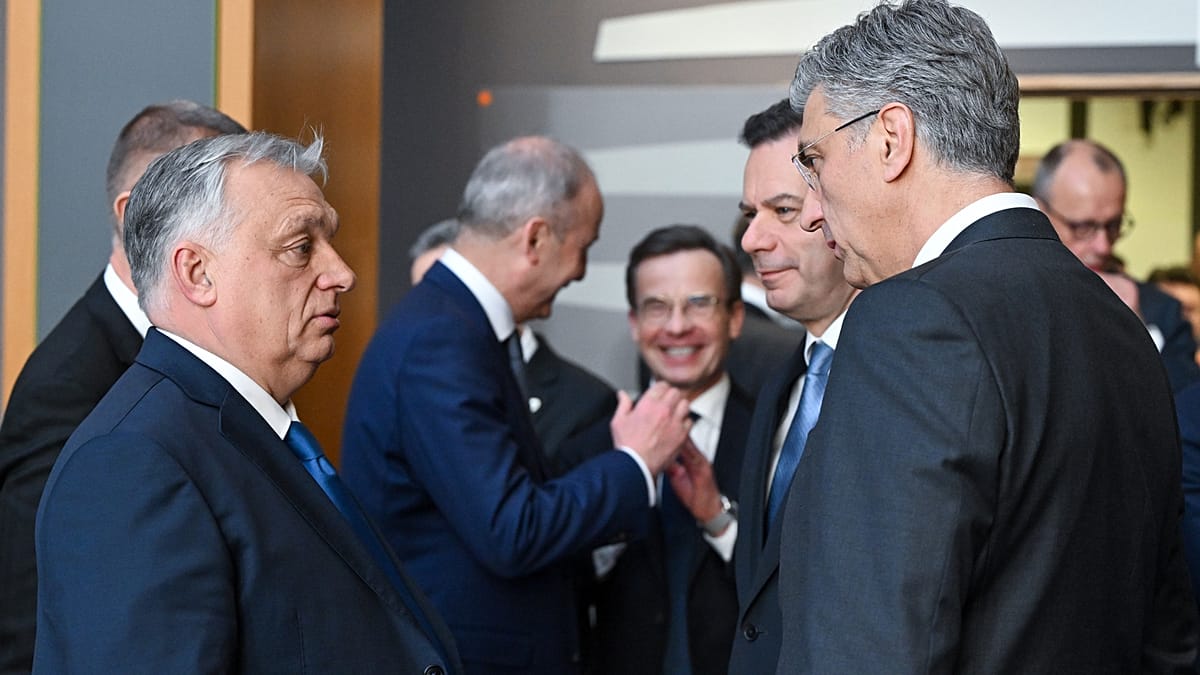
Fury over Viktor Orbán‘s decision to veto the European Union’s €90 billion loan for Ukraine burst into the open on Thursday, my colleague Jorge Liboreiro reports from the European Council this morning, as leaders castigated, in the harshest terms yet, the “unacceptable” behaviour of the Hungarian Prime Minister.
To recap: Orbán held firm on his veto on the EU’s Ukraine loan last night in protest over the disruption of the flow of cheap Russian oil via the Druzhba pipeline. Kyiv says it was damaged late January in a Russian drone strike, but Orbán insists it is due to sabotage.
Jorge reports that António Costa, the usually mild-mannered president of the European Council, led the criticism of Orbán with a sharp-worded warning, saying: “Nobody can blackmail the European Council. Nobody can blackmail the European Union institutions.”
Separately, Costa praised Ukraine’s efforts to repair the Druzhba pipeline and allow an EU-led inspection on site in line with demands by Hungary and Slovakia just days before the summit. The inspection took place despite the fact that President Volodymyr Zelenskyy said he was personally against reinstating transit of Russian oil through Ukraine as the war continues, in order to avoid further boosting Putin’s warchest.
A diplomat said that the discussion between leaders in the room was “fiery”, with Costa criticising the rhetoric coming from both Orbán and Zelenskyy in recent weeks as the dispute escalated. But Costa also noted that Hungary is putting impossible conditions on the table, such as ensuring the safety of oil transit, while Russia keeps pounding Ukraine with missiles and drones.
Orbán is said to have been pacing the room exhaling sharply, as all other leaders remained in their seats, while Zelenskyy addressed the room via video-conference to provide an update on the situation in Ukraine.
Speaking as he departed the summit, Orbán again repeated his suggestion that the Druzhba disruption is an intentional effort to put pressure on him as he campaigns for re-election after 16 uninterrupted years in office. “The European institutions, including parts of the Commission and the European Parliament, would like to have a change of government in Hungary. And they finance it,” he said.
With no Plan B to fund Ukraine, the EU now realistically faces two ways out of the deadlock. It either ensures Russian crude flows again into Hungary and Slovakia – a task Zelenskyy says could take between four and six weeks – or the dispute is solved at the ballot box when Hungarians head to the polls on 12 April.
Although opinion polls show Orbán trailing Magyar by double digits, he could still win as the gap narrows ahead of the vote, which would prolong the veto even further.
Speaking exclusively to Euronews’ EU editor Maria Tadeo while the leaders gathered on Thursday, Ukraine’s finance minister Serhiy Marchenko lamented Budapest’s veto, saying this was “definitely not welcome news from Brussels” but that he was “confident that sooner rather than later we will secure this loan.” Watch.
Jorge has this long read with all the details on how things went down last night.
The other war raging in the Middle East was also a hot-button issue at the summit, with leaders urging “de-escalation and maximum restraint” and a “moratorium on strikes against energy and water facilities”.
The gathering came just after Iran struck key energy sites across the Gulf, including the Ras Laffan export facility for LNG In Qatar, in response to Israel’s attack on the South Pars natural gas field, putting immense pressure on global supply and sending natural gas prices soaring by 30%. QatarEnergy’s CEO, Saad Sherida al-Kaabi, said on Thursday that Belgium and Italy would be affected, as the company is no longer able to fully fulfill its contractual production obligations.
Speaking at the summit, Commission President Ursula von der Leyen announced “temporary, tailored, and targeted” measures to help curb rising electricity prices, suggesting member states use state aid measures to offset the cost associated with an energy source. She will also propose lowering the tax rate on electricity to ensure it is lower than that on fossil fuels — currently, electricity is taxed much higher than gas.
There was also broad agreement on keeping the EU’s carbon pricing scheme – the Emissions Trading System (ETS) – despite a group of member states having lobbied to undo the scheme, claiming it puts extra pressure on strategic EU industries.
While the 27 heads of state and government agreed that navigation through the Strait of Hormuz should be urgently restored, they said the deployment of a naval mission, as requested by US President Donald Trump, should happen “once the conditions are met.”
Five European countries — France, Germany, Italy, the Netherlands and the UK — along with Japan said yesterday they were ready to “contribute” to “appropriate efforts” to ensure safe passage through the Strait of Hormuz and would take additional measures to stabilise energy markets. While it’s not clear what those efforts could entail, no direct intervention in the Strait is expected until after a ceasefire.
‘Iran war is Europe’s war’, says former Trump security advisor
Europe’s stance on the Iran war risks US President Donald Trump walking away from the conflict in Ukraine, his former national security advisor, John Bolton, has told Euronews, criticising the EU’s reaction to the situation in the Middle East.
Bolton, who also previously served as the US’s ambassador to the UN, branded the Iran conflict as “Europe’s war,” despite EU nations distancing themselves from the conflict which they say they did not choose or start.
“Europe is just as much, if not more, at risk from nuclear attacks if Iran gets nuclear weapons,” Bolton told our EU editor Maria Tadeo. “It has the missile capability to hit Central and Eastern Europe – not the United States.”
He warned that EU leaders could be handing an “invitation” to Trump to decide that “Ukraine is not America’s war,” branding the lack of political will across the bloc to partake in the war on Iran as a “mistake”.
Watch the full interview.
Europe must end diplomacy and push for change in Iran, says Israeli UN ambassador
Israel’s ambassador to the United Nations in Geneva has criticised Europe’s tentative approach to the Iran war, calling for a harder response as the conflict spreads across the Middle East.
Speaking to Euronews while EU leaders met in Brussels, Daniel Meron said: “We hear a lot of calls on diplomacy from the Europeans, but I think this is not the time for diplomacy, this is a time to really end diplomacy and to start seeing a change in Iran.”
His stance echoes that of US President Donald Trump, a staunch ally and defender of Israel, who has been a vocal critic of European countries’ perceived inaction during the war on Iran.
Watch the full interview.
More from our newsrooms
Ukraine may restart peace process as Iran war escalates and EU aid remains blocked. Ukraine is preparing to resume peace talks with the US, even as Moscow gains from eased American sanctions and soaring energy prices, and Kyiv faces the potential loss of EU aid for the first time. Sasha Vakulina has the story.
‘It was the decision of one oligarch’ – Bulgarian PM Gyurov walks back Board of Peace participation. Bulgaria’s caretaker Prime Minister Andrey Gyurov told Euronews that joining President Trump’s Board of Peace was the result of “one oligarch’s decision” and does not reflect the political consensus in the country. Watch.
Europe’s fertiliser crisis: prices surge due to Iran war and dependence on Russia .The fertiliser market is facing a double crisis: the Iran war is driving up prices, the Strait of Hormuz is blocked – and at the same time it is becoming clear how dependent Europe still is on Russian supplies. Maja Kunert has more.
That’s it for today. Jorge Liboreiro, Marta Pacheco, Maria Tadeo and Sasha Vakulina contributed to this newsletter. Remember to sign up to receive Europe Today in your inbox every weekday morning at 08.30.