
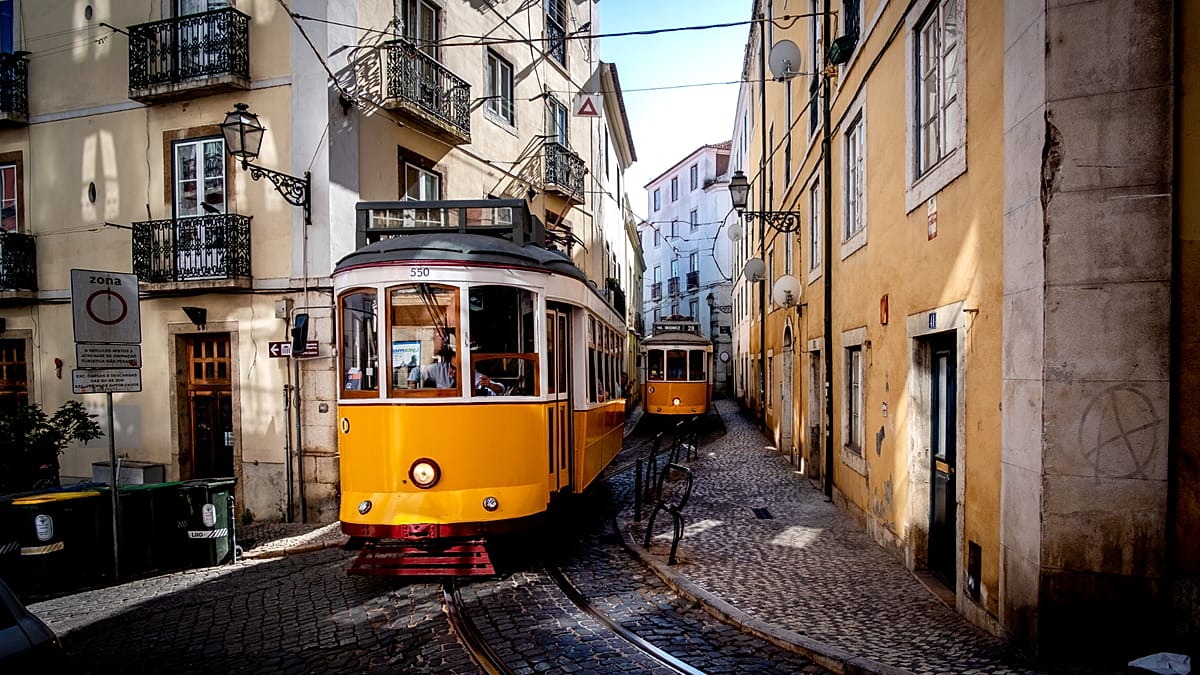
A home is more affordable relative to local incomes in Paris and London than in Lisbon.
Portugal has spent years marketing itself as one of Europe’s great success stories: sunshine, safety, a booming tourism industry and an enviable quality of life. But behind the postcard image lies one of the continent’s most stretched housing markets.
A home in Lisbon now costs about 18.7 times a typical household’s annual income, according to the latest figures from data platform Numbeo.
Among Europe’s major cities, only the Croatian coastal city of Split matches it.
10 cities with the highest price-to-income ratio in Europe
The price-to-income ratio is one of the most widely used measures of housing affordability.
It compares the cost of buying a typical home with the income of an average household, showing how many years of earnings are needed to purchase a property.
The higher it climbs, the further homes drift out of reach for those who earn local wages.
As a rule of thumb, a ratio above 10 already signals a problematic market for buyers, according to ABN AMRO senior housing economist Mike Langen. The threshold is based on standard mortgage lending rules that limit housing costs to around 30% of household income and typically cap loan terms at 30 years.
Against that benchmark, Lisbon and the Croatian city of Split top the ranking, each posting a price-to-income ratio of 18.7, almost double the level considered problematic.
They are followed by Prague, Milan and Tirana (18.1), Vienna (17.4), Belgrade (17.2), Paris (17.0), London (16.0) and Brno (15.8), highlighting how home ownership has become increasingly out of reach across many of Europe’s largest cities.
Yet Portugal’s capital offers one of the clearest examples of how house prices can pull away from local purchasing power.
The country’s sharp divergence between house prices and wages over the past decade helps explain why Lisbon now ranks among Europe’s least affordable housing markets.
Portugal: House prices rise 240%, wages up 59%
Over the past 10 years, Portuguese house prices have risen by almost 240%, according to Global Property Guide data.
Over the same stretch, the average Portuguese wage climbed from about €839 a month to €1,333, a gain of roughly 59%.
Prices rose four times faster than incomes. And in Lisbon, that gap could be even wider than the national average.
A flat in central Lisbon costs about €6,763 per square metre. That puts a modest 50-square-metre apartment at roughly €338,000.
Set against an average net salary of around €1,416 a month — about €17,000 a year — that is close to 19 years of pay, before a single euro goes on anything else.
Why housing prices keep rising in Portugal
The common explanation is often simple: not enough homes.
The warnings are no longer coming only from market data.
In its 2026 economic survey, the OECD judged Portugal to be among the countries with the least access to housing in the developed world, citing regulatory barriers, a weak rental market and housing supply that responds slowly to demand.
Young people, the institution stressed, are hit hardest.
The country is building far fewer homes than it needs. Portugal currently completes around 25,000 to 30,000 homes a year, while industry groups and public estimates suggest the country needs roughly 45,000 to 50,000 annually to meet demand.
And Portugal devotes only around 2% of its housing stock to social housing, among the lowest shares in Europe.
But research suggests the story is more complicated.
In its latest Housing Market Monitor, ABN AMRO indicated that income growth and lower mortgage rates have historically had a much greater influence on house price appreciation across Europe than population growth or construction shortages.
A crisis spilling onto the streets
The housing crunch has fuelled Portugal’s biggest wave of housing protests in decades. Since 2023, the Casa para Viver (“Homes to Live In”) movement has brought tens of thousands onto the streets across the country under the slogan “Já não dá” — “It’s just not working anymore.”
Campaigners are calling for tighter rent controls, more affordable housing and the use of vacant buildings, arguing that access to housing is a constitutional right.
The crisis is perhaps most visible on Lisbon’s outskirts, where families in informal settlements such as Talude in Loures face eviction despite many working full-time and still being unable to afford market rents.
For Jaime Luque, a member of the European Commission’s Housing Advisory Board, the consequences extend beyond the property market.
When teachers, nurses, police officers, young professionals and students can no longer afford to live in a city, he argues, that city begins to lose its economic competitiveness.
Is Portugal’s housing bubble about to burst?
Despite mounting affordability pressures, few economists expect an imminent housing crash.
A bubble implies prices have become detached from underlying fundamentals and are vulnerable to a sharp correction.
Banco de Portugal warned in its May 2026 financial stability report that supply shortages continue to push prices up, but it also credits strict lending limits with keeping risky borrowing — the usual trigger of a housing bust — in check.
BPI Research recently raised its forecast for Portuguese house-price growth in 2026 to 11.7%.
Portugal still benefits from structural demand, relatively limited supply and continued international interest.
In other words, Portugal’s housing market may be exceptionally expensive without necessarily being in a classic speculative bubble.
However, affordability metrics are flashing warning signals.
A price-to-income ratio approaching 19, combined with house prices rising roughly 240% over a decade while wages increased by only 59%, suggests valuations have become increasingly difficult to justify using domestic incomes alone.
That does not guarantee prices will fall.
But it does suggest Lisbon has become one of Europe’s least affordable housing markets, with the gap between property prices and local incomes wider than at any point in recent decades.