
By Euronews
Published on
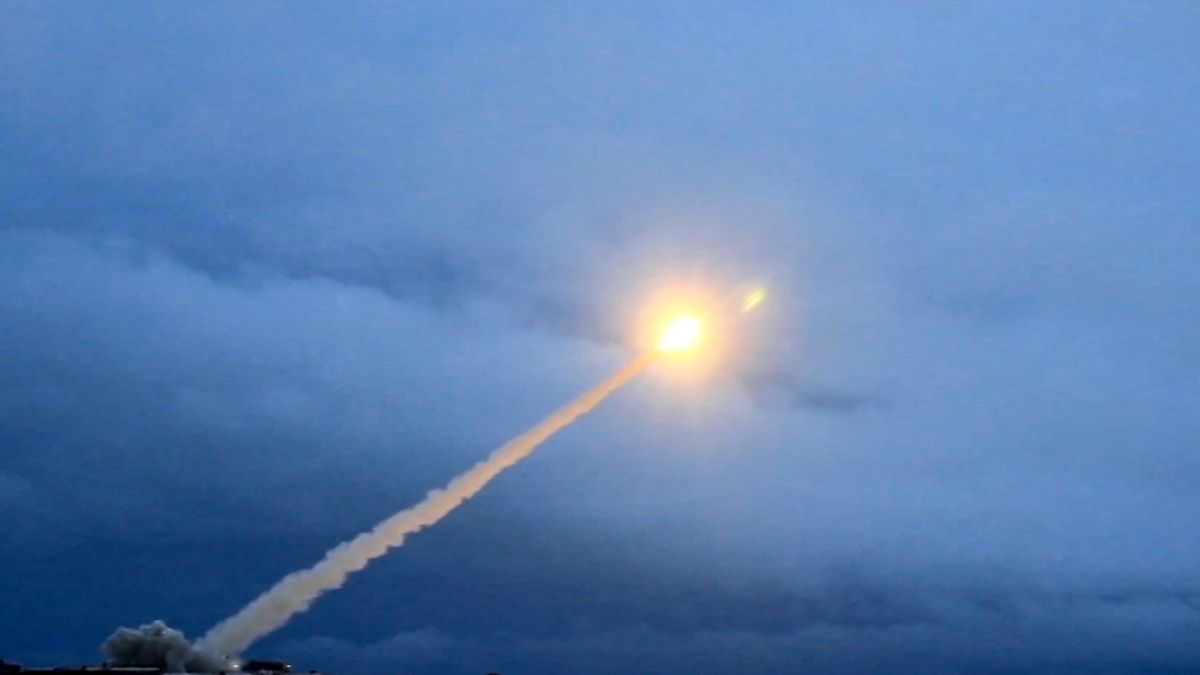
Vladimir Putin’s new super weapon “Petrel” has apparently been finalised. The nuclear-capable missile is said to be able to stay in the air for hours, avoid defence systems and pose a potentially serious threat.
This assessment is supported, at least in part, by Western intelligence analyses.
A fully operational Burevestnik would be a major problem for Europe. If Russia is indeed deploying the system, NATO would face a new and very hard-to-control risk. According to a classified NATO document:
The super-weapon is considered particularly worrying. The paper refers to a nuclear-powered cruise missile, “Burewestnik” (“Petrel”), known to NATO as the SSC-X-9 Skyfall.
The document comes from the intelligence department of the military alliance, according to Die Welt. It examines Russia’s updated arsenal of strategic nuclear weapons.
Three weeks ago, Russian Presiident Vladimir Putin publicly announced successful tests of the missile.
According to the NATO paper, the missile can reach speeds of more than 900 kilometres per hour. It is highly manoeuvrable, has long range and can be launched from mobile platforms. This would allow it to take long, indirect routes and avoid NATO air defences. According to NATO, “existing challenges (…) would be further exacerbated by the extreme range and manoeuvrability” of the missile.
What can the ‘Sturmvogel’ do?
The outstanding feature of the Burewestnik is its nuclear reactor. In contrast to conventional cruise missiles (which are fuelled by paraffin, synthetic or solid fuels and only have a limited range), this propulsion system uses nuclear energy, which theoretically gives the missile an almost unlimited range. This means that the Burewestnik can travel tens of thousands of kilometres without refuelling, stay in the air for long periods of time, change course and attack targets from any direction. It can avoid missile systems, even over southern and polar regions where surveillance is minimal.
However, some experts point out that the cruise missile does not reach hypersonic speeds and therefore becomes more vulnerable the longer it remains in the air.
NATO experts are also looking at a new mobile medium-range missile from Russia, the SS-X-28 Oreshnik. This was first tested in Ukraine in November 2024, but little is known about the technical details. Western experts are particularly concerned about the range of up to 5,500 kilometres and the possibility of equipping the warhead with various munitions, including nuclear ones.
The paper states: “The ability to attack targets anywhere in Europe, combined with the high mobility of the launcher, ensures a high survivability rate. The lack of clarity about the deployed warheads poses defence challenges for NATO.”
Belarus deploys Oreshnik
Belarus will deploy the Russian Oreshnik hypersonic medium-range missile in December. Preparations for this are therefore nearing completion. This was reported by the Russian news agency Tass, citing Natalia Eismont, the spokesperson for Belarusian President Alexander Lukashenko. According to Lukashenko, the deployment is in response to the escalation on the part of the West.
According to the NATO paper, Poseidon submarines also pose a problem and are expected to be operational by 2030. They are said to have an enormous range and have presumably been designed to “destroy naval bases, harbours and coastal cities in the Pacific, on the US East Coast and in the UK and France”.
They are also “difficult to detect and attack when operating in deep water”. NATO currently lacks “anti-submarine torpedoes with the necessary speed and range” to effectively combat the Poseidon submarines.
The paper makes it clear that Nato has deficits, particularlyin its medium- and long-range capabilities, especially with nuclear weapons.
But not all experts are convinced by the Burevestnik. Some argue that even if Russia manages to run its nuclear reactor reliably, the missile may not give Russia a major advantage.
Fabian Hoffmann, research associate at the Oslo Nuclear Project at the University of Oslo, even described “Burevestnik” on X as a “useless and superfluous” weapon.
According to observers, five Russian scientists were killed during a Burevestnik test in 2019. Several workers were thrown into the sea, and a rise in radiation levels was later recorded in the area. It is still unclear whether radiation caused any deaths.
The basic idea, combining a nuclear reactor with a nuclear weapon, was rejected by the United States in the 1950s because of the risks involved..
According to William Alberque, a Senior Associate at the Pacific Forum and former NATO arms-control director, the biggest danger comes at launch: if a Burevestnik were to be hit, radioactive material from its nuclear reactor could be scattered over a wide area – “like a mini Chernobyl in the sky”.
Independent nuclear expert Pavel Podvig was more cautious, telling DW: “I would be cautious about claiming that this was a flying Chernobyl. If there had been a release of radioactive radiation, it would have been noticed.” A crash during take-off or flight would probably be riskier, he added.