
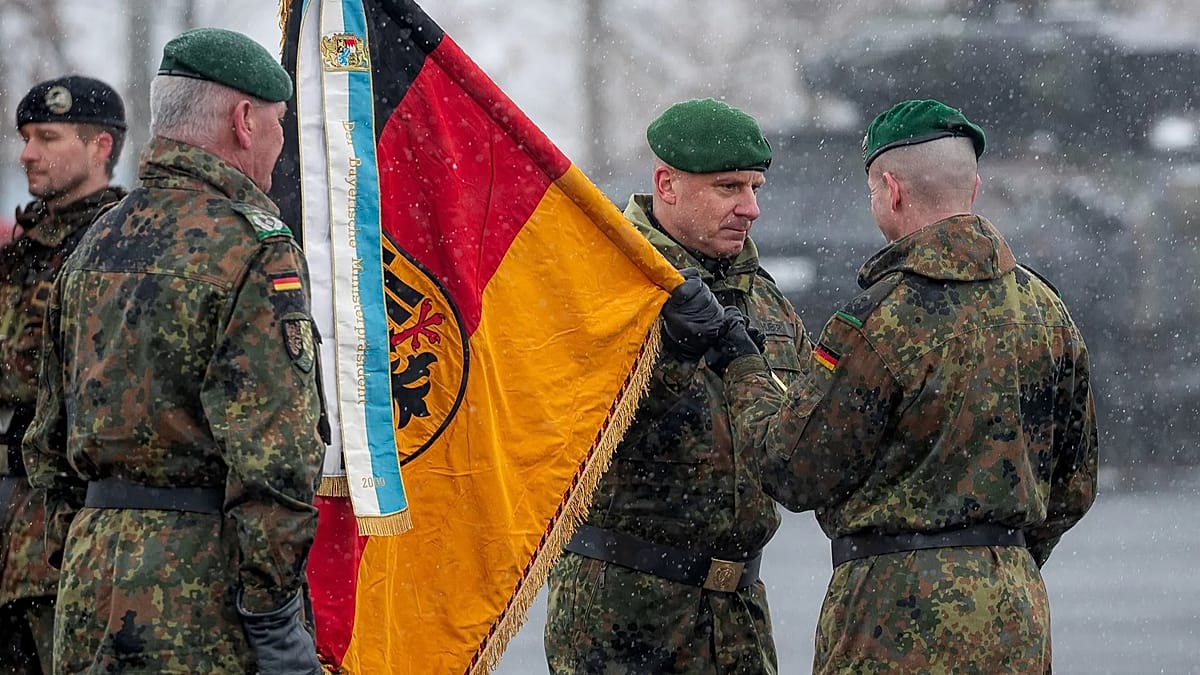
According to a Bundeswehr general, Germany is preparing for the possibility of a Russian attack within the next two years.
In an interview with The Times, Gerald Funke, head of the Bundeswehr’s new Support Command, outlined what a potential “worst-case scenario” could entail: a large-scale Russian attack on NATO in the Baltic states.
Germany would be immediately involved in any such attack because of its brigade stationed in Lithuania. This would be followed by the deployment of tens of thousands of NATO troops to the eastern flank, routed through German ports and transport corridors, even in the face of potential hybrid attacks.
In that scenario, Germany would assume a central role as NATO’s logistical hub, as set out in the Operational Plan Germany (OPLAN DEU). According to the Wall Street Journal, the plan is a classified document of around 1,200 pages, drawn up more than two and a half years ago and now set to be implemented “at full speed.”
OPLAN DEU is widely regarded as the military blueprint for the defence of Germany, bringing together the core tasks of national and collective defence and integrating them with the necessary civilian authorities and responsibilities.
Protection of Vilnius, protection of Berlin
During a visit to the Operational Command at the Schwielowsee site, Lithuania’s defence minister, Robertas Kaunas, said he also considers a Russian attack to be possible.
At the same time, he cautioned that a smaller, more limited military action designed to test Europe’s security architecture and the alliance was the more likely scenario.
It was against this backdrop that a plaque bearing a quote from the German chancellor was unveiled at Vilnius City Hall last year. It reads: “Lithuania’s security is also our security. The protection of Vilnius is the protection of Berlin.”
The words were taken from a speech delivered by the chancellor in May last year at the roll call of the German Army brigade stationed in Lithuania.
To strengthen Lithuania’s security, the German government decided in 2023, for the first time, to permanently station a Bundeswehr combat brigade outside Germany: the 45th Armoured Brigade, also known as the “Lithuania Brigade.”
Following a meeting with Lithuanian Prime Minister Inga Ruginienė in Berlin on 29 January, Chancellor Friedrich Merz reaffirmed that Germany stands by its responsibility, describing the deployment of the Lithuanian Brigade as a joint investment in Europe’s security.
“This brigade is not a political symbol, but a military contribution to deterrence and defence,” the chancellor emphasised.
Most of the brigade’s forces will be stationed in Rūdninkai, around 30 kilometres from the Belarusian border. In addition, the German-led NATO battlegroup, a multinational combat unit currently made up of eight allied countries on a rotational basis, will be integrated into the brigade’s structure.
The battlegroup is based in Rukla in central Lithuania, another key location for the deployment and basing of German forces in the Baltic region.
‘War capability requirement’
By 2027, around 4,800 soldiers, alongside some 200 civilian staff, are to be permanently stationed on NATO’s eastern flank as part of the Lithuanian Brigade, in line with the requirement to ensure full war-fighting capability.
Some 500 personnel are already permanently deployed on the ground, Federal Defence Minister Boris Pistorius said after a meeting with his Lithuanian counterpart, Robertas Kaunas.
He added that on 29 January two combat battalions, the 203rd Armoured Battalion from Augustdorf and the 122nd Armoured Infantry Battalion from Oberviechtach, were placed under the brigade’s direct command.
The multinational NATO Battlegroup Lithuania is due to be placed under the command of the 45th Armoured Brigade in February.
This will bring the number of brigade personnel serving in Lithuania to around 1,800, according to Pistorius, who added: “We are on schedule. The brigade is growing and training on the ground. 2026 will be a year of particularly intensive training activity with strong German participation.”
Once Lithuania has completed the necessary civilian and military infrastructure, Battalions 203 and 122 will be stationed in Rūdninkai and Rukla, Pistorius said.
“I would like to take this opportunity to thank our Lithuanian friends once again for their extraordinary reliability and determination in building the infrastructure for our brigade,” he added.
The defence minister was referring to the so-called Rūdninkai Military Town, which is currently under construction near the Belarusian border. The new barracks complex is designed to accommodate up to 3,000 soldiers and is scheduled for completion by the end of 2027.
When could Russia attack?
General Funke’s assessment that Russia could potentially launch an attack on the Alliance within the next two years broadly aligns with NATO’s Joint Threat Assessment.
That assessment is based on intelligence findings relating to Russia’s arms production and its ability to recruit and sustain forces. According to NATO estimates, Moscow could be in a position to field a force of up to 1.5 million troops by around 2028 or 2029.
Germany’s Inspector General, Carsten Breuer, has stressed that this does not mean Russia will necessarily attack, but that it could be capable of doing so.
To build up defensive capabilities as quickly as possible, and to achieve what the government describes as “war readiness,” Germany’s budget plans provide for an increase in defence spending to almost €153 billion by 2029.