
Published on
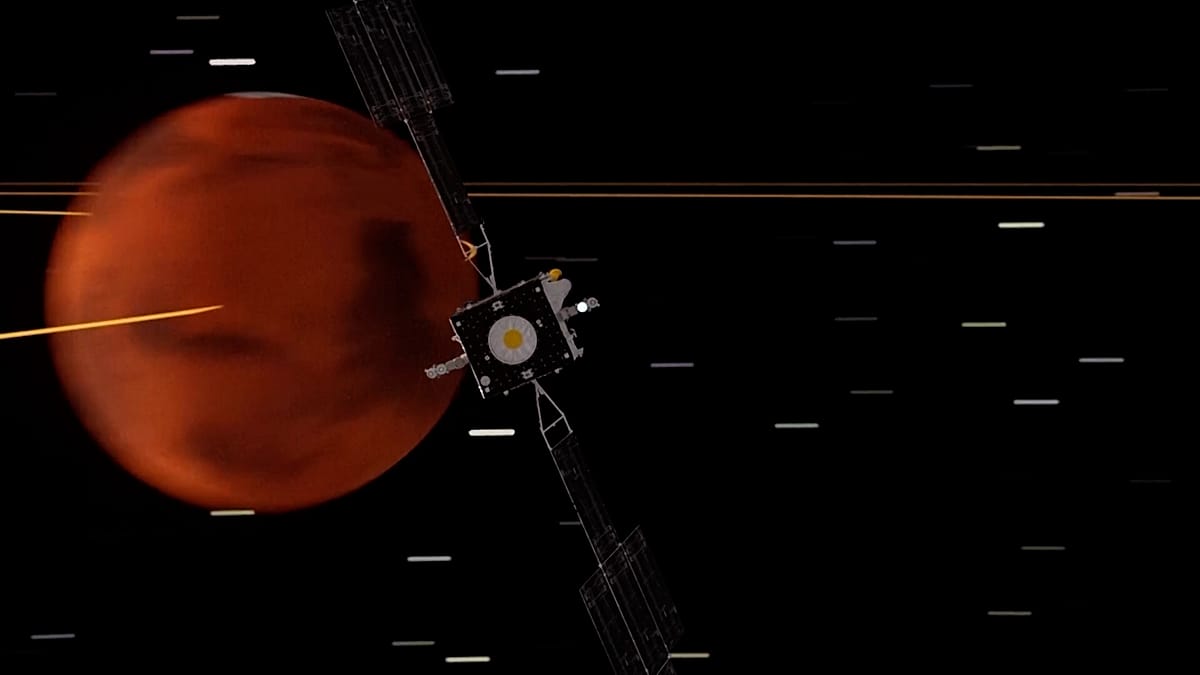
NASA’s Psyche spacecraft will fly close to Mars on Friday in a crucial manoeuvre that could bring scientists closer to understanding the birth of Earth.
The flyby will use Mars’s gravity to send the spacecraft towards Psyche, a rare metal-rich asteroid that may reveal clues about how rocky planets formed.
It will race past Mars at around 19,848kph, passing close within 4,500 kilometres of the planet’s surface.
NASA will use the close approach to harness Mars’s gravity and place the spacecraft on the correct path towards the asteroid belt between Mars and Jupiter.
“The Mars gravity assist helps us to actually go faster, and also it changes the plane,” said Don Han, Psyche Navigation Team Lead at NASA Jet Propulsion Laboratory.
“For instance, Earth orbits around the sun and Psyche’s orbit is about three degrees different… So you can make a plane change to get in line with the psyche asteroid, right? And that’s very expensive if you want to do it by rocket,” Han added.
As the spacecraft approaches Mars, its cameras are already capturing images of the planet, which currently appears as a crescent shape.
After the flyby, Mars will appear almost full sphere in the spacecraft’s rear-view images.
Scientists will use the changing views to test and fine-tune the spacecraft’s instruments.
All of Psyche’s science instruments will be switched on during the Mars flyby, according to NASA.
The space agency’s two Mars rovers, along with several American and European orbiters already around the planet, will also carry out observations at the same time so scientists can compare the data collected by the different missions.
Psyche was launched in 2023 and is now about halfway through its long journey, which is expected to take about seven years.
The spacecraft is expected to reach the asteroid in 2029, when it will spend two years orbiting and studying the object.
Scientists believe the asteroid may be the exposed metal core of an early planet that lost its outer layers billions of years ago during violent collisions in the young solar system.
Clues about how the Earth was formed
Researchers hope studying Psyche up close could reveal what lies deep inside Earth and explain more about how planets formed 4.6 billion years ago.
“No spacecraft has ever flown to this kind of asteroid before, something that’s really a big lump of metal,” said Libby Jackson, Head of Space at the Science Museum.
“I’m really excited to find out what the scientists learn about the asteroid. Is it what they think it is? Perhaps a planetesimal formed from the earliest days of the solar system. Perhaps it’s something completely different,” Jackson added.
“I’m certain that whatever it is will tell us more about the evolution of planets in our solar system and the Earth”.
While the asteroid belt contains millions of rocky and icy objects, only a small number are thought to be rich in metal like Psyche.
According to NASA, the asteroid measures about 280 kilometres across at its widest point and stretches around 232 kilometres in length. Its surface area covers roughly 165,800 square kilometres.
The distance between Earth and Psyche constantly changes because both orbit the Sun at different speeds. At its closest, the asteroid is less than 186 million miles from Earth, while at its farthest, it is more than 372 million miles away.
Discovered in 1852, Psyche has fascinated astronomers for more than 170 years because of its unusual mix of rock and metal. It is also believed to be among the oldest objects ever observed in the solar system.
For more on this story, watch the video in the media player above.
Video editor • Roselyne Min