
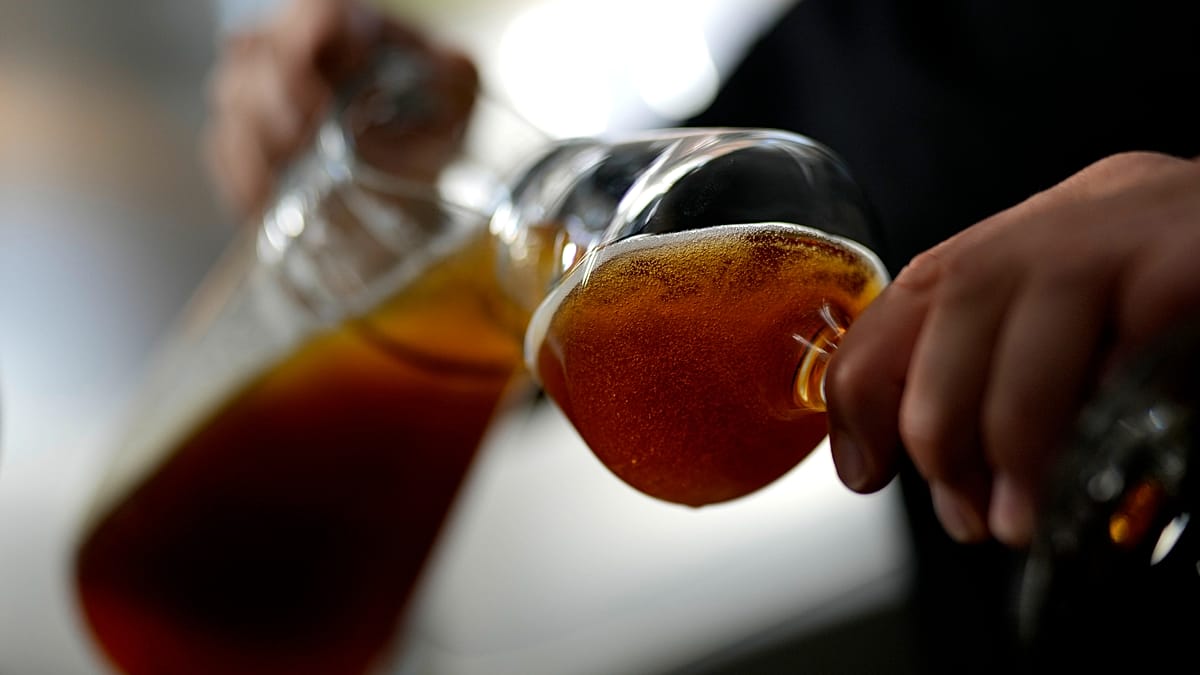
With more than 10,000 years of history, beer today is much more than a drink associated with informal moments. Its cultural richness, the more than 160 styles that exist and its potential for gastronomic pairings have been gaining recognition, albeit slowly, in markets traditionally dominated by wine, such as Portugal.
This International Beer Day, always celebrated on the first Friday in August, thus serves as an invitation to discover a vast, constantly evolving universe.
The date was created in 2007 in the city of Santa Cruz, California (United States), by a group of friends who decided to establish a day to bring people together around one of the most widely consumed drinks in the world. The initiative took on an international dimension and is now marked in more than 50 countries.
According to Sagres beer sommelier and brand manager Filipa Santos, interest in beer often stems from discovering its complexity. From the ingredients to the different brewing schools, the drink offers a diversity that ranges from classic European beers to contemporary interpretations from the so‑called “New World”.
Filipa, who has worked in marketing for 20 years and has been involved in the beer sector since 2011, has worked with several beer brands, both national and international, and took a beer sommelier course because she “felt the need to really know the product she worked with”. Along the way, what fascinated her most was “the diversity and richness of the beer world”.
Beer is traditionally made from four natural ingredients: water, malt, hops and yeast. However, the way these elements are combined and handled gives rise to an enormous variety of styles.
Water, for example, can directly influence the flavour, depending on its mineral composition.
“Around 93% of a beer is water, so if we want a pilsner, which is a low‑bitterness, versatile beer, very easy to drink, we use soft water. Here the water is not going to dominate and we will have a beer in which the malt can provide good balance. If we want a more intense, more complex beer, such as a Guinness, a stout, then we should use hard water, because we need the minerals to help the malt take on a bigger role, to really stand out,” the specialist explains to Euronews.
Malt — usually barley, but also wheat or other cereals — is responsible for the colour and the cereal notes, which can range from fresh bread to toasted bread.
In the case of hops, bitterness predominates, along with aromatic notes of tropical or citrus fruits. “They can range from herbal and floral to fruity, including tropical and citrus notes, rose and so on.”
Yeast, in turn, is the invisible ingredient that transforms sugar into alcohol and gas, and is also decisive in the final profile. “There are beers in which yeast is the protagonist, for example Belgian beers. In those we can find notes of clove, spicy notes, and banana notes as well.”
A world of more than 160 options, far beyond the standard lager
From these four elements, more than 160 recognised beer styles emerge.
Even so, Portugal remains a market dominated by one particular style. “We are a country of pilsner beer – light, easy‑drinking and refreshing,” notes Filipa. But that is only a small part of the beer universe.
Among the best‑known styles are IPA (India Pale Ale), marked by the intense hop aroma; stout, dark beers with notes of coffee or chocolate; and weissbier, wheat beers with softer, more fruity characteristics.
The diversity also reflects different geographical traditions – the so‑called brewing schools, which are divided between the “Old World” and the “New World”.
In the Old World, the most classic styles can be found – “the true archetypes of beer”, says Filipa. In Germany, Austria and Czechia, where tradition places particular value on working with malt and wheat beers, styles often appear that are more cloudy and smooth, with slightly sweet notes and characteristic aromas such as banana.
Typical of Germany are witbier, which have a straw‑yellow to pale golden colour, and Weissbier, which have a somewhat stronger colour, ranging from gold to amber. Both have a cloudy appearance because they are unfiltered.
Pilsner, now dominant in many markets, was born precisely in the city of Pilsen, in present‑day Czechia.
Another group includes England, Scotland and Ireland, where beer is also strongly linked to malt, “but also because historically they are whisky‑producing countries,” Filipa explains.
The hops used in these countries also take on their own identity. “The English have very earthy hops and I think that has a lot to do with their history in terms of tea.”
Then, the Belgians and the French “are very given to irreverence, originality and make bold blends”. Here, production includes techniques such as spontaneous fermentation, in which tanks are left open and micro‑organisms present in the air take part in the process. The result is more unpredictable and complex beers, often with marked acidity or with added fermented fruit, as in kriek, made with cherry, the sour cherry.
In contrast with these traditions, the so‑called New World, notably countries such as the United States, Brazil and Japan, has brought a new approach to beer, reinterpreting classic styles. One of the clearest examples is India Pale Ale (IPA), originally British but profoundly transformed by North American brewers, who introduced hops with more tropical, intense profiles.
That difference is also linked to territory. As with wine, hops reflect the place where they are grown. In the United States, regions such as Yakima Valley have become central to production, giving rise to more fruity, exuberant aromas, in line with the preferences of new consumers.
Tasting with all five senses
Understanding beer is not just about knowing styles or origins; it is also about how it is tasted. “To taste a beer, I always advocate, first of all, not having a glass filled to the top. We can even use the so‑called universal tasting glass, which is very similar to a white wine glass,” reveals the beer sommelier.
The choice of glass can be important when it is necessary to capture the aroma better, so that it is easy to put the nose inside the glass and smell the beer.
This is because beer tasting uses all the senses. The first contact is visual, to assess aspects such as the colour of the beer, its clarity or cloudiness and the head it produces. Touch then allows us to feel whether a beer is at the right temperature.
Hearing also plays a part in this process. “We can even listen to the beer – whether the gas is very expressive or not, whether we can hear the little bubbles of gas.”
Next comes the aroma, to identify which aromatic notes stand out. Depending on the style, it is possible to pick up citrus, tropical, toasted, spicy or even sour notes.
Only then does flavour enter into it, confirming or not what the aroma suggested, because the nose does not always match the taste. At this stage, a beer sommelier will assess the balance between the sweetness of the malt and the bitterness of the hops, the lightness or body, the freshness or intensity. “We taste in small sips and try to understand which flavour prevails and what happens on our tongue.
In the end, unlike wine tastings, no spittoon is used, “because it is important to assess the retronasal effect, what aroma comes back through the nose at the end”. Beer specialists also swirl the glass and that gesture, as well as helping to release the beer’s aromas, brings back the head.
According to Filipa Santos, “a rigorous beer tasting can take 20 minutes or more“.
New habits and new consumers
The interplay between tradition and innovation has been crucial for the evolution of the global market, increasing diversity in the beer world, driven both by craft beers and by more demanding, better‑informed consumers.
Although it retains a central role as a social element, beer has been gaining space in new contexts, including at the table.
“Beer is a bit of a social glue, because it also works as a disinhibitor. It is always associated with an early‑evening moment, with socialising, with drinking, with or without food. It may simply be a meeting of friends. But I feel that, over time, beer is gaining more space in different consumption occasions,” observes the beer specialist, pointing to a growing openness to food pairings.
That versatility translates into unexpected combinations. “There is a huge range of possible pairings,” she explains, citing examples that range from light beers with seafood to more daring proposals such as dark beer with pastel de nata.
Another decisive factor is the change in habits. “We have consumers who are more concerned about a healthy lifestyle, more diligent about what they consume,” says Filipa Santos, pointing to the growth of the alcohol‑free segment and to a new generation that “drinks less alcohol” and makes more conscious choices.
In the sector, the challenge also lies in valuing service and the overall experience. “We may have good beers, but if the beer is not served in the right way, in the right glass at the right temperature, we cannot move forward. So the question of service is very important,” she warns, stressing the importance of the so‑called “perfect serve” to guarantee beer quality.
Despite the progress, some prejudices persist. “There is a stigma, but it makes no sense,” she says, referring to the idea that beer is less sophisticated than wine. For the specialist, it is above all a question of lack of knowledge: “Beer has great richness, not only in its history but also in its diversity, which is barely recognised.”