
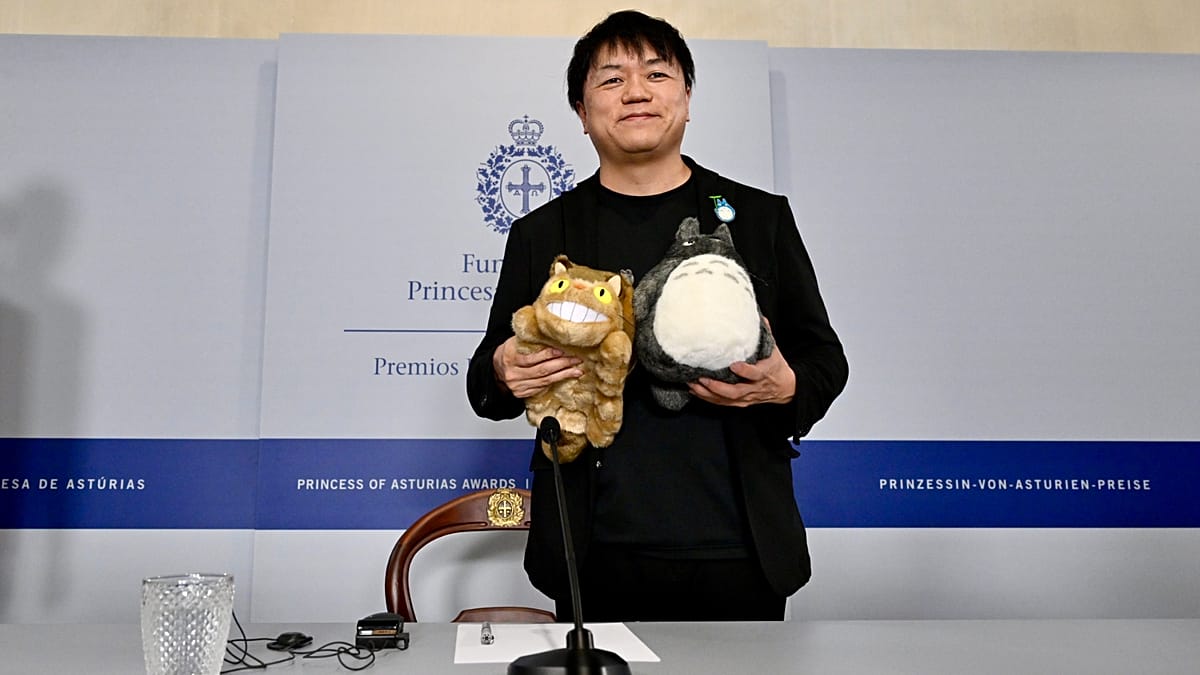
A former reporter for Japanese newspaper Yomiuri Shimbun, where at the start of his career he covered stories on the Ghibli animation studios, it is highly unlikely that Kenichi Yoda (1974) could have imagined he would one day go on to lead the very company he specialised in during his time as a culture journalist.
His rise to the summit of this legendary temple of cinematic anime came on 22 June, when he took over the presidency from Hiroyuki Fukuda. His interview with Euronews takes place 48 hours before he accepts, on behalf of his studio, the 2026 Princess of Asturias Award for Communication and Humanities.
The ideas of two of its creators, the late Isao Takahata and his partner Hayao Miyazaki, together with the work of the roughly 200 people employed by the company, remain one of the main gateways into Japanese culture for millions of people around the globe.
That was the case with “Marco” and “Heidi” in Spain. The anime series were broadcast between the dying days of Francoism and the Transition, at a time when Ghibli had not even been dreamt up by the pair of film-makers who met in a trade union while both were working at the Toei Doga studio in the 1960s. Those series were probably, with the exception of milestones such as the films of Akira Kurosawa, the first contact an entire generation of Spaniards had with the Land of the Rising Sun.
Yoda laughs when asked whether they see themselves as an instrument of Japanese soft power. “I think each work exists only because its directors and animators poured so much care into it. It makes us very happy that, as a result, people all over the world watch them. But we do not do it for the sake of diplomacy,” says the president.
Ghibli and the terrible beauty of war
In 2026 it is impossible not to ask Yoda about one of the themes that recurs most frequently in the studio’s scripts, alongside environmental protection, friendship and the strength of its female characters: armed conflict.
Takahata, a communist sympathiser, was an outspoken defender of Article 9 of the Japanese Constitution and a convinced pacifist, while Miyazaki was steeped in war from childhood: his family’s company manufactured parts for military aircraft on the fascist side during the Second World War.
Both bear witness to this fixation in such animated classics as “Grave of the Fireflies”, through “Princess Mononoke” or “Howl’s Moving Castle”, and up to “The Wind Rises”. In today’s Japan, which is allocating unprecedented shares of its GDP to its Self-Defence Forces and whose Defence White Paper has been driven by the far-right politician Sanae Takaichi, is it still possible to make pacifist films?
Yoda deftly sidesteps the question. “How to portray war is a very important issue for Studio Ghibli. Of course, it is better if there are no wars. But what I find admirable about Miyazaki as a director is that he has also been fascinated by the weapons used in war, and by fighter planes, by their beauty as objects, as forms. Of course, he has not the slightest sympathy for war. But there is in him a feeling he cannot resist: the allure of those things as objects. And that is, in a way, something very human,” he argues.
We also ask him about one of the studio’s most quoted lines, uttered by the lead in “Porco Rosso” (1992), when in a cinema he declares that he would rather be a pig than a fascist. Would a line like that get through a contemporary script meeting, whether at Ghibli or another studio? Once again, the executive opts to duck the issue: he says he is very pleased that one of Emmanuel Macron’s favourite films (recalling a remark made during an official visit to Japan) is “Porco”, as the interviewee points out.
The question of artificial intelligence also hangs over the Covadonga room at the Hotel Reconquista, where laureates of the Princess of Asturias Foundation traditionally stay. It arises in connection with the famous viral clip of Miyazaki (source in Spanish) from 2016, in which he brutally deflates two developers from another company as they try to sell the genius a kind of proto-AI to use in his drawings. “It is an insult to life itself,” he tells them.
“Ten years on, in every single interview I am asked what Studio Ghibli thinks about AI,” Yoda says with a sigh. “It is very difficult to predict how it will develop, and I think we are all living with that uncertainty. But if there is one thing we can say right now, and I say this in a personal capacity as well, it is this. Imagine two restaurants: one where the food is made by an AI and another where it is made by people. I would undoubtedly choose the latter.“
His team signal that it is time to wrap up the interview, but the former journalist says he wants to make one last point. “Listening to your questions, I realised that Ghibli is very closely tied to its own era (…) Every day we debate what the studio can do in this day and age and about the kind of era we are living in. In that sense, I feel we are creating something with a sense of proportion,” he argues.
“There is great honesty in the way we approach artistic creation,” he continues. “This is not a business plan: it is about thinking seriously about how the studio responds to its own time. That is what the studio’s day-to-day work is now. And it has probably always been that way.” The coming decade will show whether, after the generational handover from Miyazaki, still active at 85, the iconic studio manages to maintain its creative independence and ideals, after enchanting millions of children and adults far beyond the Japanese islands.