
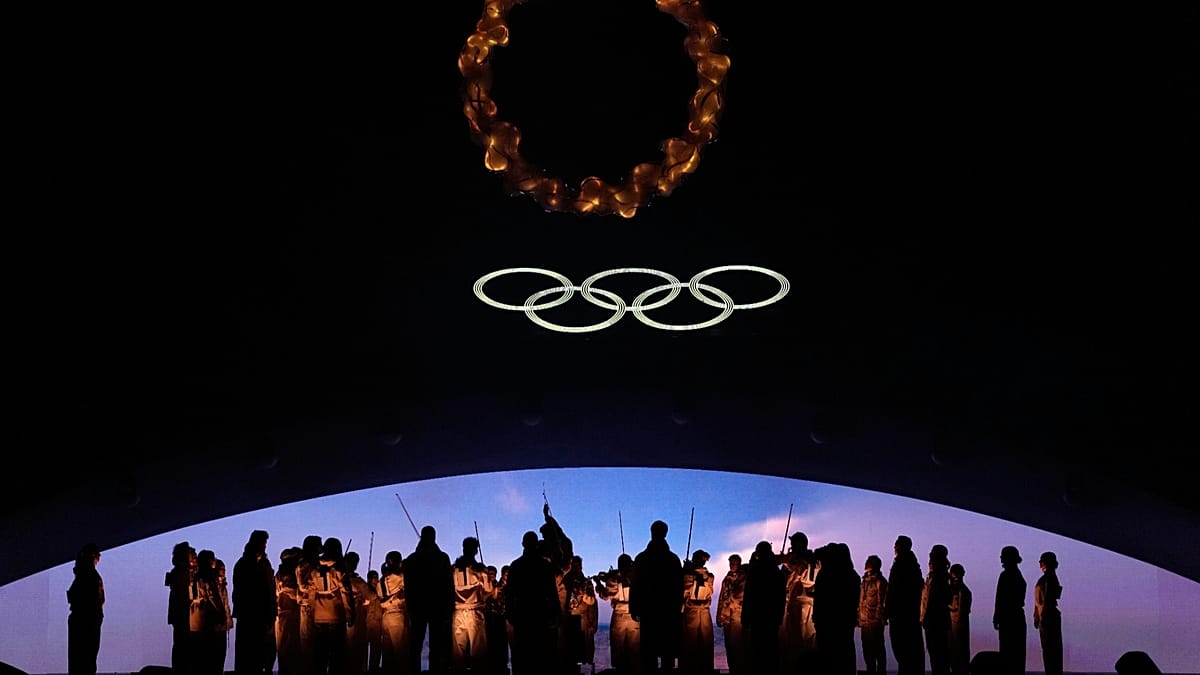
The Olympic Flame was extinguished on Sunday, marking the official end of the Milano-Cortina 2026 Winter Olympics.
A total of 116 medal events were held across 61 Olympic disciplines, with 1,146 medals awarded.
As athletes head home, Euronews bureaus reflect on this year’s Winter Games, and how the competition in all its drama and glory was seen across Europe.
Italy
The 2026 Milan-Cortina Winter Olympics have been widely praised by officials and the public alike in their host country.
Italian President Sergio Mattarella hailed “an Italy showing talent and cohesion,” while Prime Minister Giorgia Meloni called the Games “an extraordinary international showcase” and “proof that we can organise and succeed.”
Italian Olympic Committee President Giovanni Malagò described the 30 medals Italy won as a “historic achievement” which was “the result of years of careful planning”.
Italian media and public spoke of pride and satisfaction, celebrating Italy’s sporting success and international image. At the same time, discussions continue over the event’s overall costs, the legacy of the infrastructure, and the future use of the venues.
France
France viewed the Milano-Cortina Olympics as a test run for the Games to be held in the French Alps in 2030.
French National Olympic and Sports Committee President Amélie Oudéa-Castéra said she “fully felt the Olympic spirit” at the Games, praising the organisers for successfully managing the Games despite their dispersed locations.
French Sports Minister Marina Ferrari believes that “Italy managed well” and that France should learn from this.
Renaud Muselier, president of the Provence-Alpes-Côte d’Azur region, one of the two regions where the 2030 Games will take place, also applauded the fact that the Games were held at multiple venues, as will be the case in France.
Spain
Spain delivered the best Winter Olympic performance in the southern European country’s history at the Milano-Cortina Games.
The Spanish delegation finished with three medals, all in ski mountaineering, a discipline making its Olympic debut and becoming the centrepiece of Spain’s success.
Oriol Cardona was crowned Olympic champion in the men’s sprint, securing Spain’s first Winter Olympic gold medal since 1972.
Ana Alonso claimed bronze in the women’s sprint, and the pair added another bronze in the mixed relay, completing a tally of one gold and two bronze medals.
The result marks a milestone for Spain in winter sports, where the country has traditionally lagged behind Europe’s major powers.
Beyond the medal count, Spain’s performance in Milano-Cortina highlights the emergence of a competitive new generation and positions ski mountaineering as a strategic discipline for the country’s Olympic future.
Germany
The Winter Olympics left a lasting impression in Germany, from spectacular falls to bizarre costumes, most notably the German team’s outfit at the opening ceremony.
The Adidas-designed poncho drew mixed results.
Also, the accidents during the competition made headlines across the country. From the dramatic fall by US ski star Lindsey Vonn to Germany’s luge legend Georg Hackl injuring his shoulder.
“I wanted to watch my luge athletes training. I went along a path and climbed up a bit to get a look at the track. That’s my job, after all. Unfortunately, something broke away beneath me, and I fell 1,80 meters and hit my head,” Hackl told local media.
Overall, the Germans can be proud, as the country is fifth in the medal table with 26 medals, including 10 gold, 6 silver and 14 bronze.
Poland
Poland can also be proud, as the country brought home four medals — three silver and one bronze — marking a significant improvement compared to the Games in Beijing, where the White-and-Reds brought home only a single bronze medal.
The phenomenal form of ski jumper Kacper Tomasiak came as a surprise — he won two individual medals and one in a duo competition.
There is also growing optimism for the future, as the athletes winning medals and finishing in the top eight are relatively young. Some commentators even spoke of a generational change within the Polish national team.
However, the Games’ coverage has been overshadowed by complaints from some athletes about poor equipment and a lack of support from their sports federation.
The statements made by lugers and bobsleigh athletes resonated widely — they were competing on equipment nearly 10 years old.
Portugal
Portugal has traditionally had a minor presence at the Winter Olympics, largely due to the country’s lack of favourable natural conditions, such as snow and ice, and the lack of infrastructure needed to train for winter sports.
Historically, Portugal’s main sporting interests are centred on football, athletics, cycling and surfing, activities that can be practised year-round.
Cultural preferences also play a role: fewer Portuguese follow the Winter Olympics compared with the Summer Games, where sports align more closely with local interests.
The Games are mostly followed on social media, though with little interest in the results.
Greece
Like in Portugal, the Winter Olympics attract little attention in Greece. The country has no strong tradition in winter sports, and only a handful of athletes typically qualify for the Games.
Greek television ratings reflect this limited interest, with Winter Olympics broadcasts failing to make the top 10 programmes on any given day.
Greece’s central place in the Olympic movement, as the country of its origin, means that the Games always hold special significance for the Greek people.
Turkey
In Turkey, the 2026 Winter Olympics have not received much fanfare because no medals could be brought home this time. Still, the increase in institutional ambition was evident.
Even though many Turkish people are preoccupied with football, media outlets have published numerous stories about the Games, especially amid the spike in the number of Turkish athletes participating.
Much of the domestic excitement centred on Fatih Arda İpcioğlu, who has proven that a Mediterranean nation can compete at the elite level of ski jumping.
Unlike some European neighbours who expressed fatigue with the Games, Turkish sports commentators have praised the Milano-Cortina organisation as a model for Turkey’s own future hosting aspirations in Erzurum, the eastern province famous for its ski resorts.
Russia
Russian and Belarusian Olympians have been prohibited from competing under their flags in the Olympics and Paralympics since Russia’s full-scale invasion of Ukraine in 2022, a rule which was observed at Milano-Cortina as well.
Neutral athletes, however, were allowed to attend the Olympic closing ceremony.
Athletes were allowed to participate as “individual neutral athletes”, a category that allows those who have qualified for the Games to compete under certain conditions, such as not actively supporting the full-scale invasion and not being contracted to the Russian or Belarusian military or national security agencies.
According to The Moscow Times, Russian state television gradually adjusted its Olympic coverage, from initial limited reporting to later highlighting the success of neutral athletes, particularly Nikita Filippov’s silver medal, which was hailed as a significant achievement.