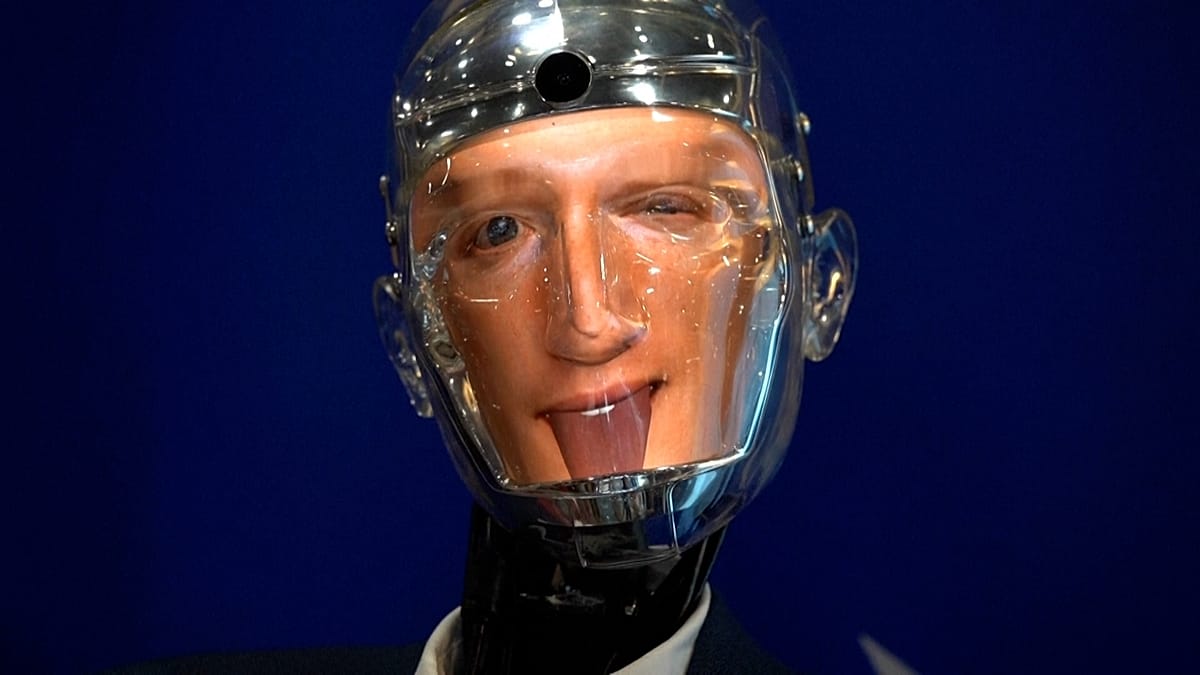




At the start of this week, a robot beat human runners in a half-marathon in Beijing. Now, another one can apparently outplay table tennis professionals. Is this how it begins – machines quietly overtaking us, one task at a time?
The answer is yes – and no. In a new study, a robot built by Japanese electronics giant Sony has beaten professional players. But the features that make this possible are anything but human-like. The robot, called “Ace,” has a single arm with eight joints and uses its nine camera eyes to track the ball’s logo and detect its spin.
How did it get so good?
One thing humans and robot arms have in common is the need for training. Simply programming a robot to play table tennis is not enough, Sony AI researcher Peter Dürr, co-author of the study published Wednesday in Nature, explains. “You have to learn how to play from experience.”
Ace was trained using an AI method known as reinforcement learning. According to Sony, the study shows how advances in artificial intelligence can not only help to make robots faster but also much more agile.
Sony set up a full-size Olympic table tennis court at its Tokyo headquarters, where official rules were applied, Dürr said. Several athletes said they were impressed by how good Ace was.
The experiment was conducted on a standard-sized court, and official table tennis rules were applied.
The outcome shows that a machine can achieve human, expert-level play in a common competitive sport, interacting with skilled human athletes, “a longstanding milestone for AI and robotics research”, according to Sony.
The technology behind the speed and agility
The goal wasn’t just speed. Researchers could have built a machine that catches the ball and plays it back faster than a human can react to. But the idea was to build a robot that would actually play the game – and be on as level a playing field as possible, said Michael Spranger, president of Sony AI.
The speed, reach, and performance of the machine are compared to those of a skilled athlete who trains at least 20 hours a week. “The goal is to have some level of comparability, some level of fairness to the human, and win really at the level of AI and the level of decision-making and tactics and, to some extent, skill”, Spranger said.
After submitting their paper for review before it was published in Nature, Sony’s team kept improving the robot. They said Ace became faster, played longer rallies, and moved more aggressively closer to the table. In December, it faced four highly skilled players and beat all but one.
Another professional player, Kinjiro Nakamura, who competed in the 1992 Barcelona Olympics, said he saw Ace make a shot that seemed impossible for a human. But now that the robot has done it, he added, it suggests a human might be able to do it too.
Video editor • Theo Farrant