
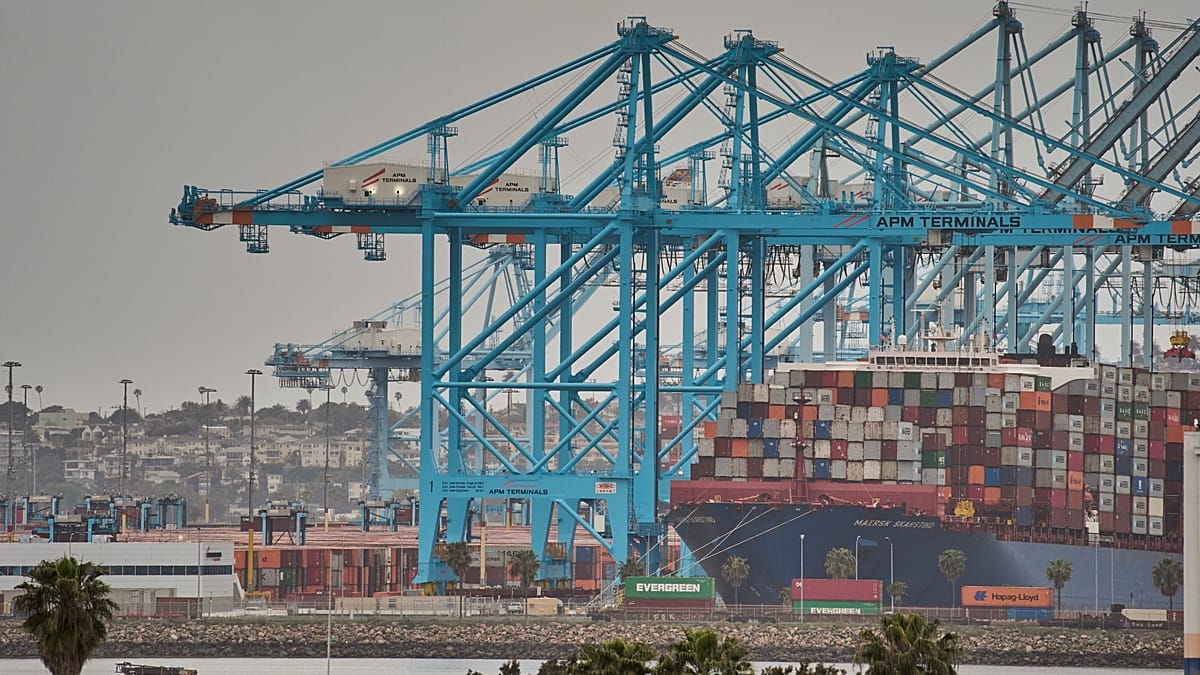
Shipping giant Maersk reported sharply lower earnings in the first three months of the year, despite strong demand for container transport.
Net profit for January to March fell to $100m (€85m), around 12 times lower than a year earlier, when earnings were boosted by exceptionally strong demand for sea freight.
Revenue slipped 2.6% to just under $13bn (€11bn), while earnings per share dropped to $4, down from $74 in the same quarter last year.
The Copenhagen-based company said weaker freight rates in its Ocean division were the main drag on earnings, although a 9.3% rise in volumes across its business helped offset some of the decline.
Maersk said the conflict in the Middle East had only a limited direct impact on first-quarter results, but warned that it had added fresh uncertainty to the global outlook.
“The conflict in the Middle East, which began on 28 February 2026, has introduced an additional layer of uncertainty,” the company said in a statement.
It added that traffic through the Strait of Hormuz remained “at a near standstill”, while weaker sentiment had weighed on consumer confidence.
Even so, global demand for container shipping rose by 3% to 5% in the quarter.
Chief executive Vincent Clerc said demand had remained resilient across most regions.
“We’ve seen strong demand across most regions this quarter, supporting robust volume growth in our three business segments,” he said.
But he warned that volatility remained high in ocean freight, with excess shipping capacity continuing to put pressure on rates.
Maersk kept its full-year guidance unchanged and said it still expected global container demand to grow by 2% to 4% in 2026, broadly in line with the wider market.
However, it cautioned that the industry continues to face oversupply from new vessel deliveries, alongside uncertainty over when key shipping routes through the Red Sea and Strait of Hormuz may fully reopen.
Maersk’s share price lost 4% on Nasdaq Copenhagen in Denmark by 10h30 CET.
Industry under pressure
The wider shipping sector is also grappling with disruption.
Hundreds of vessels remain stranded in the Persian Gulf more than two months into the Iran conflict, driving up costs and disrupting trade flows. Cargoes delayed in the region include crude oil, refined products and fertiliser, while thousands of seafarers remain aboard ships unable to move freely.
According to US military estimates, more than 1,550 vessels carrying around 22,500 mariners are inside the Persian Gulf.
Insurance premiums for ships operating in the region have also surged sharply because of the threat of attack, adding to pressure on operators already facing rising fuel costs.
German shipping group Hapag-Lloyd said disruption around Hormuz is costing it around $60mn (€51mn)a week, driven largely by higher fuel and insurance bills.
Analysts warn that even if the Strait reopens soon, markets are unlikely to return quickly to normal.
Kaho Yu, head of energy and resources at Verisk Maplecroft, said refiners, shippers and commodity traders would remain cautious until there was clear evidence that the threat of renewed disruption had passed.
“Energy markets are unlikely to return quickly to pre-crisis assumptions,” he said.