
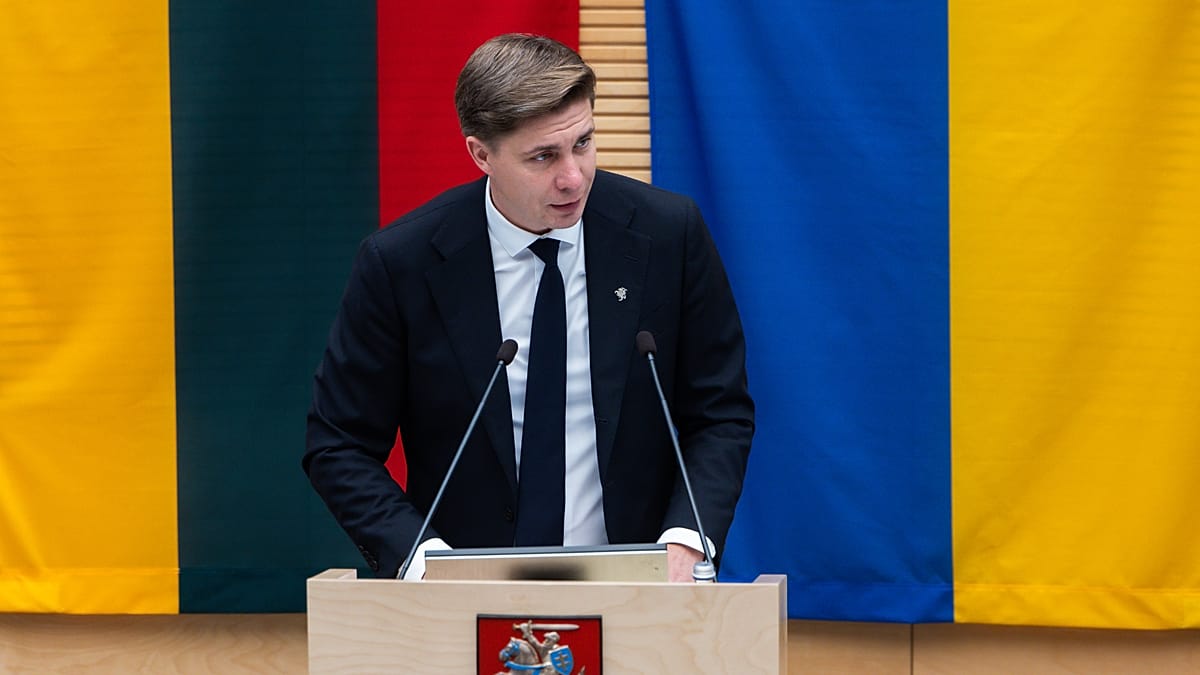
Lithuania’s new Prime Minister Mindaugas Sinkevičius presented his government’s policy agenda to the Lithuanian parliament on Tuesday, setting out a programme focused on defence, civil resilience and recalibration of foreign policy towards China while maintaining a hard line on Russia, as the country seeks to respond to a deteriorating security environment on NATO’s eastern flank.
Bordering both Russia and Belarus, the Baltic country of less than three million has faced a growing number of hybrid threats in recent years, including drone incursions, airspace violations, cyber-attacks and cross-border smuggling. This has forced the country to move full steam ahead with its defence preparations.
And that’s reflected in the incoming government’s policy programme.
To bolster national security, it has committed to spend no less than 5% of GDP on defence, accelerating investment in air defence and counter-drone capabilities, strengthening cyber security and expanding the country’s defence industry.
In his address to parliament, Sinkevičius argued that technological adaptation, rather than conventional military superiority alone, would determine success in future conflicts.
“Future conflicts will be won by the countries that integrate innovation into their military doctrine the fastest and can learn from modern warfare,” he said, pointing to drones, artificial intelligence and autonomous systems as increasingly decisive on the battlefield.
The agenda also pledges to complete preparations for hosting a German brigade by 2027 and to ensure Lithuania’s national division reaches full operational capability by 2030.
To achieve “real” preparedness, the incoming government is eyeing funds from the European Union, ready to push for additional funding for reinforcing NATO’s north-eastern flank security under the EU’s 2028–2034 long-term budget (MFF).
China reset
The clearest shift in foreign policy comes on China.
The programme says Lithuania will “normalise diplomatic relations with China to the level maintained by other EU member states”, signalling a more pragmatic approach after several years of strained ties.
The shift is clear from the previous mandate when Conservatives were leading the ruling coalition. Back then, in 2021, Vilnius allowed Taiwan to open a representative office, prompting China to downgrade diplomatic relations and impose economic restrictions.
Conservative Žygimantas Pavilionis asked the prime minister why “the threat of China is not seen” and why “you love China so much,” during the agenda’s presentation.
“I don’t feel either love or dislike toward China,” Sinkevičius said, adding that he has two priorities in foreign policy. “The first is security; the second, without overshadowing the first, is economic cooperation — those matters related to bilateral relations and trade.”
The policy shift on China was seen last month as Lithuania paused negotiations with Taiwan on an economic cooperation action plan because of “changes in the domestic political environment,” according to the foreign ministry, LRT reported.
At the EU level, Lithuania is aligned with France, Italy, Spain and the Netherlands — countries that during last week’s European Council called for broader use of tariffs and other defensive trade instruments to counter China’s unfair trade practices.
Stance on Russia
While the government is rethinking its approach to China, its policy towards Russia remains unchanged.
The programme commits Lithuania to taking “active measures” to preserve Russia’s international isolation and to continue coordinating with allies to maintain pressure on Moscow through sanctions and other measures.
The document states that Vilnius sees no prospect of normal relations with Russia while it continues its war against Ukraine and says the government will seek to ensure frozen Russian state assets are used for Ukraine’s reconstruction in line with EU and international law.
The incoming government also reiterates Lithuania’s unwavering support for Ukraine, arguing that “the only path to restoring a stable and just peace in Europe” is a Ukrainian victory and the restoration of the country’s territorial integrity. It also commits to supporting Ukraine’s reconstruction and long-term economic recovery.
Belarus is described as another key security challenge. While the programme identifies a democratic Belarus as a long-term foreign policy objective, it pledges to increase pressure on Minsk if it continues supporting Russia’s war or carrying out hybrid attacks against the EU.
Upcoming EU presidency
As Lithuania will hold the rotating presidency of the Council of the EU from January 2027, the government says it wants to shape debates on competitiveness, defence and security, safeguarding democracy, food security and Europe’s global role.
Vilnius also plans to use negotiations on the EU’s next long-term budget to push for higher defence spending, increased investment in military infrastructure and stronger support for the bloc’s defence industry, while protecting cohesion funding and agricultural payments.
The programme also reiterates support for Ukraine and Moldova’s EU accession and calls for a stronger Common Security and Defence Policy.
The agenda must still be approved by parliament, with the vote set for 14 July.