
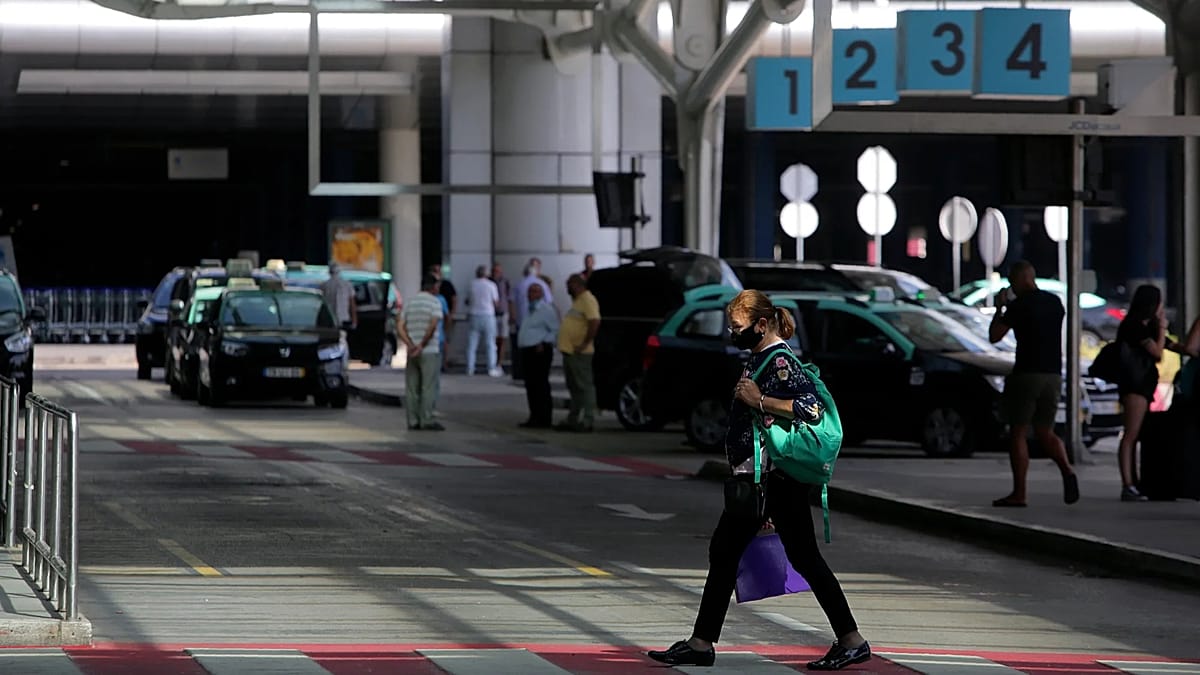
Over the past few years, there have been many reports from tourists about excessive prices, scams and even drivers refusing to take passengers from Lisbon airport.
Faced with problems affecting both foreign visitors and locals, a protocol was signed last September to set fixed fares for taxi journeys.
Several complaints on social media describe allegedly tampered taximeters, mileage being diverted and cases in which taxi drivers will only accept cash payments.
Back in August, Josien Nation, a Dutch citizen living in Portugal, described the situation as a “tourist trap”. In a video posted on the Facebook page Nations Without Borders, she said that “not all taxi drivers are ‘crooks'”, but that some try to negotiate the fare before setting off and then make the trip with the meter switched off, a practice expressly banned in Portugal.
In another account, posted in a Reddit group, a passenger says that on a journey from Lisbon airport to Rossio he was charged 18.50 euros, even though the meter showed 13 euros. According to the post, the driver justified the difference with an additional luggage fee. He also refused to let the passenger pay by card.
Most of these accounts come from tourists or foreign nationals living in Portugal who are allegedly treated as tourists. However, there are also testimonies from residents who use the service, such as a Portuguese man who shared his experience on the same platform.
“The last time I arrived in Lisbon, after a trip, I got into a taxi and immediately got back out again,” he began. “The driver said he didn’t take card payments. I asked him how much the journey from the airport to my home might cost, as I had some cash with me, but he replied that the price depended on a series of factors, such as traffic and how long the journey would take, among other nonsense.”
Other users also say that some taxi drivers take less direct routes to reach their destination, in an attempt to make the journey longer and thus justify overcharging.
To prevent many of these situations, a fixed-fare mechanism came into force on Thursday, under which everyone will pay the same for trips to certain areas. Anyone travelling to areas within the so‑called “zone 1” (see image below) will pay 16 euros during the daytime, from 7:00 to 22:00, and 20 euros at night, from 22:00 to 7:00.
For trips to “zone 2”, a daytime journey costs 19 euros and rises to 23 euros at night. These fares also apply at weekends and on public holidays.
Destinations not covered by the scheme will continue to be charged using the meter.
The fares include luggage, removing the additional fee of 1.60 euros that used to be charged for bags exceeding 55x35x20 centimetres.
Carlos Silva, president of the Portuguese Taxi Federation (FPT), explained in comments to Portuguese news agency Lusa that the system will only be fully operational from November and that a price still needs to be set for areas outside the capital, such as Moscavide, Sacavém and Prior Velho.
He believes “it is not fair for someone to pay 16 euros to Parque das Nações and, if the destination is a little further on but already in another municipality, Loures, and so close to the airport, for the service then to be paid according to the meter”.
‘Tourist prices’
Reactions to the new price list were quick to appear on social media, with many people branding the fares far too high and pointing to short journeys, such as trips from the airport to the parish of Alvalade or to Parque das Nações, both little more than two kilometres away.
An Instagram user says she usually takes a taxi to Oriente station, in Parque das Nações, and used to pay between 7.50 and 10 euros. “And now a fixed fare at such a high rate, why?”, she asks. Among the comments, some argue that alternative transport platforms, such as TVDE services, will be the main beneficiaries of the new fares.
Some accuse the authorities of setting “tourist prices” or “rubber-stamping” the high fares and practices of many taxi drivers. “They are going to legalise what some have already been doing for years: turning off the meter,” reads one comment.
Others, meanwhile, recognise the need for fixed prices in the name of transparency. “Having already seen this system in other countries, having the fares per destination set in advance without depending on the meter is actually useful,” writes one user on Reddit.
The possibility of using public transport, such as the metro and the bus, is also mentioned in the comments, although users point to obstacles such as “large, heavy suitcases” or “travelling with children”.
Protocol goes beyond fares
The new fares, which came into force on Thursday, will cover all taxi drivers in this first phase, even those not yet accredited to operate at the airport taxi rank. “Accreditation will also start to be carried out on Thursday,” the official explained.
Carlos Silva also believes that these new rules could attract more drivers and ensure more taxis are available at the airport rank. “We know that many do not stop at the airport for various reasons, but that they are considering doing so if there are rules, because at the moment they do not feel comfortable. Fixed prices may be more advantageous, offsetting the time they might have to wait”, he said.
If you arrive at Lisbon airport today, you can already expect these prices on taxi services. However, information panels are still missing in the arrivals area and outside, displaying this information so that it is visible to everyone. Transparency is one of the pillars of this new regulation, along with “improving the quality of the service and protecting users”.
The protocol on fixed-price journeys, signed in September by Lisbon City Council, ANA – Aeroportos de Portugal, the Lisbon Tourism Association (ATL), the FPT (Portuguese Taxi Federation) and ANTRAL – National Association of Road Transport in Light Vehicles, also lays down other rules, such as the “non-refusal of services” by taxi drivers.
Taxi drivers are also obliged to accept vouchers and electronic payments, meaning the payment terminal must be operational.
PSP inspections confirmed need for regulation
The tightening of measures, even though they will only be fully implemented at the start of next month, also follows a major inspection operation by the Public Security Police (PSP) at the arrivals area of Humberto Delgado Airport in Lisbon at the end of August, during which 67 offences related to taxi activity were detected.
In a statement, Lisbon Metropolitan Command (COMETLIS) said that around 100 taxis were inspected at the site, resulting in 32 offences for “incorrect positioning of the taximeter”, out of a total of 67.
Among the offences detected, eight related to lack of a CMT (Taxi Driver Certificate), six to lack of mandatory documents, six to fire extinguishers past their expiry date, three to lack of vehicle inspection and three to “lack of Group 2 on the taxi driver’s licence” (the mandatory driving licence certification for taxi drivers).
Two offences were also recorded for a taximeter past its validity period, two for taxis in poor condition, one for failure to use restraint systems, one for lack of insurance, one for driving under the influence of alcohol and one for parking in a private car park.
The PSP also issued two warnings to present documents and complied with two requests for external action that were pending against one of the drivers.
Joana Mourão Carvalho contributed to the writing of this article.