
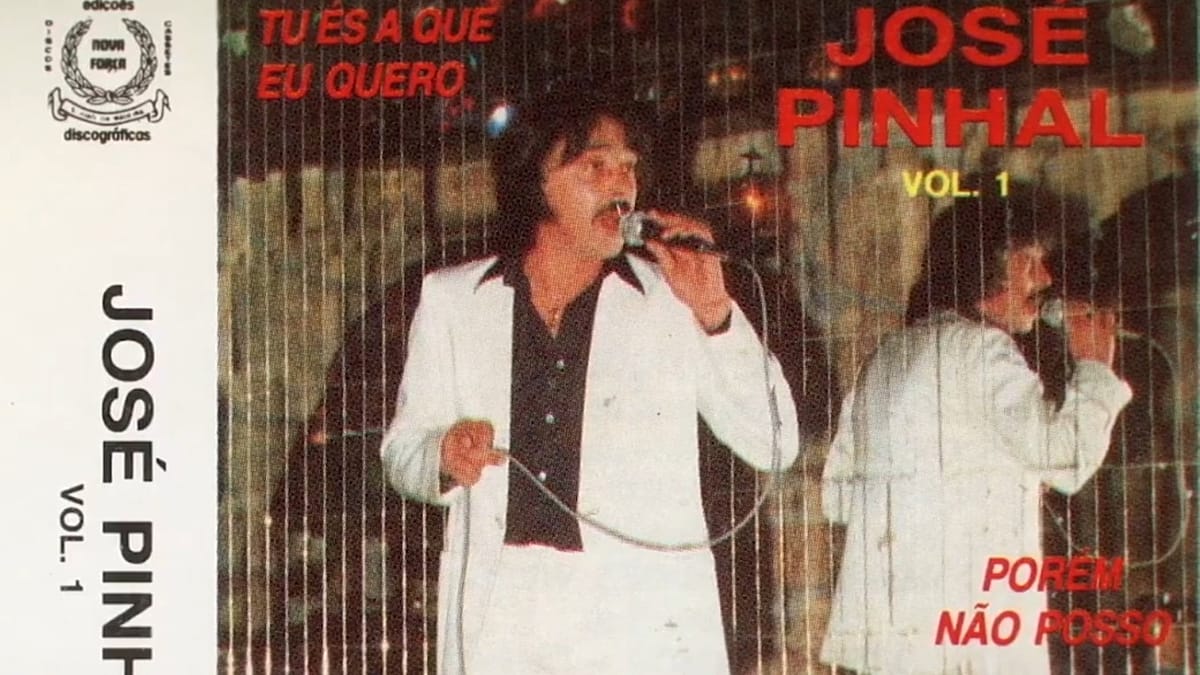
José Pinhal is a name that, until about a decade ago or a little more, nobody knew.
Born in Santa Cruz do Bispo (Matosinhos), he had a career on the circuit of dances and nightclubs in northern Portugal in the 1980s, and died at just 41, in 1993, in a road accident as he was returning from a performance, in almost complete anonymity.
It would probably have stayed that way if our century did not have a voracious appetite for stories of nuggets rescued from the past and from oblivion, proof of that is, for example, the story of the photographer Vivian Maier, whose genius was only discovered after her death, or the plot of one of Paul Auster‘s biggest best-sellers, O Livro das Ilusões, in which a man trying to overcome the grief for his wife and children, killed in a plane crash, strives to rescue from oblivion an actor and director from the golden age of silent cinema (although here there is a plot twist that differs from the stories of Maier and Pinhal).
Pinhal’s fate began to change on the day when the brother of Paulo Cunha Martins, a photographer and collector of musical rarities from Porto, moved into a flat that had previously housed the office of a music agent. Inside, everything had been left as it was, among the many relics the new tenant found two cassettes covered in dust.
At first they were played within a circle of friends. It was some years more before José Pinhal’s songs turned into a viral phenomenon, which happened after they were uploaded to YouTube.
Songs such as “Tu És a Que Eu Quero (Tu Não Prendas o Cabelo)”, later used in advertising by an online betting company, started being hummed across half of Portugal. The story reached the pages of the British newspaper The Guardian (source in Portuguese) and led to a documentary (source in Portuguese).
One mystery still had to be solved: Who was José Pinhal? The answers only started to emerge when Marina Pinhal, the singer’s only daughter, commented on the video posted online in 2016, which already has around 1.4 million views.
It was also that year that José Pinhal Post-Mortem Experience appeared. The tribute band, founded to honour the singer, has now said goodbye to the stage after ten years, with a concert in the hall where Pinhal dreamed of singing one day, the Coliseu dos Recreios in Lisbon.
The band began as a joke in 2016 and was supposed to perform for only one night. In the meantime, ten years have passed. The members, all of them from the alternative music scene, have other projects they want to develop. But they wanted the finale to be total, with final concerts in the coliseums of Porto and Lisbon.
João Sarnadas is a guitarist and was the driving force behind the band, as well as being part of the collective that runs Favela Discos and having a career in experimental music under the alias “Coelho Radioactivo”: “My first reaction when I heard José Pinhal’s music was realising that it is something unique. Although it is something that lives within a context, the context of romantic music, of dance music, his music is something unique,” he says.
In 2016 Sarnadas and some friends wanted to form a band to play Pinhal’s songs, which they had been listening to obsessively, at a birthday party. Several other musicians joined them. Over the following ten years they played at dozens of parties and venues all over the country. Sarnadas says they even considered suggesting to Pinhal himself that they rescue him from oblivion and form a band that could accompany him, before they knew that he had already died.
Bruno Martins, who uses the stage name Bruno de Seda, is the singer and “wears” Pinhal’s skin: “I already had the moustache,” he jokes. The look is completed with Pinhal’s trademark image, “more 80s would be impossible”: black shirt, white suit and gold chain round his neck. “What impressed me most about him was the voice and the way he sang. That vast commitment he gave to the songs,” he says.
That commitment and authenticity, which Bruno de Seda reproduces perfectly on stage, seem to be what have fascinated an entire legion of fans from various generations, largely young, urban and educated, an audience radically different from the one that usually follows this kind of music. Pinhal did not hide his strong northern accent, he sometimes sang out of tune, but always with passion and without apologising for being who he was. “We feel immense genuineness,” says musician Rui Fonseca, from 800 Gondomar, in the documentary A Vida Dura Muito Pouco by Dinis Leal Machado. The music he made, together with Manuel Eduardo’s arrangements, has “something”, sometimes hard to explain, that sets him apart from all the others who marked Portuguese popular music or what started to be called, disparagingly, música pimba.
Yet one thing that it is very hard to ascribe to Pinhal is originality. Although most of the compositions are simply signed as “DR” (rights reserved), a visit to this playlist on Spotify (source in Portuguese) is enough to realise that José Pinhal’s “greatest hits” are in fact versions of songs by Brazilian and Spanish artists of the time, such as Paco Escudero, Chiquitete or Cláudio Fontana.
For José Pinhal Post-Mortem Experience, whose final concert at the Coliseu dos Recreios will go down in history as a rare explosion of energy, it is time to declare their mission accomplished: “The message of showing who José Pinhal is and his work has been delivered. That job has been done,” says Bruno de Seda. “Above all, this takes up a lot of our time. A band of this calibre requires almost total dedication and, after ten years, we already want to do other things,” he concludes.
In the front row, as at most of the band’s concerts, was Marina Pinhal who, besides being the singer’s daughter, is also one of the tribute band’s biggest fans. At this concert, because it was so special, she was emotional: “All I can do is thank the band, but it is sad that they are ending, especially in this hall, where my father so often dreamed of singing one day,” she says. “I am very happy with their journey, I am very happy with my father’s journey, and with everything my father does to people with his music.”
The band is closing the circle, but José Pinhal’s music is kept alive by all the fans he has gained since he was rediscovered, who will go on chanting the rallying cry that is always heard at the concerts: “José Pinhal, immortal!”