
Foreign propaganda is not a new phenomenon. It dates back centuries and became more visible with the rise of mass media. It continues to evolve, adapting itself to the latest communication tools.
The internet and social media have provided powerful new channels for international propaganda, including misinformation and disinformation. Russia has been accused in multiple cases, including interference in the US elections, and has increasingly become a common suspect across Europe as well.
A recent Eurobarometer survey found that ‘foreign information manipulation, interference and disinformation, including in the context of elections’ are the second most serious challenge facing the EU. More than two in five Europeans (42%) shared this view. This concern exceeds 50 percent in some countries.
“I will caution against over-interpreting these results… The question itself tells us a lot about the authors’ (i.e., European Commission’s communication team?) self-perception as to what might be the challenge to democracy in the EU,” Dr Pawel Zerka, senior policy fellow at European Council on Foreign Relations (ECFR), told Euronews Next.
_“_Of course, this doesn’t mean that these results are completely useless.”
The third most serious challenge is an internal one, but on a related issue: ‘the lack of transparency concerning whether political content online is promoted through new technologies like AI.’ Almost a third of respondents (32%) agreed with this view.
European respondents first mention ‘the growing public distrust towards democratic institutions and processes’, cited by almost half (49%).
Media bias or real threat?
To what extent is foreign information manipulation a threat to democracy in the EU?
Sander van der Linden from the University of Cambridge pointed to two competing hypotheses. One suggests media bias. Under this view, widespread coverage of foreign information manipulation is making people unnecessarily alarmed.
The other model suggests that people are rightly concerned because they are perceiving reality accurately: foreign information manipulation is happening at a large scale now, with unprecedented assistance from AI.
“Personally, I would say that it’s true that the media is amplifying concern about foreign information manipulation but this concern is warranted,” he told Euronews Next.
“Is Russia Today weaponising information?”
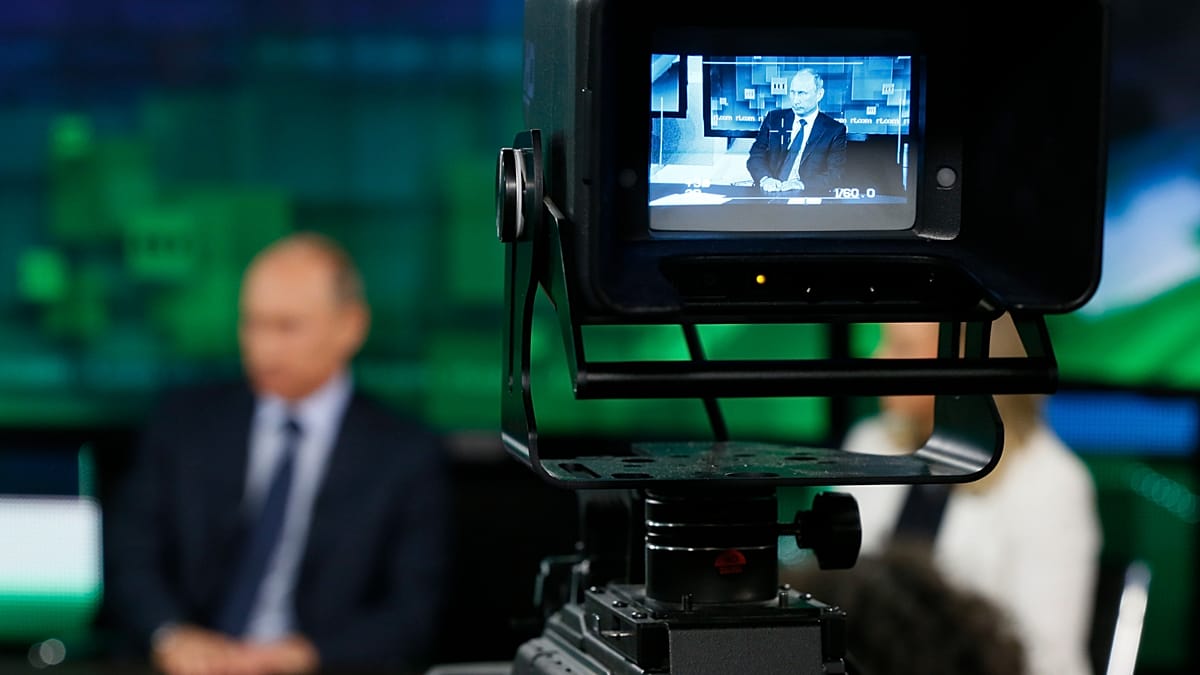
“Europe’s political elites tell a story that foreign information operations must be bad because they might be bad,” Ben O’Loughlin at Royal Holloway, a professor at University of London, told Euronews Next. He emphasised thatresearch published after the 2022 ban of Russia Today (RT) showed that while some RT content was manipulative, some was just accurate.
If there are protests for any reason in European capitals, RT would report that. It indicates European citizens are unhappy, so the politics isn’t working.
“This then causes panic in European governments that RT is weaponising information to harm those very governments. This panic is doubled because there were challenges to democracy even if foreign manipulation didn’t exist,” he added.
Why is Sweden an outlier?
In Sweden, 73% of respondents see foreign information manipulation as the most serious challenge facing the EU. This makes the Nordic country an outlier.
“[This] can tentatively be linked to several factors, including its geographical proximity to Russia, its recent accession to NATO, and influence campaigns attributed to the Kremlin,” Cristina Arribas, a researcher at the University Rey Juan Carlos, told Euronews Next.
She explained thatthis perception is also connected to internal structural elements such as a strong tradition of media literacy, the cultivation of critical thinking, high educational attainment, a consolidated democratic culture, and a pluralistic media system.
“These features extend to other Nordic countries—particularly Finland and Denmark—and account for their greater resilience to disinformation,” she added.
Finland and the Netherlands follow Sweden at 55 percent, with Denmark at 51 percent and Germany at 49 percent.
In eight EU countries, this share is below one third. Czechia, Portugal, and Estonia record the lowest levels, with just 28 percent of respondents holding this view.
Does geographical proximity to Russia matter?
Arribas pointed out that geographical proximity does not necessarily translate into heightened perceptions of foreign information manipulation as a threat. This is evident in the Baltic states, Poland (29%), and Romania (31%), where, despite their closeness to Russia, concern expressed in the survey is comparatively lower.
“This finding reinforces the hypothesis that structural factors—rather than geography alone—play a more decisive role in shaping citizens’ perceptions of disinformation and FIMI as risks to democracy,” she said.
Among the EU’s “Big Four”, Germany records the highest share, with almost half of respondents (49%) agreeing. France and Spain are close to the EU average at 43%, while Italy matches it at 42%.
Explaining differences between countries, Zerka said that whether major cases of foreign interference or cyberattacks have occurred in a country’s recent past can shape public perceptions.