
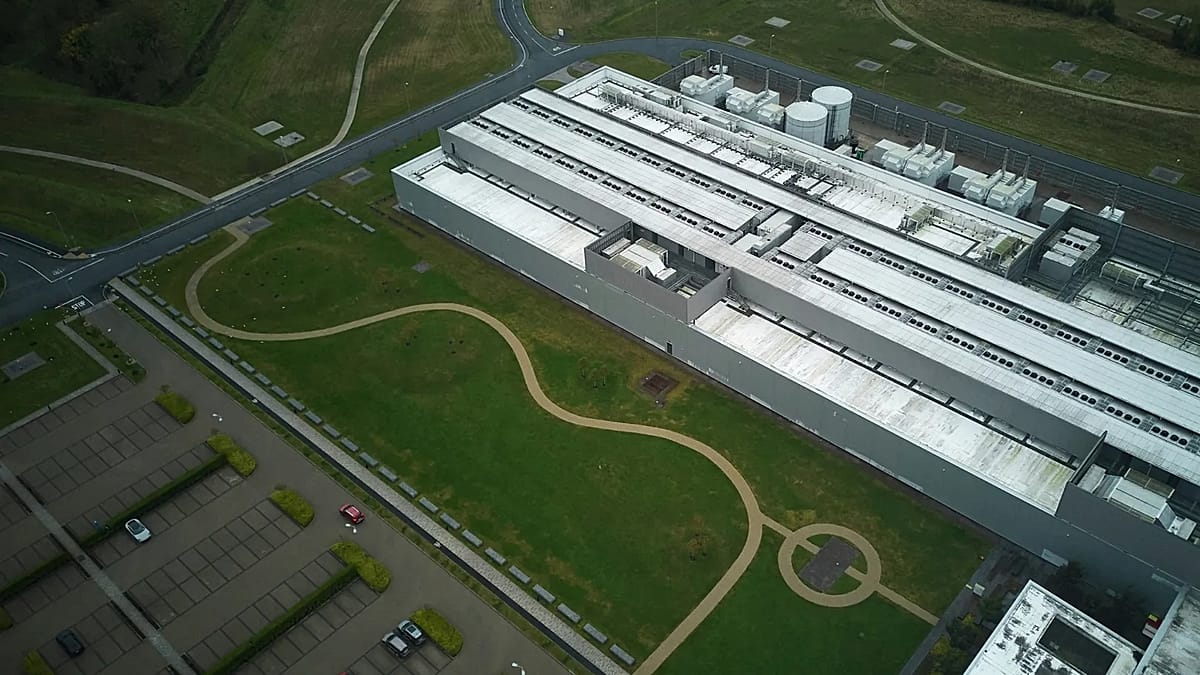
Ireland is keeping the door open to nuclear power as a potential answer to the growing energy demand from data centres, even as the government insists its immediate energy strategy will remain firmly focused on renewables, an Irish government official told Euronews.
“There is a need to consider all options (with decarbonising potential) in the long-term,” a spokesperson for the Irish Department of Climate, Energy and the Environment said.
Political talks about the future of data centres are heating up in Dublin, the Silicon Valley of Europe. According to the country’s Central Statistics Office, data centres consume roughly 21% to 22% of Ireland’s total electricity, a figure projected to rise toward 31% by the early 2030s with the massive surge of artificial intelligence models.
Ireland has never produced nuclear power and officially banned domestic nuclear generation by law in 1999, citing an international record of nuclear accidents.
The government maintains that Ireland should prioritise technologies that can deliver quickly, including onshore wind, solar, battery storage and interconnectors, as well as the country’s first offshore wind projects.
But Irish Taoiseach Micheál Martin hinted in May at a new “openness” on turning to nuclear, shortly before urging the Irish people to stop the “demonisation of data centres”.
Data centres in the EU consumed an estimated 70TWh of electricity in 2024 and are projected to reach 115 TWh by 2030, enough to power roughly 32.9 million European homes for an entire year.
A long road ahead
Nonetheless, Dublin acknowledges that conventional nuclear power plants would take years to develop, and wouldn’t be a quick fix for the growing demand from data centres expected in the future.
Moreover, investment in nuclear would require Ireland to build an entirely new regulatory system covering everything from construction and operation to decommissioning and radioactive waste.
According to the government official, “nuclear power could not practically be part of our electricity system until at least the 2040s”. Nonetheless, Dublin is increasingly signalling that it does not want to rule it out beyond that point.
According to the government spokesperson, a technical study is examining 30 technologies capable of helping decarbonise the electricity system, including nuclear.
The assessment will compare technologies on cost, readiness, deployment times and public acceptance. The decision would also help Ireland lower electricity prices, currently the highest in the EU, followed by Cyprus.
Revoking the ban
However, the biggest immediate hurdle to unleashing nuclear power in Ireland is legal. But in May, Fianna Fáil legislator James O’Connor introduced a bill to legalise nuclear energy, inaugurating a new debate on the matter.
And on 2 June, the Minister for Enterprise, Tourism & Employment, Fine Gael’s Peter Burke, presented an economic study showing that the data centre sector in Ireland generates €2.2 billion in economic activity annually and supports 19,500 jobs.
The Irish government coalition hailed the report as proof that the data centre sector plays a critical role in driving economic activity in Ireland.
“The report highlights that the continued development of data centre capacity must be aligned with Ireland’s economic, energy and climate objectives,” Burke said. “Through our new Large Energy User Plan, all new data centres must provide their own energy generation onsite or nearby, 80% of which must be from renewable sources.”
Tom Parlon, chair of the Irish Data Centre Supplier Alliance, welcomed the economic study, saying it provides “clear evidence” of the scale of economic activity the data centre sector can deliver in Ireland.
“We routinely hear claims that the data centre sector creates no jobs and provides little benefit to the Irish economy, yet this report shows these claims couldn’t be further from the truth,” Parlon said.
Economic prosperity vs environmental degradation
But data centres aren’t viewed so positively by the general public. Critics argue they use as much electricity as entire cities and require millions of litres of water a day just to stay cool. In many cases, water is pulled straight from local communities, often already hit hard by drought.
A new EU law that would force data centres to reveal their true energy costs and push them to clean up their emissions is being challenged by Big Tech lobbyists. If unchallenged, the new data centre rating scheme is expected to apply from 15 August 2027, with the first sustainability labels generated.
Worried about the environmental impact, green groups are urging Energy Commissioner Dan Jørgensen to stop data centres’ rapid expansion ahead of a final decision between the EU co-legislators due by the end of the year.
Commenting on the growing debate about the possibility of building a nuclear power plant in Ireland, Oisín Coghlan, policy adviser to the Irish Environmental Network, derided the Irish premier’s recent words on nuclear as “vice signalling”.
“From his St Patrick’s day trips to the US he knows the Trump administration is very keen on AI,” Coghlan told Euronews. “Taoiseach Micheál Martin is making it clear that his Government will do whatever it takes to power US tech data centres, not just with the ‘windmills’ that Trump hates, but with macho nuclear too. Even if it takes too long, costs too much and isn’t needed.”
Scott Lane, founder and CEO of Speeki, an independent environmental, sustainability and governance assurance firm, said that despite the environmental risks, data centres are a “necessity” for the future of the world’s economies despite their “massive impact” on the environment and the question of where they can be built fairly.
“Rather than fighting a foregone conclusion, the onus must now be on policymakers and ESG leaders to mitigate, and wherever possible turn positive, the environmental impact of these centres,” Lane told Euronews.
“That might be through tougher due diligence on operators and third-party providers when it comes to how they interact with and impact local communities, or it might look like fast-tracking renewable energy solutions and responsible water-cooling systems. If data centre providers cannot evidence that they are making progress on these fronts, businesses and their Chief Sustainability Officers must walk away.”