
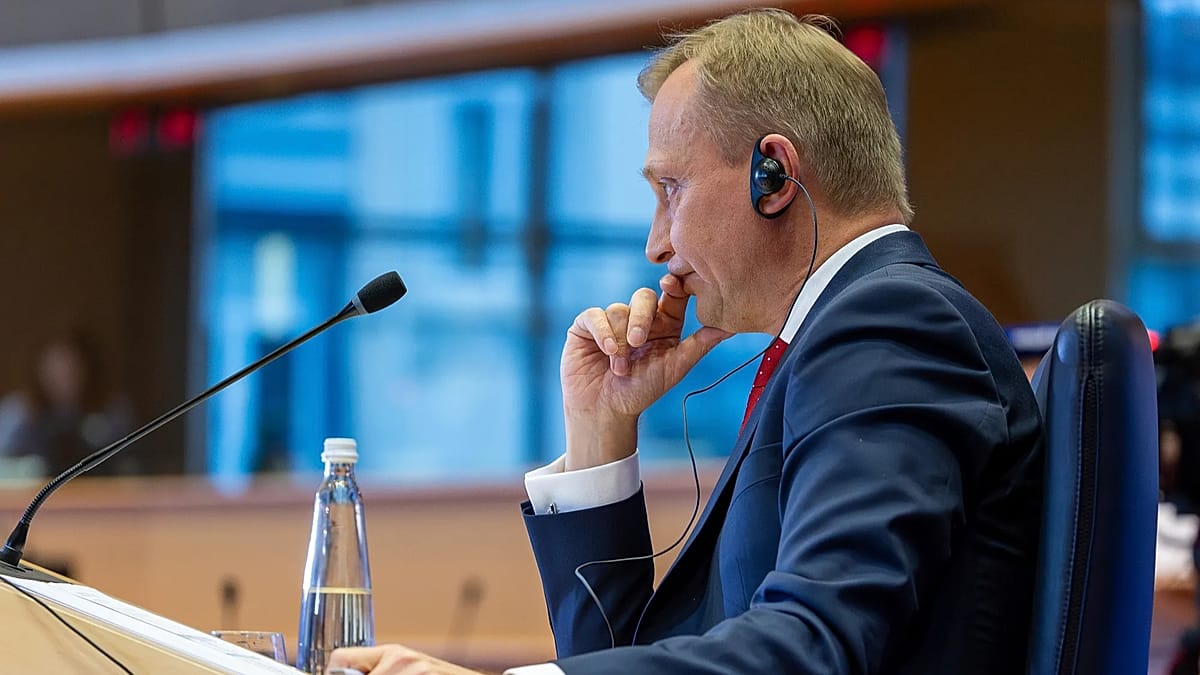
European affairs ministers met in Brussels on Tuesday for another round of negotiations on the EU’s next seven-year budget. Despite a shared ambition to reach a deal by the end of the year, negotiations appear to have stalled, with significant differences still unresolved.
“This is my fourth [Multiannual Financial Framework] negotiations, so I have to admit that some of the discussions come with a large sense of déjà vu,” European Commissioner for the Budget Piotr Serafin said during a debate with EU ministers on Tuesday.
“Many positions are quite predictable, as they have been consistently repeated over the last decades,” the commissioner added.
The next key stage in the negotiations will come at the European Council in Brussels in mid-October. Ahead of that meeting, the Irish government, which is currently chairing negotiations among the member states, will present a compromise text for leaders to consider.
“There is a general agreement to reach a deal by the end of the year,” Irish Minister for European Affairs Thomas Byrne told journalists on Tuesday, referring to discussions among the EU’s 27 member states.
October’s text would mark the penultimate stage before a final compromise is expected in December, when EU leaders will need to bridge their differences and find a workable trade-off to break the deadlock.
European Commission President Ursula von der Leyen and European Council President António Costa have repeatedly called for an ambitious budget, backed by new EU taxes and sufficient spending to match Europe’s ambitions in strategic sectors such as AI and defence, while preserving adequate funding for traditional areas such as agriculture and fisheries.
EU institutions want to avoid a repeat of the previous budget negotiations, when member states ultimately failed to agree on new sources of EU revenue, known as “own resources.” This time, however, growing global uncertainty and the Commission’s push to strengthen Europe’s competitiveness on the global stage have made the need for additional EU revenue to invest in strategic sectors even more pressing.
The €2 trillion proposal presented by the Commission in July 2025 reflected this trend. It provided increased funding for competitiveness, security, and defence, alongside significant cuts to agricultural and regional funds, compared with the current budget.
The two camps
Two main camps have emerged among member states in recent months. One, made up of 17 countries and known as the “Friends of Cohesion,” is pushing to preserve funding for agriculture and regional development.
Another group, including Germany, Austria, the Netherlands, Finland, Sweden and Denmark, is calling for cuts of “several hundred billion euros” across the budget, while prioritising spending on defence and competitiveness. They refer to themselves as the “modernisers,” although they are also commonly described as the “frugals.”
Germany is leading the group of frugal countries and used the occasion on Tuesday to escalate its rhetoric, even in opposition to the position of EU institutions. Targeting Costa in particular—who has been outspoken against major budget cuts—German Minister Gunther Krichbaum said he had lost touch with reality. “You have to ask yourself whether Mr. Costa has now completely lost his grip on reality,” the minister told journalists on the sidelines of the meeting, as Germany continues to push for substantial cuts.
The “Friends of Cohesion” generally support the introduction of new “own resources,” while the frugal countries remain more sceptical.
They argue that, as net contributors, they will bear a disproportionate share of the cost of the next budget, noting that they already account for around 40% of contributions to the current one.
The budget is likely to be financed through a combination of contributions based on a percentage of member states’ gross national income (GNI) and new “own resources.” Member states will have to agree on the share of GNI to be allocated to the EU budget and determine which own resources should be mobilised to make up the remaining funding.
“I see many different ways of computing national contributions. It seems that there is a competition going on between capitals to come up with numbers that show that their national contribution increases the most. This is not really helpful,” Serafin said during the debate on Tuesday, calling EU countries to build a “common understanding on the actual numbers” to present in the most objective way.
Byrne told journalists on Monday that the Irish presidency would put forward a set of proposals on own resources as part of the text to be presented in October.
To reach a deal, all the 27 member states have to agree on the new budget.
The final deal will also require the backing of the European Parliament, whose position on the budget differs significantly from that of the member states.
EU lawmakers are calling for a 10% increase in funding across the main budget headings and want the repayment of the Recovery Plan loans, issued in 2020 to support the economy following the COVID-19 pandemic, to be kept outside the regular EU budget.
During the discussion on Tuesday, leading MEPs asked the member states to avoid cuts.
“If we reduce the EU budget, EU countries will have to address these challenges separately at national level, and likely at a higher cost,” said Romanian MEP Siegfried Mureșan, who is co-leading the negotiations on behalf of the European Parliament alongside Portuguese MEP Carla Tavares.
Tavares also urged member states to step up the negotiations.
“The clock is ticking, and we need to make progress if we are to reach an agreement on the next MFF in time. Parliament is ready to work towards the conditions needed for its consent, but the Council still needs to move forward as well, particularly on new genuine own resources,” she said.