
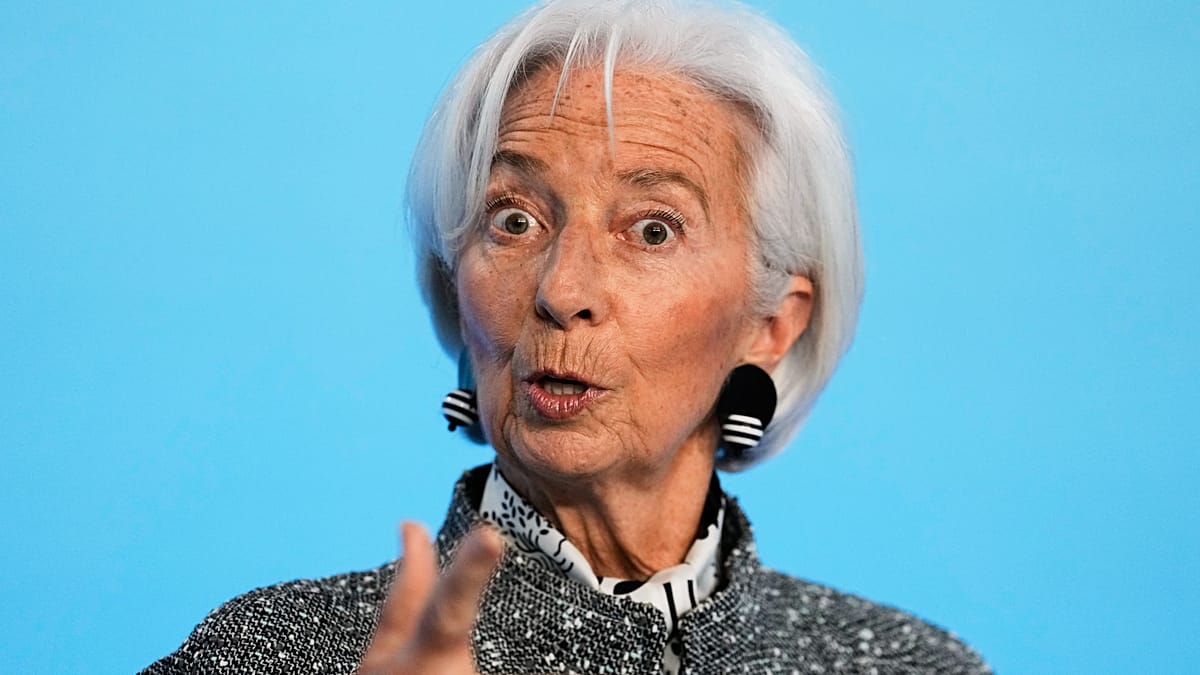
European Central Bank President Christine Lagarde delivered one of her most direct warnings yet about the potential inflationary consequences of the ongoing conflict in Iran.
Speaking after Thursday’s Governing Council meeting which left interest rates unchanged, Lagarde said the war “has made the outlook significantly more uncertain” and will have “a material impact on near-term inflation.”
Energy shock at centre of the ECB’s revised inflation outlook
Lagarde stressed that the war is creating “upside risks for inflation”, primarily through oil and gas markets, with immediate consequences for consumer prices.
The ECB’s latest staff projections show inflation averaging 2.6% in 2026, before easing to 2.0% in 2027 and 2.1% in 2028. The upward revision compared with previous forecasts is largely driven by higher energy prices linked to the Middle East conflict.
Core inflation, which excludes energy and food, is also expected to remain slightly above target over the forecast horizon, reflecting indirect effects from energy costs filtering through the economy.
However, Lagarde made clear that this scenario rests on relatively contained energy disruptions.
In a more adverse scenario — involving stronger and longer-lasting disruptions to oil and gas supply through the Strait of Hormuz — inflation could rise to 3.5% in 2026.
In a severe scenario, where energy prices remain elevated for longer, headline inflation could reach as high as 4.4% in 2026.
The ECB is particularly alert to so-called second-round effects, where an initial energy shock spreads beyond fuel costs into wages, services and core inflation.
“If persistent, higher energy prices may lead to a broader increase in inflation through indirect and second-round effects — a situation which requires close monitoring,” Lagarde said.
Growth revised down: Stagflationary risks rising
The inflationary pressure from energy markets arrives at precisely the wrong moment for the euro area economy.
GDP growth has been revised down to just 0.9% for 2026 — barely above stagnation — as the war weighs on real incomes, business confidence, and consumption.
The result is a more complex policy environment.
The same oil shock that threatens to push inflation higher is also expected to weigh on growth by eroding real incomes and dampening confidence.
Lagarde reiterated that a prolonged conflict would simultaneously lift inflation and weaken economic activity, complicating the ECB’s policy response.
Lagarde stresses meeting-by-meeting approach, but analysts already eye rate hikes
Lagarde stressed that policymakers are closely monitoring key indicators, including wage growth, inflation expectations, and developments in energy markets.
“We are not pre-committing to a particular rate path,” she said, adding that the ECB stands ready to adjust its tools if needed to ensure inflation returns sustainably to target.
“The ECB is unlikely to show the same patience it did during the last inflation shock,” warned Sylvain Broyer, Chief EMEA Economist at S&P Global Ratings.
According to Roman Ziruk, Senior Market Analyst at global financial services firm Ebury, this is a “hawkish tilt” from the ECB.
“The ECB is more likely to raise rates rather than lower them this year, with cuts now seemingly out of the question,” he said.
“The rules of the game have changed. Escalating geopolitical tensions have altered the outlook, reopening the possibility that interest rate hikes could return to the agenda,” said Joe Nellis, Professor of Global Economy at Cranfield School of Management and MAH adviser.
Market reactions
The euro rose 0.5% to 1.1520 versus the US dollar on Thursday, while European equity markets turned negative as oil and gas prices surged.
Brent crude traded at around $111 per barrel, up roughly 55% since the war began, while European natural gas prices jumped 13% to €61 per megawatt-hour. Both surged sharply overnight after Iran’s attack on Qatar’s Ras Laffan LNG complex intensified fears of supply disruptions.
Germany’s DAX fell 2.39% to 22,940 points by 16:00 in Frankfurt, while the pan-European Euro STOXX 50 dropped 1.8% to 5,635.
German Bund yields edged lower to 2.95% after touching an intraday peak of 3%, the highest level since September 2023.
What comes next
With the Hormuz situation unresolved and oil markets prone to sudden repricing on any escalation involving Iran, the ECB faces an unusually wide distribution of outcomes ahead of its 30th April meeting.
Lagarde’s message was essentially one of watchful patience: the bank has the tools, the data framework, and — for now — the runway to wait and observe before acting.