
Oil prices staged one of their most dramatic single-session reversals on record on Monday, as President Donald Trump signaled the US-led military campaign against Iran was drawing to a close.
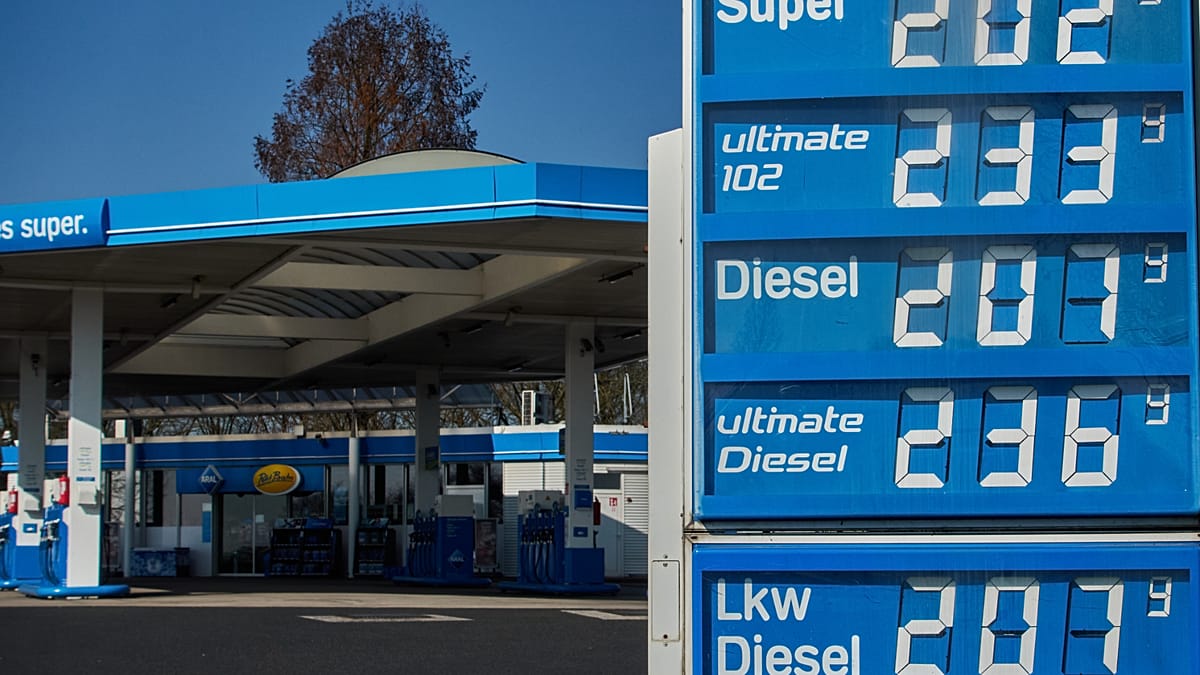
But for European consumers, the relief has yet to reach the pump.
Speaking at a press conference on Monday night, Trump said US and Israeli forces had made rapid progress in military operations against Iran and stressed that Washington would not allow disruptions to global energy supply routes, including the Strait of Hormuz.
“Oil supplies will be dramatically more secure,” Trump said, adding that the United States could escort tankers through the strategic waterway if necessary.
When asked whether the conflict could be over within days, Trump replied: “I think so.”
West Texas Intermediate crude — which had surged to $119 (€110) per barrel on Sunday night amid fears of a potential closure of the Strait of Hormuz — fell to below $90 (€83) by the end of Monday’s session, a swing of more than $30 in less than 24 hours.
Despite the sharp reversal in crude futures, the pass-through from wholesale oil prices to retail fuel costs is neither immediate nor symmetric.
That lag is precisely why economists are not yet ready to declare an all-clear on eurozone inflation risks.
European fuel prices remain around €2 per litre
According to Fuelo, a platform tracking real-time fuel prices across Europe, petrol and diesel remain elevated in several major European cities.
In Milan, unleaded 95 is running at €1.89 per litre and diesel at €2.10, while Paris is slightly higher on petrol at €1.92 and slightly lower on diesel at €2.06.
Frankfurt is the most expensive of the three, with unleaded 95 at €2.12 per litre and diesel at €2.19.
“The most relevant channel of transmission from the Iran conflict to growth, inflation, and monetary policy in Europe is the increase in energy prices, because most European countries are net oil and gas importers,” said Sven Jari Stehn, Goldman Sachs chief European economist, in a note published last week.
“Most European countries are net oil and gas importers,” he added.
According to Goldman’s rule of thumb, a 10% increase in oil prices translates into a 0.3% increase in Eurozone headline inflation.
But the bank cautioned that non-linear effects could amplify the shock, particularly if gas prices, which move with different dynamics to oil, also remain elevated.
Three scenarios for European inflation
Bank of America’s European chief economist Ruben Segura-Cayuela has laid out three scenarios depending on how long elevated energy prices persist.
In the most likely outcome, oil stabilises near $80 (€74) per barrel and Dutch TTF gas around €50/MWh for roughly two months.
Under that scenario, eurozone inflation would briefly peak near 2.5% in March and April before falling back below 2% by late summer, with GDP expanding about 1.0% in 2026 — slow but manageable and unlikely to prompt the ECB to tighten policy.
A sharper shock, with oil reaching $100 (€92) and gas €60/MWh, would be more damaging.
Inflation would average 2.4% across 2026 with a second-quarter peak above 3%, growth would slow to around 0.8%, and a return to the ECB’s 2% target would likely slip to early 2027.
The third scenario involves a prolonged disruption — even with oil held near $80, a four-month energy shock could push annual inflation to around 2.2%, with second-quarter inflation averaging 2.5% and eurozone GDP slowing to roughly 0.9%, with the risk of a temporary contraction.
If energy prices remain elevated, Segura-Cayuela estimates the ECB would likely need to raise rates by a total of 50–75 basis points, most probably by September.
“If the energy prices do not normalise by June, the ECB may well raise rates,” he said.
“Markets have been pricing this risk.”
Oxford Economics: the old ‘look-through’ playbook no longer applies
For Michael Saunders, senior economic adviser at Oxford Economics, the threat is not just about the level of oil prices — it is about whether central banks still have the credibility to absorb the shock without acting.
The old assumption that central banks could simply look through energy-driven inflation no longer holds, Saunders argued in a recent note. The new playbook, he said, is to lean against the risk that energy price shocks feed through to broader inflation expectations.
Using Oxford Economics’ Global Economic Model, Saunders estimated that current energy price assumptions point to eurozone inflation running approximately 0.5–0.6 percentage points higher in the fourth quarter of 2026 than previously forecast — a greater impact than in most other major economies, reflecting Europe’s structural dependence on energy imports.
The ECB is likely to keep rates on hold in the near term, Saunders added, but with rates already at roughly neutral levels, it may opt to tighten this year if the energy price surge persists.
Prediction markets price in a 42% chance of ECB hike
Financial prediction platform Polymarket now implies a 42% probability of an ECB rate hike in 2026 — up from just 12% before the Iran conflict began less than two weeks ago.
That near-tripling of the implied probability reflects the degree to which the market has repriced the ECB’s reaction function.
Before the Trump administration’s Iran campaign, the consensus was firmly for rate cuts across the developed world.
Now, with energy-driven inflation threatening to push eurozone headline inflation back above 3% in the coming months, investors are increasingly hedging against the possibility that the ECB may instead be forced to tighten policy once again.