
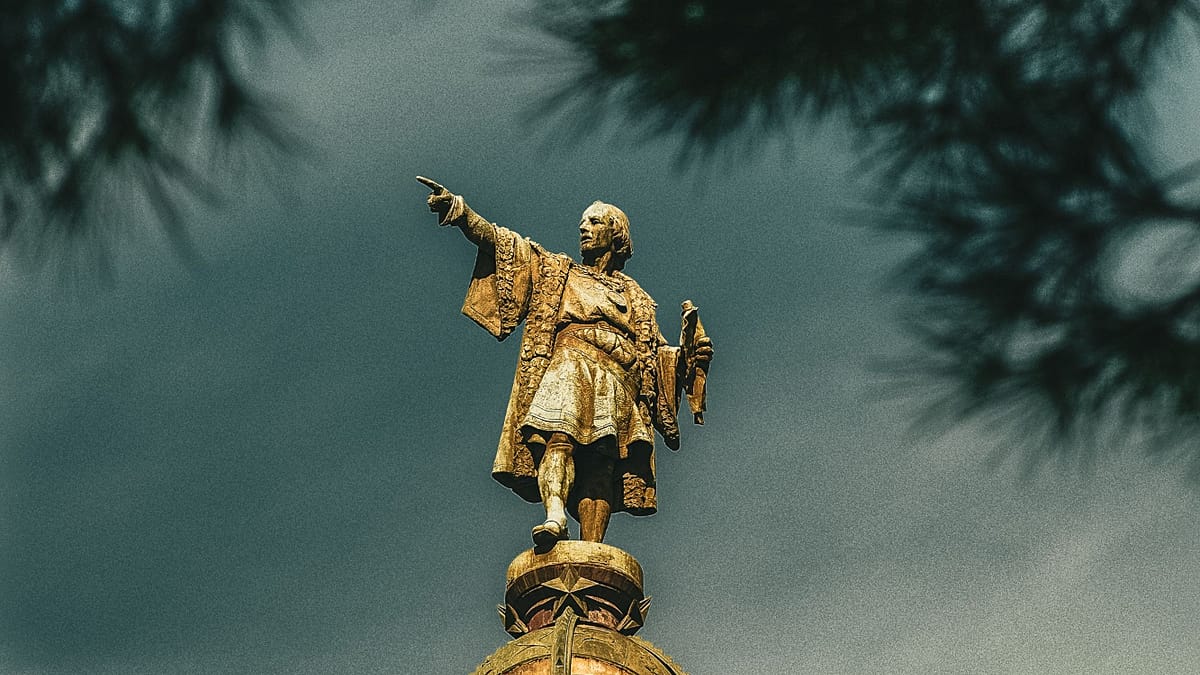
It was 1504 and Christopher Columbus was on his fourth voyage to the New World when his ships ran aground off the coast of Jamaica, which, although it had been christened in 1494 as the island of Santiago, was always known by the name given to it by the native people ‘Xaymaca’ or ‘Yamaya’, meaning “land of wood and water”. The admiral and his crew were stranded, unable to put to sea, trapped on an island they could not leave.
A dead end in Jamaica
The chief scribe of the voyage, Diego Méndez, tried the only possible solution: to set off by canoe to La Española, in what is now the Dominican Republic, to ask for help from the governor Nicolás de Ovando. It took him five days to get there, but Ovando, who deeply distrusted Columbus, refused to send assistance and kept Méndez back for months. Meanwhile, in Jamaica, the castaways had managed to establish a trading relationship with the indigenous people, who supplied them with food in exchange for trinkets and European tools.
For months the arrangement held, but hope gradually faded. A mutiny broke out among the sailors themselves, which heightened tensions with the islanders. The inhabitants of the island, tired of the conflict and at the end of their tether, decided to stop supplying the Europeans with food. Columbus’s crew were on the brink of starving to death.
Astronomical tables, Columbus’s salvation
It was then that Columbus resorted to one of the most ingenious ploys in the history of exploration: his astronomical tables. The navigator was carrying the “Almanach Perpetuum”, an astronomical calendar compiled by the German astronomer Johann Müller, known as ‘Regiomontanus’, which recorded with great accuracy the movements of celestial bodies for the years ahead, including lunar eclipses.
Columbus consulted his papers and found what he was looking for: on 29 February 1504 there would be a lunar eclipse visible from Jamaica. The Moon would turn a deep crimson red, the distinctive colour it takes on during total eclipses because of the refraction of sunlight through Earth’s atmosphere, the same phenomenon that is today popularly known as the blood moon.
Three days before the eclipse, Columbus summoned the indigenous leaders and told them that his Christian God was deeply angered with them for having cut off the food supply. As a sign of his wrath, he warned them, that very night the Moon would disappear and turn blood red.
The eclipse and the Taíno surrender
When the night of 29 February came, the Jamaican sky behaved exactly as the admiral had predicted. The Moon gradually began to darken and took on the unmistakable reddish hue of a total eclipse. The native people, terrified by what they interpreted as a supernatural sign, came to beg Columbus to intercede with his God to stop the phenomenon.
The navigator, as his son Hernando recounts in the admiral’s biography, pretended to withdraw to pray and consult the deity. He calculated the exact moment at which the eclipse would begin to wane and then reappeared before the islanders, telling them that his God had accepted their plea and would pardon the indigenous people if they resumed supplying food.
When the Moon returned to its normal appearance, the indigenous people were convinced. The supply of provisions resumed until a ship finally chartered by Diego Méndez arrived to pick up the castaways. Columbus landed at Sanlúcar de Barrameda in November 1504. He would die two years later, in Valladolid, in May 1506.
Science as a means of survival
Columbus’s episode is one of the most famous examples in the history of science of how astronomical knowledge can become a tool for survival. He was not the only explorer to resort to this tactic; there are numerous similar stories attributed to other European adventurers in different parts of the world.
What makes the Columbus case distinctive is its documentary precision: the date of the 29 February 1504 eclipse has been verified by modern astronomers, who have confirmed that it was visible from Jamaica with the characteristics described in the historical sources.
The admiral and “discoverer of America” did not improvise: he calculated, waited for the right moment and used the scientific knowledge of his time with a cool-headed efficiency that saved his life and that of his crew.