
Ask most people to name Catalonia’s greatest cultural figures, and Antoni Gaudí and Joan Miró are likely to be among the first names mentioned. Far fewer will say Joaquim Gomis. Yet without his camera, the world’s understanding of Gaudí’s architecture may have looked completely different.
At a time when the radical architect’s work was still being by dismissed by parts of Barcelona’s own artistic establishment as eccentric rather than visionary, Gomis understood its significance.
A photographer, modernist and close friend of Miró, he documented Gaudí’s extraordinary forms, textures and details. In doing so, he did more than preserve the architect’s buildings – he helped shape how later generations would see, interpret and appreciate Gaudí’s vision.
That overlooked connection between architect, artist and photographer is at the heart of Gaudí–Miró–Gomis: Deconstructed, a reimagined version of an earlier exhibition by the Fundació Joan Miró exploring the links between Gaudí’s architecture, Miró’s art and Joaquim Gomis’ photography.
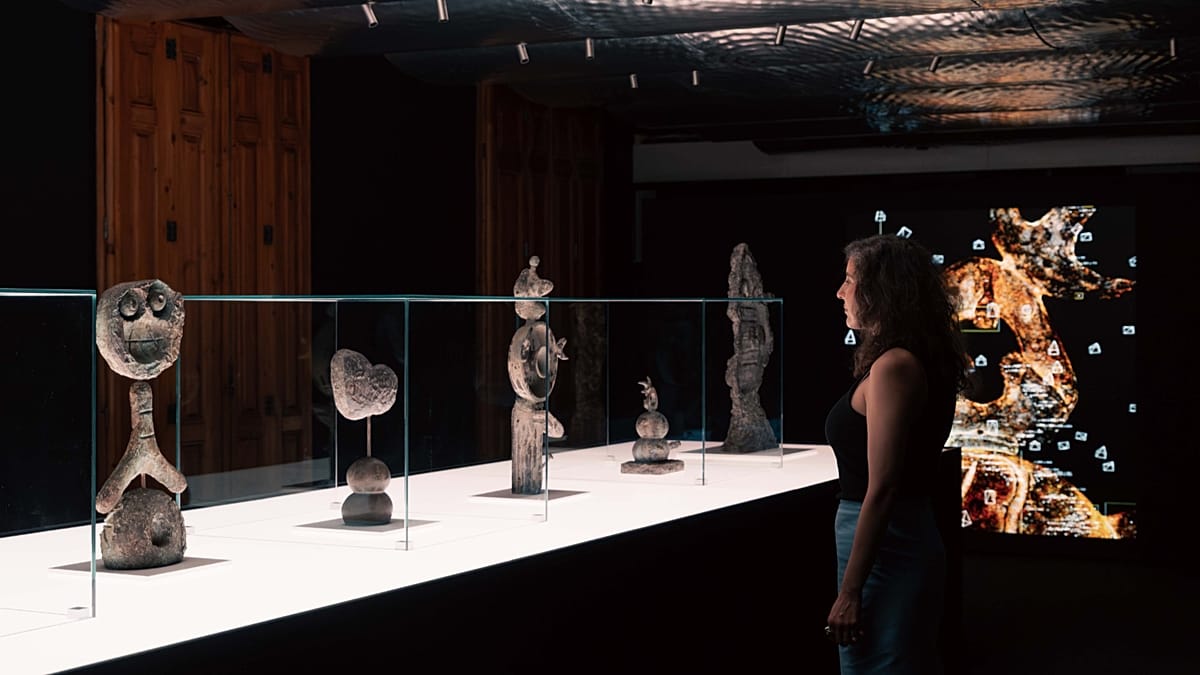
Fittingly housed across the newly restored third floor at Gaudi’s Casa Batlló_,_ the new edition expands the dialogue between these three creative figures with immersive digital installations, AI and 3D technology developed with the Fundació Joan Miró and creative studio Tomorrow Bureau.
Using artificial intelligence, high-resolution photogrammetry and 3D scanning, the stunning new works expose details invisible to the naked eye. Tool marks and weathering across Miró’s sculptures, scanned this way for the first time, sit in one section, while a reworking of Gomis’ archive through generative reinterpretation occupies the other.
Euronews Culture spoke with the exhibition’s co-curator and artistic director of Casa Batlló Contemporary, Joana Seguro, about rediscovering Gomis’ overlooked legacy, how technology is changing the way we experience art, and why the radical ideas of Gaudí and Miró continue to inspire artist’s today.
Euronews Culture: Could you take us back to the beginning of this exhibition? How did the idea of bringing Gaudí, Miró and Gomis together first emerge?
Joana Seguro: It started from a conversation. We were starting to plan the first year of exhibitions here on the second floor of Casa Batlló so we went to Fundació Joan Miró and we had a conversation with them. We were just trying to think, what could we do together? What is the impact of Casa Batlló on Miró’s work?
And they said, “Well, we have done an exhibition exactly about this.” The original exhibition was called Miró, Gomis, Gaudí, and it was very much about the photographs of Gomis documenting the work of Miró, and then in dialogue with the architecture of Gaudí. I was so excited because you could very much see a direct connection between Gaudí’s work, this building in particular, and the work of Miró.
I think it’s understanding, as Miró moved away from painting and he started looking at more 3D elements, it was to Gaudí’s work that he started to look at, and started looking at his shapes, inspired by nature, to create sculptures and bronzes. He also did a series of etchings which were called Gaudí.
But the thing that was most exciting is that I didn’t know much about Joaquim Gomis. And then I started looking at the photographs and the importance of the work that he did documenting Casa Batlló, and also Gaudí’s work across Barcelona.
A key part of this exhibition is the dialogue between the original artworks and the new digital installations. Could you explain how these digital works were created, and what they add to the way visitors experience these pieces?
So I think perhaps the more radical approach that we’re doing with this show, compared with the original exhibition – is that we commissioned Tomorrow Bureau not only to create the digital pieces, but also the set design and the audio soundscapes that are present throughout the whole exhibition, to really create an environment where we can appreciate and explore this connection in a different way.
So we have the etchings from Miró, we have the bronzes, but then they’re in dialogue with high-resolution scans done from the original pieces of Miró, and then deconstructed, looking at these objects very much like an archaeologist would, and using the latest techniques that we have these days with technology to be able to see these objects in a different way.
The same thing happens with the photographs. It’s taking those photographs and this archive that took place mainly in the 1940s, and then creating this living database using artificial intelligence to create another digital piece that takes that knowledge one step further with the techniques that we have in 2026.
Tomorrow Bureau are deconstructing, creating digital artefacts, and being able not to have the limitations that conservation, rightly so, imposes on these objects, or that perhaps gravity has, because these are quite heavy pieces.
With the digital artefact, you have so much freedom in terms of being able to spin them around and go into details beautifully. The digital and the physical work in balance. And I think, I hope this is what we’re able to do with this exhibition.
But also created a carousel of Gomis’ work, and in the carousel we have his entire archive that we were able to have digitised, and it hasn’t been really accessible even in the original exhibition because digital allows us multitudes more and a lot more flexibility.
Both Gaudí and Miró were known for pushing boundaries and experimenting with new ideas. If they were alive today, do you think they would embrace technologies like artificial intelligence and digital art as part of that same creative process?
I never know, but I think what is even more interesting is that contemporary living artists embrace the vision of Gaudí.
Gaudí is relevant, and I think Miró is relevant. Their curiosity, willingness to experiment, that radical, visionary mentality is still becoming such an inspiration for contemporary artists, and the techniques that Gomis and Miró used are still relevant to this day. Their vision as artists, and Gaudí’s vision, is even more relevant now than it was then.
Someone called Gomis the creator of Photoshop. A lot of the techniques that he uses as a photographer are almost collages, and it’s digital calibrations before that was the case. So I think we’re talking about people that, within the work that they’re doing, were being experimental and radical. And I think it’s that spirit that needs to continue.
I like to think they would embrace new opportunities and technologies, but without forgetting the objects, the craftsmanship, the artisanship, and what these tools allow: the ability to replicate work like I did, at larger scales and across the board.
For visitors who may not be familiar with modern art, Miró’s work can sometimes appear very simple or even childlike at first glance. How much of that apparent simplicity is actually the result of careful thought and experimentation.
I think there’s a beauty in simplicity, and there’s childlike excitement in all these three artists. There’s the excitement of creating, an exploration.
I mean, I could point you out across this building – these beautiful, playful elements, from the door handles that are shaped like mushrooms and elements there. Miró and Gaudí and Gomis were obsessed with nature. And they looked at these really simple solutions that may look simple, but they’re so elegant and they’re so fantastic that what might look childlike is actually something very elegant and efficient and playful.
And we must never forget that element.
Finally, when visitors leave the exhibition, what do you hope they take away with them? What is the connection or message you hope stays with them after experiencing the work of these three artists?
I would like people to discover Gomis’ work and how important it was to Gaudí’s international recognition.
But then also to understand the thread that unites all these artists, which is a curiosity for life and nature, and a love of the natural world, and a love of Catalonia in particular.
And also there’s different layers to this exhibition. There’s different elements. So if you want to go deeper into the biographies of them, you have a section that you can do. If you want to go deeper into the work of Gomis, you can do.
You can experience it and just feel the connection between all three of them.
Gaudí–Miró–Gomis: Deconstructed runs at Barcelona’s Casa Batlló until January 2027.