


Published on
Azerbaijan has put ‘Green Energy Corridors’ at the top of its agenda at the COP31 climate summit in Antalya.
The goal is to physically integrate renewable grids across multiple countries and establish a direct electricity transit route from the Caspian Sea to European markets.
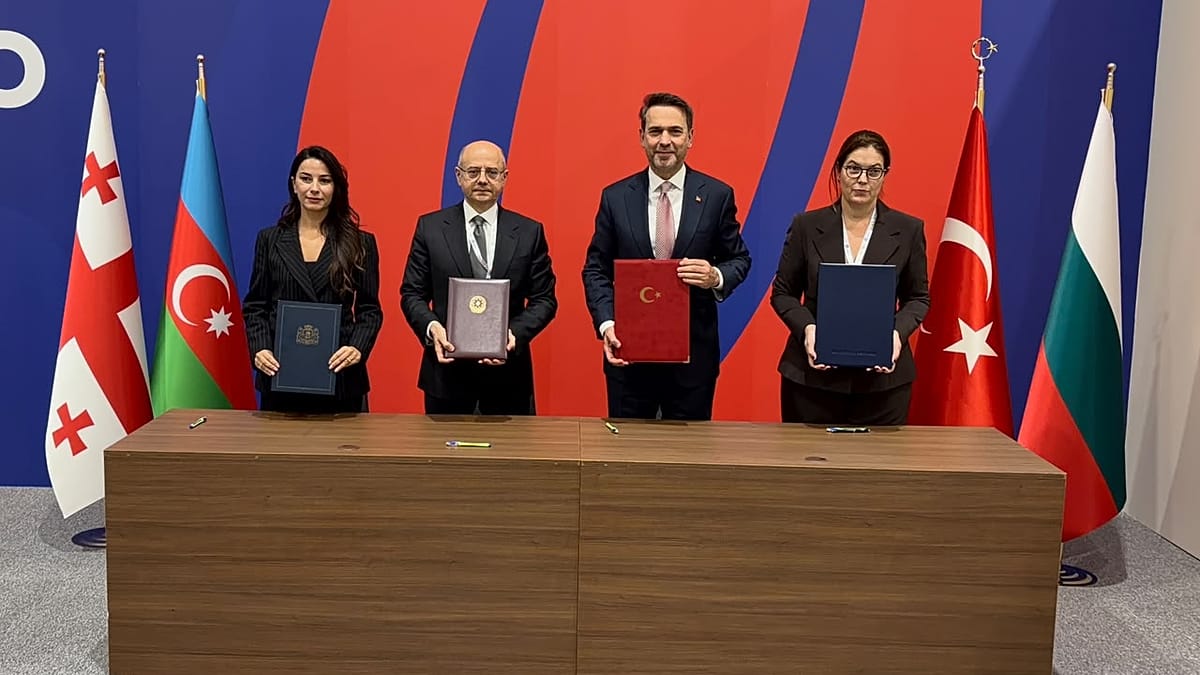
The country has formed a new alliance with Türkiye, Georgia and Bulgaria, who all signed the multi-state Strategic Partnership Agreement in Clean Energy.
Moving beyond broad climate pledges, discussions at the Azerbaijan Pavilion highlighted the proposed green energy routes and strategic Azerbaijan-Türkiye energy interconnection as critical drivers of cross-border infrastructure.
By linking the South Caucasus and Eastern Europe, the four nations intend to diversify transmission routes and ensure long-term regional energy security.
Forging the Green Energy Corridor
Formalised on the sidelines of the Antalya climate talks, the agreement turns years of conceptual planning into binding infrastructure commitments.
The core objective is to develop a high-capacity transmission network that exports wind and solar energy generated in the Caspian basin directly to Eastern and Central Europe.
Azerbaijan’s Energy Minister Parviz Shahbazov, Türkiye’s Minister of Energy and Natural Resources Alparslan Bayraktar, Georgia’s Vice Prime Minister, Minister of Economy and Sustainable Development Mariam Kvrivishvili, and Bulgaria’s Minister of Energy Iva Petrova signed the document on 10 November 2026.
To achieve their goals, the four nations are establishing a synchronised grid framework that bypasses traditional logistical bottlenecks.
The infrastructure will rely on expanding existing overland high-voltage lines through the South Caucasus and Türkiye.
A crucial component of the project involves the parallel enhancement of fibre-optic communications along the transit route, ensuring secure, uninterrupted transmission and modern grid management.
The initiative aims to transform Azerbaijan into an interregional electricity hub.
Driving EU supply diversification
For European markets, Bulgaria’s formal involvement as a signatory is critical.
The partnership directly addresses Eastern Europe’s urgent macroeconomic mandate to diversify energy imports and reduce historical reliance on legacy fossil fuel corridors.
Integrating the South Caucasus power network directly with Bulgaria establishes a vital new energy artery into the broader European Union grid.
Establishing a dedicated Green Energy Corridor will provide European consumer markets with a stable, alternative supply of decarbonised electricity.
Distributing the immense financial and technical burdens of grid modernisation across four distinct national economies will create a highly structured environment.
Multilateral alignment lowers logistical risks for international investors, private equity firms, and development banks expected to fund the upcoming construction phases.
Accelerating bilateral grid diplomacy
Throughout the COP31 summit, the Azerbaijan Pavilion functioned as a central hub for detailing the logistical and financial scope of these cross-border projects.
Presentations highlighted the ‘Corridor of Dialogue’ concept, framing the strategic Azerbaijan-Türkiye energy interconnection as the foundational backbone for the wider four-nation initiative.
Massive investments in domestic renewable generation, particularly onshore and offshore wind projects in the Caspian Sea, will require robust, export-oriented infrastructure to be economically viable.
Aside from the principal signing, the Azerbaijani Ministry of Energy conducted a rapid series of parallel diplomatic engagements to solidify the broader grid agenda.
Minister Shahbazov held intensive bilateral meetings with international renewable giants including Vestas, ACWA Power and NKT to discuss the parallel development of power generation, energy storage and cross-border grids.
Framing the Antalya pact as a continuation of Baku’s historical energy strategy, Shahbazov stated that the ministry is actively turning previous COP grid agendas into concrete projects physically connecting producer nations with consumer markets.